Published
Name: Yellowjackets
Members: Russell Ferrante (piano, synthesizers), Bob Mintzer (woodwinds, EWI), Will Kennedy (drums), Dane Alderson (bass)
Interviewee: Dane Alderson
Nationality: American, Australian (Dane)
Current release: Yellowjackets' new album Fasten Up is out February 21st 2025 via Mack Avenue.
Recommendation for Perth, Australia: Perth is a beautiful hidden gem in the south west of the country. Perth not only has a vibrant music scene but also some of the most beautiful beaches I’ve seen anywhere in the world! If you can handle some long flights it’s well worth a visit!!
My current hometown is Charlottesville, Virginia - a gorgeous place, rich with history and amazing people, food and music! Check out the downtown mall or one of the many incredible wineries that Charlottesville has to offer!!
Topic I rarely get to talk about: I have an amazing family and wonderful friends, all of whom have been nothing but supportive and encouraging in my journey of being a musician. I’m very lucky to have been surrounded by such incredible people my whole life. I don’t think I tell them often enough how grateful I am for everything they’ve done for me. I love you guys!!
[Read our Bob Mintzer of Yellowjackets interview]
If you enjoyed this Yellowjackets interview and would like to know more about the band and their music, visit their official homepage. They are also on Soundcloud.
What were some of the musical experiences which planted a seed for your interest in jazz?
I’m very lucky to come from a family of musicians and music lovers. My Dad, Rick Alderson is a drummer and seeing him perform regularly when I was a kid was a huge influence on me.
I was obsessed with heavy metal growing up (Metallica and Pantera in particular) but listening to my Dad’s record collection, which included bands and artists such as Oscar Peterson, Chick Corea, Weather Report and Buddy Rich (just to name a few) was the beginning of my journey into the world of Jazz.
What does the term jazz mean today, would you say?
To me, the term jazz is rather difficult to define. It seems to be always evolving, especially with the integration of technology and the growing eclectic nature of the genre (not that that’s a bad thing at all!).
I think the main element of jazz that makes it unique is improvisation. Even if you decide play the same tunes every night, they will always be different due to the improvisational factor, which is really what makes jazz different to a lot of other styles.
To be able to have a conversation using your instruments to your fellow band mates and the audience is a special thing and always exciting!
As of today, what kind of materials, ideas, and technologies are particularly stimulating for you?
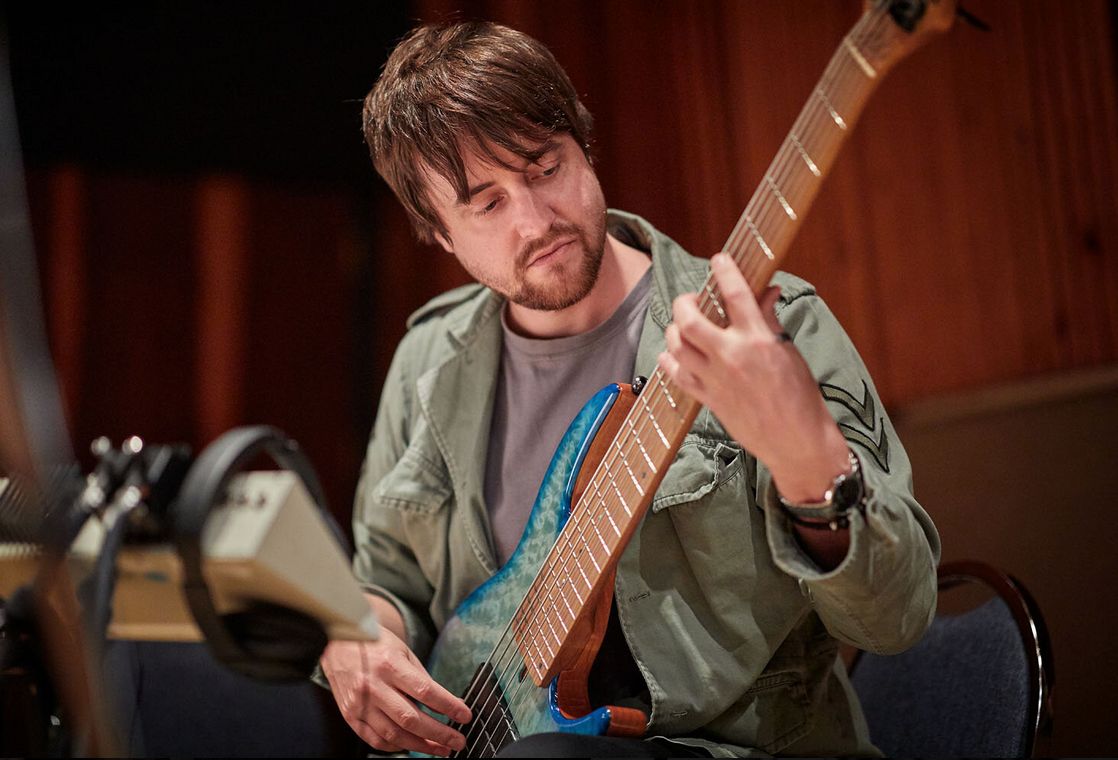
I have three beautiful electric basses built by David Segal from New York Bass Works (a 6-string with a built in MIDI system, a 5 string fretless and a 4 string Precision bass). I can find almost any sound I’m looking for with these instruments which is always stimulating for me.
I use Logic Pro on my Mac, a set of Roland V-drums and a beautiful pair of Bose headphones. There are endless possibilities with all these technologies combined!
Where do most of your inspirations to create come from – rather from internal impulses or external ones? Which current social / political / ecological or other developments make you feel like you need to respond as an artist?
For me, internal impulses seem to be the main source of creativity for both performing and composing. I love using imagery, sometimes surrounding myself with photos of people and places from different periods of my life when I’m working on music.
If my social and political views ever do somewhat inspire me to create, I tend to keep that to myself and let the listener just enjoy the music. I use music and concerts as a way to forget about current events, worries or concerns and just let the music take me elsewhere for a while.
Music has become a lot more global, and incorporating elements from other parts of the world or the musical spectrum is commonplace. Do you still think there are city scenes with a distinct, unique sound? How does your local scene influence your work?
There certainly are cities that have a more distinct sound, a style or genre that is more popular or dominating. The incorporating of different musical styles from around the world is a lovely thing and one of the pros of the internet and social media. The technology has made it easy for us to listen to and learn from styles of music from all over the world.
I live in Charlottesville, Virginia which has a rich music scene and very talented performers of most styles of music. I discovered bluegrass when I moved there 13 years ago, which is a style of music I’m so glad I was introduced to and has been very influential to me.
I’ve always adored traditional Irish music from a young age too.
What role do electronic tools and instruments play for your creative process?
They play a very large part in my creative process, mostly by default because I’m an electric bassist! Logic Pro on my Mac has been an amazing tool and something I use predominantly when composing and recording.
I love using effects and pedals - especially my Boss loop station, which has been an incredibly helpful tool, especially for composing.
Thanks to technological advances, collaboration has become a lot easier. What have been some of the most fruitful collaborations for you recently and what approaches to and modes of collaboration currently seem best to you?
Our last two albums ‘Parallel Motion’ and ‘Fasten Up’, we had two amazing singers feature on two tracks (Gene Baylor and Raul Midon).
They both recorded their parts remotely from their home studios and both songs turned out beautiful. The fact that we can do that, and even overdub or redo parts from home if necessary is a pretty awesome thing and it’s only going to get easier as the technology evolves!
All you need today is a laptop or even just a smartphone and you have endless capabilities at your fingertips.
Jazz has always had an interesting relationship between honoring its roots and exploring the unknown. What does the balance between these two poles look like in your music?
I like to think that my compositions reflect all the music that influences me. Heavy metal, electronica, ambient, R&B, rock & pop are some of my favorite genres (just to name a few!) and combining those styles with elements of jazz and improvisation is really exciting to me.
I don’t think I can help but draw on all of my influences when I’m composing and performing.
How much potential for something “new” is there still in jazz? What could this “new” look like?
I think there is always potential for something new in jazz. The evolution throughout the history of jazz is proof that there’s no stopping folks getting more creative and trying out new ideas and concepts.
In terms of what it might look like in the future, I’m not quite sure but I’m very excited to watch it unfold and I’m so grateful to be a part of it!
For many artists, life-changing musical experiences take place live. How do you see that yourself?
I’ve been so lucky throughout my career to have performed with such amazing musicians, including some of my heroes with whom I share the stage with still to this day.
I’ve had some experiences performing live that I can only describe as the greatest natural ‘high’, and it’s that feeling that I’m always trying to achieve. There are moments during a show when you just feel a wide variety of emotions - gratitude, confidence, joy, elation and those feelings are the reason I do what I do!
It’s not the easiest lifestyle but those moments on stage make it all worthwhile.
How, would you say are your live performances and your recording projects connected at the moment? How do they mutually influence and feed off each other?
Recording in a studio and performing live are certainly two different disciplines and both come with challenges, pros and cons. In both settings, you’re performing, and any type of performance requires practice, preparation, and some kind of a plan.
Performing live, you get to feed off the energy of the audience and the type of venue you’re playing in, which is always fun and different every night. Recording however, seems to be more personal and intimate at first, performing for yourself, your band mates, and your engineer.
The energy I get when recording however comes from the understanding that whatever I play here will be documented forever and possibly listened to by thousands of people for years to come. Those aren’t easy thoughts to deal with in the moment but they force you to focus and play a certain type of way, which is both challenging and exciting.
Improvisation is obviously an essential element of jazz, but I would assume that just like composition, it is transforming. How do you feel has the role of improvisation changed in jazz?
I guess this could be said about any era throughout the history of jazz but there is always an urge for some to really push the limits of their instrument and their compositions. Since it’s so easy nowadays to share information and ideas, we’re able to hear, see and learn about what many musicians from around the world are doing in terms of improvisation, and that is a really amazing thing, even if it’s a bit overwhelming at times!
I don’t think the fundamentals of improvisation have changed much but generally speaking, there seems to be much more focus and interest in technique and complexity (both of which certainly have their place), especially when sharing content in the digital age and surviving in the online landscape.
I’m all for it, especially when the artist is dynamic and musical in their approach.
What, would you say, are the key ideas behind your approach to improvisation?
My main goal when I’m improvising is to tell a story. A story with ups and downs, highs and lows, and everything in between.
There is nothing like being told a great story, especially one that really captures your attention and takes you on a journey. A great story and a great solo share many of the same fundamental techniques such as timing, dynamics, vocabulary and tone (just to name a few).
Even if I feel I don’t always achieve this goal, it is what I’m constantly striving for and working on being better at.
Are there approaches, artists, festivals, labels, spaces or anyone/-thing else out there who you feel deserve a shout out for taking jazz into the future?
My good friend, saxophonist & multi instrumentalist Troy Roberts from Perth, Australia is a true innovator and is always pushing the limits and constantly creating amazing music.
Bass players such as Matthew Garrison, Victor Wooten, Hadrien Feraud and Dominique DiPiazza (just to name a few) have truly revolutionized the instrument and are master improvisors.
Another good friend of mine from Perth, the amazing drummer Andy Fisenden is a true master of his craft and I learnt so much from all the years I worked with him.
Louis Cole and Jacob Collier are two musicians who are doing amazing things that have been very influential to me for a long time now.
Mack Avenue Records, (our amazing label) is doing wonderful things for the jazz community and have an incredible team who go above and beyond to support and promote a large number of jazz bands and artists.
There are so many more to mention but these names really stick out to me as folks who are making a huge difference to the world of jazz!