Published
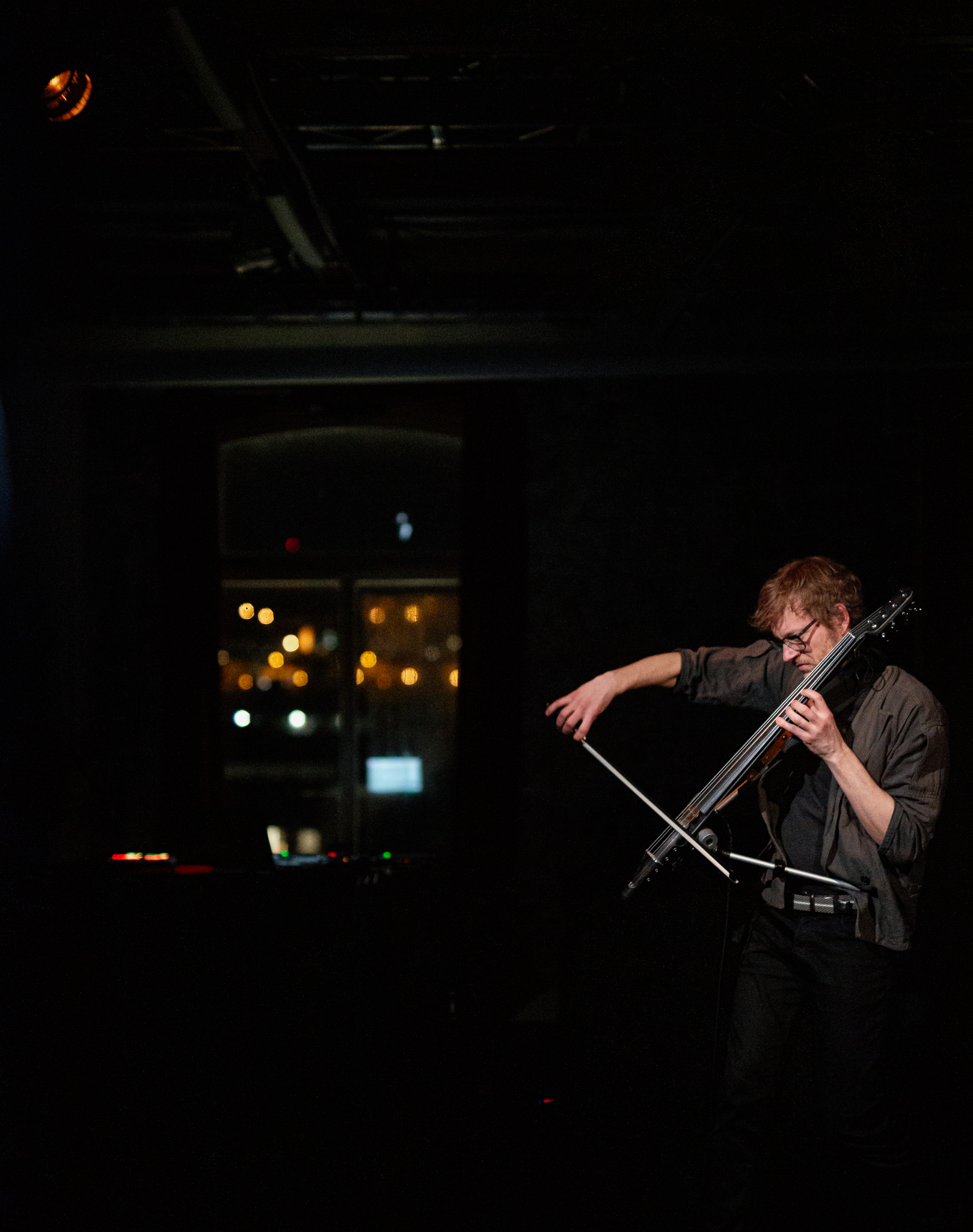
Name: Daniel Brandl
Nationality: German
Occupation: Cellist, composer, improviser
Current release: Daniel Brandl's new album Solo 3 is out via Protomaterial.
Recommendation for Bochum, Germany: Bochum is a city that is known primarily for industry and hard work. But here too there is good and interesting culture away from the main streets.I like going to the Rottstraße 5 Theater, an old railway arch in which a theater has been set up in a former storage room. I also recorded the release concert for my album there. The atmosphere is unique and typical for this region.
Things that I am passionate about but rarely get to talk about: I love sports and philosophy. At the moment I am reading Gödel Escher Bach by Douglas R. Hofstadter. A wonderfully philosophical book covering art, computers, maths and music.
If you enjoyed this Daniel Brandl interview and would like to know more about his music, visit his official homepage. He is also on Instagram, Facebook, bluesky, Soundcloud, and bandcamp.
When did you first consciously start getting interested in musical improvisation? What was your first improvisation on stage or in the studio and what was the experience like?
I come from a strictly classical tradition on the cello, my mother and grandmother play the instrument and I started playing at the age of 5.
So I began improvising quite late, around age 13, when I made a brief "excursion" to the saxophone. My teacher taught me the pentatonic scale and said: "now think up something of your own." I was so afraid of making a mistake that my saxophone career came to an abrupt end after that.
I really got into the subject through free improvisation, with my great-uncle. He was a classical pianist, composer, and the black sheep of the musical family because he also improvised. He had the ability to create the calm in me that's needed to trust one's own little spark of music. I was so blocked by concepts like "masterpiece" and "genius" that I first had to break free from them.
My first steps on stage with improvisation were more in areas like rock and grunge music. I also play guitar and that gave me the opportunity to make loud, angry music in the smoky and dark cellars of my hometown Duisburg. Jazz came into my life through the work of Duke Ellington and Miles Davis. I still love listening to these old records.
This path, which includes jazz, free jazz, rock music and classical music, can be heard well on my current album Solo 3 and the corresponding release concert.
Tell me about your instrument and/or tools, please. What made you seek it out, what makes it “your” instrument, and what are some of the most important aspects of playing it?
I play cello, plus guitar and I produce music on the computer. My solo project is an attempt to integrate the cello, found objects and the computer into one sound body. For this I use various software programs, in live situations Ableton Live in combination with Max MSP plugins. Sometimes the software Gleetchlab.
The idea of extending the cello with found objects comes from the pianist Hauschka, for whom I occasionally get to record cello parts.
[Read our Hauschka interview]
During a hardware store visit, I spontaneously bought a compression spring and quickly discovered that you can create very interesting sounds on the instrument with it. The first track on Solo 3 "You know this right?" is an improvisation with a heavily prepared cello.
For this I stuck a thin piece of metal into the strings and placed a piece of plastic film between the fingerboard and strings. I like how complex sounds emerge from trying something "forbidden." I'm convinced that every sound this instrument can produce is beautiful by definition.
Solo 3 also contains pieces with electric cello (an SBIP electric Cello). For this I use my Kemper Amp, distortion and an H9 effects processor. The piece "He Knows" is the rockiest on Solo 3 and there I use the electric cello very intensively.
My instrument becomes the cello through the constant engagement with its possibilities. It's a dialectical process between my sound vision and the possibilities that the instrument allows.
How would you describe your own relationship with your instrument – is it an extension of your self/body, a partner and companion, a creative catalyst, a challenge to be overcome, something else entirely?
The connection to my instrument becomes more and more intuitive over the years. The landscape of improvising cellists is growing ever larger and so I too keep learning new sound possibilities of this "box with four strings." Which produces challenges to keep up with.
My cello is not an incredibly expensive professional instrument, but rather a part of my musicality that has grown with and alongside me. We've known each other for a very long time and have experienced a lot together. Therefore I would say that in good moments it really feels as if it were an extension of myself.
My instrument doesn’t allow for any hiding, so it sends exactly what I think and feel at the moment.
Derek Bailey defined improvising as the search for material which is endlessly transformable. What kind of materials have turned to be particularly transformable and stimulating for you?
In recent years it's mainly a feeling of acceptance and also the search for chaos in the process that inspires me.
On Solo 3 there are many effect parameters that I let be controlled by nearly chaotic processes. And preparations that behave in a way, that can’t really be controlled.
I find the engagement with my own limitations and strengths inspiring. I didn't know until Solo 3 that I could also work as a real composer, but also that there's a limitation to the maximum speed in my playing due to my physicality. Often I think too fast for what I can meaningfully express and have to find ways to transform that into something possible.
Do you feel as though there are at least elements of composition and improvisation which are entirely unique to each? Based on your own work or maybe performances or recordings by other artists, do you feel that there are results which could only have happened through one of them?
I definitely think that there are elements which are unique to both. Improvisation and composition are strongly related to each other and can often reach the same point.
Measured against my own work, however, there are musics that could not arise through improvisation. On Solo 3 there are 2 cello trios, one tries to think through a theme in various ways in a kind of rondo form, the other is an abstract sequence of atmospheres.
In both pieces there is room for improvisation, but here it appears as part of a composition. On the other hand, there are always sounds and situations that can only arise through unplanned music-making.
Exemplary of this for me are concerts by the band "The Dorf" from Dortmund, the house band of the Domicil Jazz Club.
When you're improvising, does it actually feel like you're inventing something on the spot – or are you inventively re-arranging patterns from preparations, practise or previous performances? What balance is there between forgetting and remembering in your work?
When I improvise, many factors play into the moment. In the best case scenario I reach a point where the self connects with the outside world with virtually no barriers.
Above all, judgments stop playing a role and I can trust the music intuitively. What happens musically then can be a pattern, a lick, a prepared thing, or something completely new. There are often enough situations that are an approximation of this state, whether through stress or other reasons.
Improvisation and especially collective improvisation is characterized for me by being able to enter into an honest connection with my fellow human beings in that moment. It's hard to explain what I mean by that exactly, it's a situation in which something third emerges between me and my fellow players, which only exists in that moment in that way. Between us, belonging to no one. The invention then refers to the shaping of the music, but also to what emerges between us.
The balance of remembering and forgetting often refers to the idea to learn all the patterns and scales and to “forget“ them while playing. For me, that doesn’t always apply. I like to be able to choose consciously what scale or sound I play, to remember what I practiced. Then I also sometimes give myself completely to the moment.
In the end I have to say: It depends.
Artists from all corner of the musical spectrum, not just “free jazz” have emphasised the importance of freedom in their creativity. What defines freedom for your improvisations?
Freedom is not a value in itself for me, since I'm aware that I'm always bound to factors that are not within my influence. Whether it's my body, the sound on stage, stress or other things. I search for freedom from judgments that I once learned or that I encounter again and again.
As an improvising cellist one stands between worlds and hears astonished comments from everywhere again and again. Freedom here also means the strength to be able to implement one's own vision.
The piece "He Knows" tries to translate this search into music. The drums and the cello search in ever new attempts for the "perfect solo"... circling around this project. Like Sisyphus, who was supposed to roll a stone up the mountain again and again.
In this sense, freedom is the decision to begin the work anew again and again.
Taking your recent projects, releases, and performances as examples, what, would you say, are the key ideas behind your approach to improvisation?
I don't know if there is one key that makes my music accessible. I originally come from the classical world, which is rightfully accused of having an elitist attitude. Therefore it's important to me that my music comes from me unfiltered, but happens in an atmosphere that is inviting to the audience.
The key for me to be able to evaluate my own music is the striving for authenticity. A feeling that I cannot describe more precisely.
In your best improvisations, do you feel a strong sense of personal presence or do you (or your ego) “disappear”?
In the improvisations I experience as good moments, my ego and evaluating self are in the background. It's a moment of connection and emergence.
The beautiful thing about it is that musics that are read as "simple" can also emerge from this. It doesn't have to fulfill the demand of complexity, but is allowed to simply be.
What are some of your favourite collaborators and how do they enrich your improvisations?
I'm currently building up a quartet, with Johan Leenders on keys, Knud Krautwig on bass and Sven Petri on drums. These three are my absolute favorite band when it comes to making music together. Since they're all very busy, I have to have patience.
The reason for the collaboration lies on one hand in the intuitive musical understanding that exists between us and then in the fact that I trust all three of them on a human level. They are colleagues and friends to me.
In a live situation, decisions between creatives often work without words. From your experience and current projects, what does this process feel like and how does it work?
It's a process that has to grow together. With some people I had such moments after 5 minutes, with others only after a few rehearsals.
It feels as if two (or more) people link arms and walk in the same direction at the same pace.
Stewart Copeland said: “Listening is where the cool stuff comes from. And that listening thing, magically, turns all of your chops into gold.” What do you listen for?
In the strongest situations I am able to listen to my inner voice that tells me what to play.
The ability of my mind to grasp the musical situation and use a creative impulse to think myself and my music into it.
There can be surprising moments during improvisations – from one of the performers not playing a single note to another shaking up a quiet section with an outburst of noise. Can you tell me about such situations from your own performances and how they impacted the performance?
In one of my recent concerts (a duo of cello and double bass), which took place open air, a train had to brake in relative proximity to the stage. The noise it produced was a kind of drone for the double bassist, who was playing an unaccompanied solo at that moment. I love it when the moment of playing spontaneously changes the music and extremes happen too.
Music never happens without context, and I love it when the background becomes the foreground like that.
As a listener, do you also have a preference for improvised music? If so, what is it about this music that you appreciate as part of the audience?
I very much like listening to improvised music. However, not on all channels.
I think that social media is not suitable for conveying free improvisation. I love long-format recordings, currently I like listening to the podcast The Moderns by Kevin Press.
However, recorded music is no substitute for the real concert. Improvised music enables me to listen intensively, to switch off categories and maintain an open attitude. I often experience music as colours and shapes before my mind's eye.
In a way, we improvise all the time. In which way is your creative work feeding back and possibly supporting other areas of your life?
I agree that we're actually improvising all the time. I use this experience to be able to convey in concerts or in teaching what improvisation actually is and that it's something that virtually all people can have access to.
The self-confidence that I've developed through engaging with my own creativity flows back into all areas of my life. Improvising means trusting one's own feeling to me.