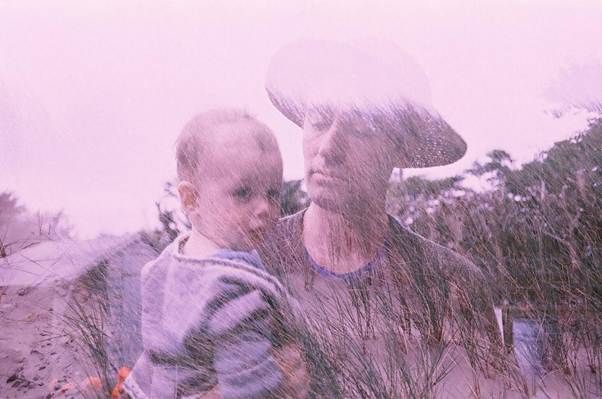
Published
Name: Daniel O'Sullivan
Occupation: Composer, musician, producer
Nationality: British
Current release: Daniel O'Sullivan's new album Eros is out via Surefire.
Recommendations for London: There are a few spots in London that are worth visiting: John Soane's House by candlelight, Crossness Pumping Station, and Bunhill Fields, to name a few. Atlantis, Treadwells, and Watkins are all amazing bookshops within walking distance of each other. For dining, St. John's Bread and Wine, Andrew Edmunds, and J. Sheeky's are probably my faves.
Topics that I am passionate about but rarely get to talk about: I could go on for hours about the intersection between alchemy and music. Not in a mystical-woo sense, but in how transmutation happens across form and feeling.
Also: animism in sound. I’ve been reading a lot about how different cultures perceive non-human intelligences—and how music can act as a medium between worlds.
If you enjoyed this Daniel O'Sullivan interview and would like to stay up to date with his music, visit his official website and blog. He is also on Instagram, and bandcamp.
The borders between producers, sound artists, and even songwriters are becoming increasingly blurry. What does being a composer mean today, would you say?
For me, composing is about listening and then organising that listening into form. Whether that form takes shape through notation, improvisation, collage, or collaboration is less important than the sensitivity guiding it into being.
I think we’ve moved beyond the idea of the composer as a solitary genius. We’re all part of a dense ecology of sounds, tools, histories, and intuitions.
Composing today is as much about curating and connecting as it is about generating.
Many people perceive classical music and contemporary composition as having high barriers of entrance, both for listeners and musicians. What have your own experiences been in this regard?
There are inherited hierarchies in the classical world. But I think there’s also a growing appetite for permeability.
I didn’t come up through conservatoire training; I found my way in through instinct and collaboration. A lot of my musical education happened in rehearsal rooms, on the road, and in record shops. I try to make work that welcomes people in, even if it’s complex or layered.
Music is a shared hallucination where we can all trip together.
As of today, what kind of materials, ideas, and technologies are particularly stimulating for you?
I’m mainly interested in intervals and how they reorient perception. Before I realised that was the magic ingredient I was seeking in all my listening habits it was kind of a mystery.
I’m also very drawn to tactile composition: scoring for ensembles where the physicality of sound-making is foregrounded.
Beyond tools, I’m inspired by myth, memory, the smashing together of ideas ancient and modern.
Where do most of your inspirations to create come from – rather from internal impulses or external ones? Which current social / political / ecological or other developments make you feel like you need to respond as an artist?
Both—sometimes it's an internal image or phrase that keeps returning, other times it's a reaction to the world outside. I'm interested in how inner and outer worlds mirror each other.
Lately I’ve felt a growing pull toward ecological listening—trying to compose in a way that acknowledges non-human time, non-human voices. I’m also a father, so there’s a sense of urgency in the face of climate collapse and cultural fragmentation.
But rather than making agitprop, I look for open spaces for embodiment or attunement.
Tell me a bit about the sounds & creative directions, artists & communities, as well as the colleagues & creative hotspots of your current hometown, please. How do they influence your music?
London is dense with overlapping scenes. Spaces like Cafe OTO and Avalon Cafe are vital meeting points. But I move through a web of porous scenes—some local, many far-flung.
London is a magnetic centre, but the real pulse comes from the exchanges: fragments passed between friends, long-distance transmissions, shared obsessions. I find kinship with Harry and Louis Stevenson Miller in Manchester, whose bookshop Bound & Infinity feels more like a ritual space than a retail one.
Whether it’s Charlemagne Palestine or Echo Collective in Brussels, Christian Fennesz in Vienna, Steve Moore in New York—it’s a global community really. The creative directions I follow aren’t tethered to a scene so much as attuned to a kind of intuition.
[Read our Charlemagne Palestine interview]
That’s what shaped Eros—composing it felt like charting constellations from fragments—some ancient, some entirely imagined. The influence of others appears more like a scent than a citation.
How much potential for something “new” is there still in composition? What could this “new” look like?
The idea of “newness” can be a bit of a trap. I’m more interested in what feels alive than what’s new. That might mean discovering new structures or vocabularies, but it could just as easily mean bringing forgotten or marginalised modes into focus.
The “new” might be the unclassifiable thing that emerges from two opposing traditions colliding. Or from subtracting.
I often feel that composition is about listening to what the piece wants, not what I want it to be.
It is my impression that adding a conceptual, non-musical dimension to one's work is almost a prerequisite for commissions and grants. How do you view this tendency and how “conceptual” is your own approach to writing?
It’s true that music is often asked to justify itself with a concept, but I think concepts can be fertile as long as they aren’t cages.
For me, the conceptual emerges organically—it’s often revealed by the process, rather than imposed beforehand. Eros, for example, began with an intuitive pull towards certain intervals and shapes, and only later did it reveal its secret centre.
I do enjoy writing about music, but ideally the music comes first.
Working with long forms, complex concepts or new vocabulary is potentially more challenging today because they require us to remember things that happened perhaps minutes ago – while most of us are finding it hard to focus even on what's happening right now. Both as a composer and as a listener yourself, how do you deal with this?
I see that fractured attention everywhere, and it definitely shapes how music is received.
But I also think there’s a hunger for deep listening—ritual, immersion, transformation. I’ve been drawn lately to writing music that functions as a kind of spell or offering. I like structures that reward repeated listening but also give something immediate, whether that’s a texture or gesture or a hook (depending on how the hook is framed).
As a listener, I approach music the way I approach a poem: slowly, patiently, returning often.
For many artists, life-changing musical experiences take place live. Few works these days, however, are performed beyond their premiere. What, do you feel, does this mean for composers, and the music they write, and how does this reality influence your own work?
It’s a strange tension—so much labour and care goes into a performance that may only happen once. I’m certainly feeling this now with Eros. But I try to see each performance as a unique invocation rather than a repeat.
That said, I’m working to create sustainable models for returning to these pieces, evolving them over time, performing them in different constellations. I think part of our job now is to design frameworks that allow works to breathe beyond their premieres.
How, would you say, are live performances of your music and your recording projects connected at the moment? How do they mutually influence and feed off each other?
They’re increasingly interconnected.
When writing Eros, I thought a lot about the live ensemble—not just what they would play, but how they would feel inside the piece. That performance intimacy influenced the studio version.
Likewise, in rehearsal and performance, new things emerge—timbres, tensions, vulnerabilities—that can fold back into recordings. I see both realms as laboratories for the other.
To some, the advent of AI and 'intelligent' composing tools offers potential for machines to contribute to the creative process. What are your hopes, fears, expectations and possible concrete plans in this regard?
I think machines are already part of the compositional ecosystem, just as instruments once were. What matters is how they’re used.
My fear is that we’ll outsource not just craft but curiosity to AI. My hope is that these tools can open unexpected doors—not by mimicking human creativity, but by offering strange juxtapositions or revealing patterns we overlook.
I’ve used generative tools in small ways, often as provocations rather than solutions. But I think the soul of a piece still comes from a person listening.
Are there approaches, artists, festivals, labels, spaces or anyone/-thing else out there who you feel deserve a shout out for taking composition into the future?
Absolutely. Labels like Black Truffle, Be With, and VHF come to mind—they’re not just releasing music, but cultivating sonic ecosystems.
The ongoing work of Charlemagne Palestine continues to inspire, as does the next generation of composers engaging with duration, tuning systems, and animism in music. There’s a sense of devotion in that approach—something ceremonial, even when it’s subtle.
Spaces like Cafe OTO hold room for experimentation in a grounded, generous way. And I’d shout out the ensemble I’ve been working with for Eros—their interpretation of my shoddy scores were invaluable.
Under my Magic Hollow series, which sits within the wider Sonoton Music Library, I’ve been lucky to work with a constellation of visionary artists: Richard Youngs, Rose Keeler-Schaffeler, Echo Collective, Sonic Boom, Jan Andersen and Jussi Lehtisalo, Peter Broderick, Frank Maston … Each brings a singular voice to the idea of “library music”—taking it somewhere deeper.
The Montreux Festival intends to preserve its archive of recordings for future generations. Do you personally feel it's important that everything should remain available forever—or is there something to be said for letting beautiful moments pass and linger in the memories of those that experienced them?
I think there’s real power in transience. Not everything needs to be fossilised. Some performances should vanish like dreams—felt deeply, then gone.
That said, archives are important too. They give us access to other timelines, especially for underrepresented voices. I’m in favour of a kind of selective remembering, guided by care rather than completeness.
Let some things remain sacred through their absence.