

Name: Danielle Nia
Nationality: American
Occupation: Composer, synthesist, producer
Current release: Danielle Nia's new album A New Light is out via i u we.
If you enjoyed this Danielle Nia interview and would like to know more, visit her official homepage. She is also on Instagram, bluesky, and bandcamp.
There are artists who can realise their ideas best with a traditional – or modified – piano interface, others with a keyboard and a mouse, yet others by turning knobs or touching screens. What's your preferred and most intuitive/natural way of making music and why?
I feel I’m a combination of a keyboard and analog knobs/sliders. Having played keys and percussion my entire life (and studied at college) I’m intimately familiar with the keyboard layout and over the years it’s become a natural conduit for my voice.
However, I will say something was always missing for me. I always wanted to be a vocalist and would listen to “Three Voices For Joan La Barbara” by Morton Feldman over and over and be mesmerized by the quality of her voice and how accurate yet emotional it could be.
The way the three parts rubbed against each other creating intricately detailed vibrations and interactions of the sound.
Once I began to finally experiment with modular, I realized how I had this natural intuition to connect the control of the analog sound with my ear and my emotional state. By having full control over the patching I was able to realize what was in my head instead of fighting with a traditional synthesizer trying to morph it to my vision.
Another aspect of modular which I find myself embracing is the monophonic voices. At first I felt I needed chords but I quickly realized that all these years, it was the chords that got in my way. I could never replicate “Three Voices” because I was always playing chords and melodies. Now I was forced to have monophonic voices but I immediately knew how to make them interact from my years of listening and obsessing.
And it all fell into place. Melodies and counter melodies played through my keyboard and then modulated and manipulated through the modular system.
What did your first modular look like? Tell me about the first pieces you produced and performed on it, please.
I began with a Make Noise Strega. I purchased it in order to utilize it as an effect for my keyboards. However through experiments with that, I began to realize there was so much more to all of this than special effects and noise.
I moved on to semi modular a Moog 32 and labyrinth and realized I actually just wanted full control over what was happening and after hearing some tracks by Panic Girl of the TipTop Buchla modules, I knew what I needed.
I began piecing together a full modular setup using the Buchla modules as the basis. There was something about the quality of their sound and the simplicity (yet complexity) of their control that spoke to me on an intuitive level.
[Read our Panic Girl interview]
[Read our interview with Panic Girl about her creative process]
There is a worldwide community around modular synthesizers. How would you describe your involvement with it and its role for your creative development especially in the early days of your modular journey?
Locally, in Philadelphia I was first introduced to modular through a modular weekend put on by The Low Pass and an intro to modular class generously taught for free by local modular musicians Jerry Kaba and Stefano Daddi.
Through that weekend there was also an open mic where I met one of my closest friends and musical compatriots, MANNA. Hearing her perform on modular that evening completely changed my view on what was possible.
I was so inspired, and I immediately went home and purchased her track on Bandcamp listening intently as my mind and heart began to open with possibilities.
I feel I owe my renewed musical life and positive momentum to the community. They are a special group and so kind and welcoming and encouraging.
And beyond the local community, meeting Panic Girl through Instagram has been so wonderful. Her music is so beautiful and inspiring, and she is incredibly kind and supportive.
I can’t wait until I can give back more to the community for everything it has given me.
Which modules incisively changed your way of making music – and why?
The Buchla Dual Oscillator Model 258t and Quad Function Generator 281t were what finally changed it all for me.
For the 258t, having the FM input and processing inputs opened up so many possibilities. I could send all kinds of wave forms through them and have highly detailed control over how much they would alter the oscillators sound. A small twist of the knob and the sound can be ever so slightly altered creating a warble effect that feels so much like the human voice. I took that and ran.
The 281t function generator also had a similar effect in that it is so simple to understand just by looking and touching it’s controls, it enables me to alter sounds intuitively.
Portability has been one of the main drivers for music production over the past years. What importance does mobility have for you when it comes to production – and what strategies for making the modular portable have you developed?
Coming from the world of touring and live shows a portable instrument is a requirement. While I’d love to have a smaller instrument, modular is small enough that it is quite portable even with 2 – 3 cases and a couple keyboards.
It’s a little intimidating that there are so many wires and possible points of failure. But so far I haven’t had any issues. I just make sure to get there early and test!
Modulars suggest a more immediate relationship with sound. In how far does this hold true from your point of view and what has working with them taught you about sound in general?
Listening to Suzanne Ciani’s live performance recordings taught me that you can compose and perform a piece, and it is not just the melodies and rhythms that make up the piece, but the sound itself.
How she shapes a performance by moving melodies and ideas through time and modulation create a new form of expression.
And yet she does not abandon what came before, but studied it, mastered it, and uses that knowledge and those traditions as a springboard to something evolved and something reflective of who she is and the time she lives in.
[Read our Suzanne Ciani interview]
In which way does the modular influence musical results and what kind of compositions does it encourage / foster?
I don’t think the modular instrument influences musical results. I think it is a platform for those who have a connection to the sound of electronics to utilize to empower their vision.
There are an unimaginable amount of ways to combine and interact modules together that if one has a vision, with enough understanding and practice, that vision can be realized.
Many modular set-ups still do not support saving patches or quickly switching between them. What possible benefits or inspiring consequences does this quite severe limitation have for your own music and creative practise?
I do not believe this is a limitation at all. In fact, I believe having the ability to save patches introduces a limitation and disconnection between performer and instrument.
I have played keyboards for 30 years using patches and never being able to communicate my feelings through those instruments. But with modular, creating your patch, knowing the sounds that will be possible through a connection of inputs and outputs, this creates an intimate and fine grain understanding of what is happening and with that knowledge comes control and the ability to shape the sound.
A violin player knows deeply and intimately the sound that is created through their connection of fingers and bow and the string. The vibrations these create with the body and the room. That is the connection of instrument to player I feel I am able to achieve with modular because of the direct connection to each part of the sound achieved through patching.
For you personally, is the goal to become as proficient and fluent on the modular as others might get at the piano – or to keep discovery mode on forever?
I view the modular instrument as a an instrument I am in the process of mastering. I have knowledge of theory and keyboard technique, and now I can finally have the ability to shape my sound to the same degree as a string player or vocalist.
To stay in “discovery mode” would be an impediment to being able to master a specific instrument. There are benefits to limitations. And my ultimate goal is to express my emotions in a way that my human language does not allow.
And by practicing and understanding the instrument before me, I will be able to utilize to heal and spread joy and love.

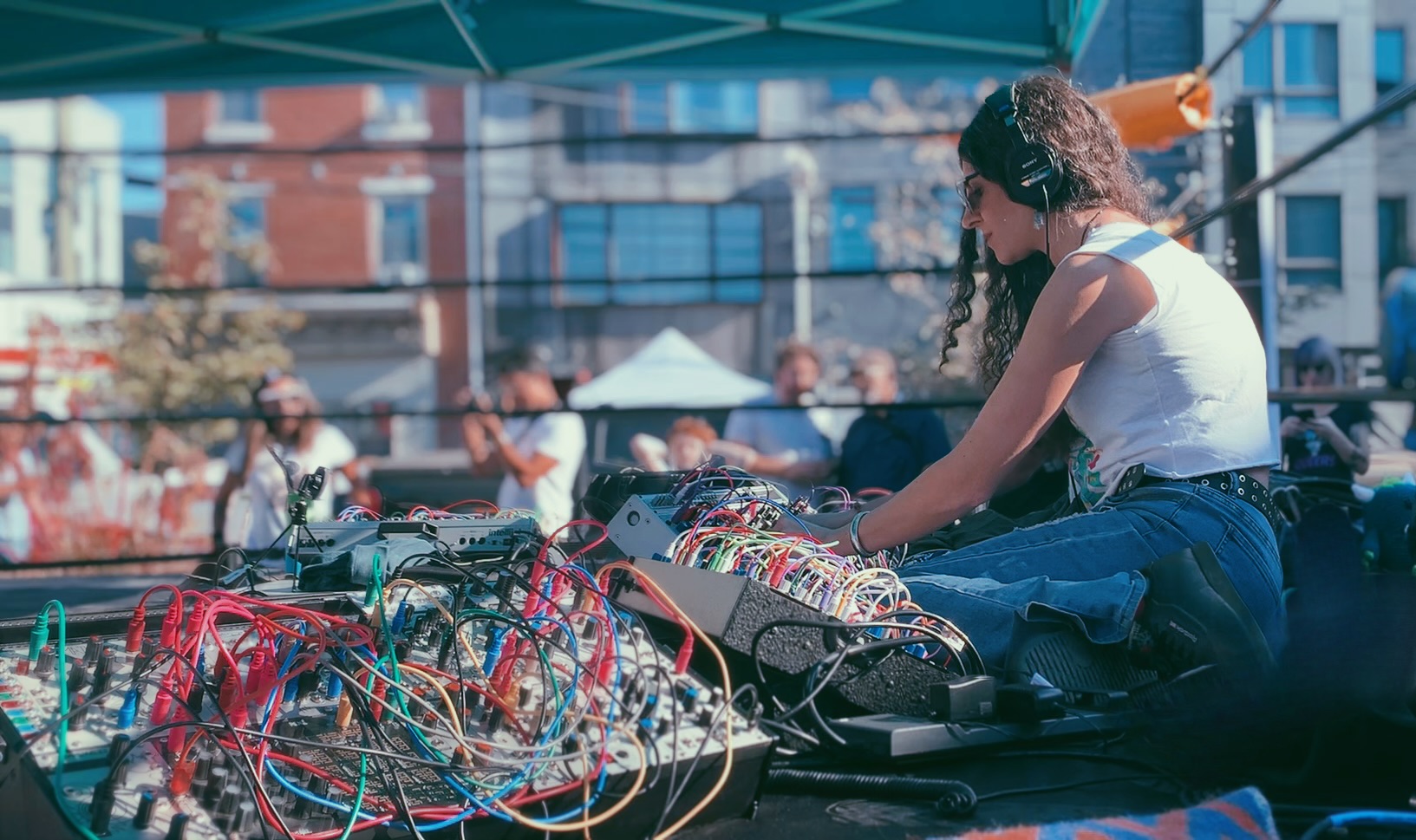 Danielle Nia Interview Image (c) the artist
"Modular is a platform for those who have a connection to the sound of electronics to utilize to empower their vision."
Video
