Published
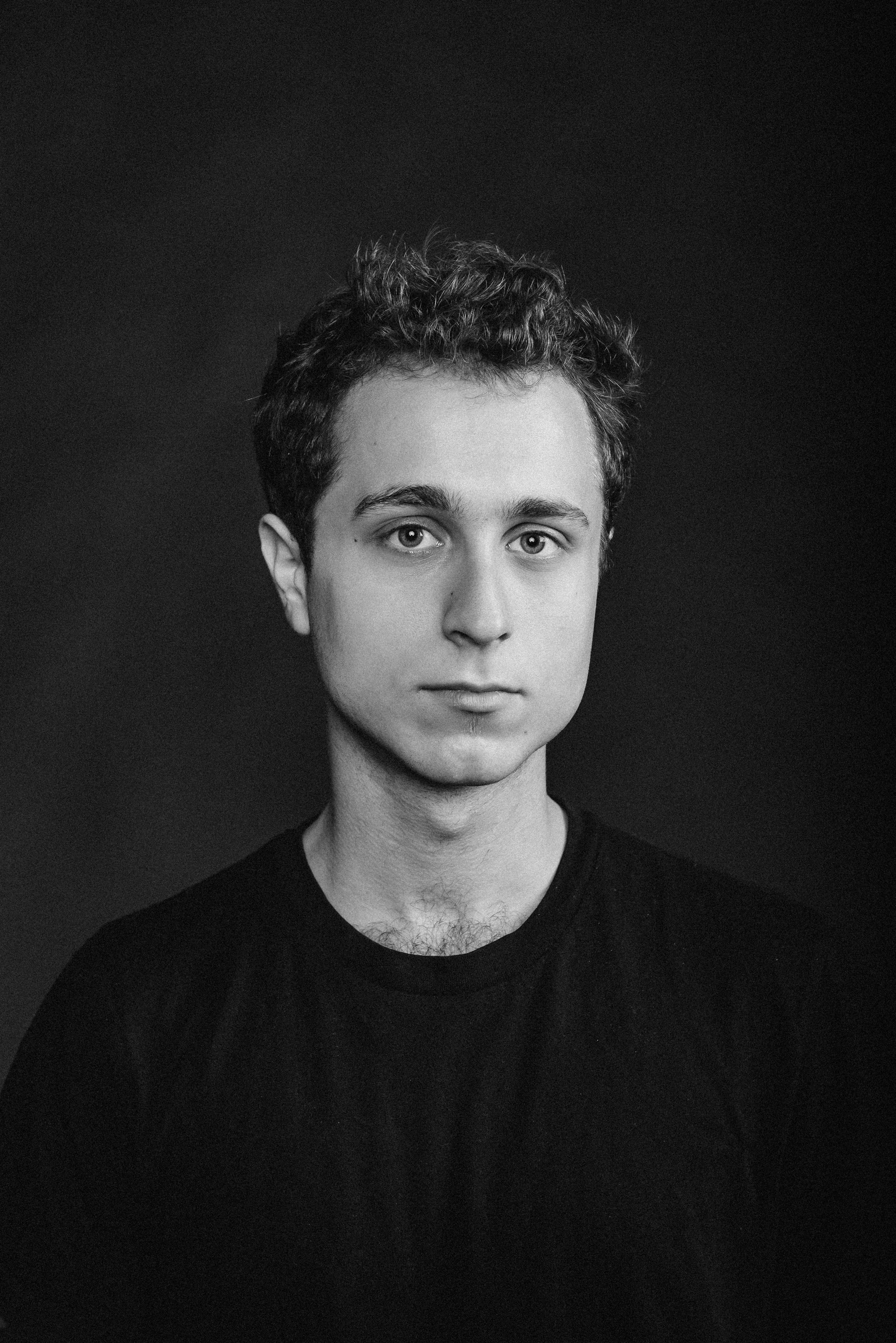
Name: Darius Heid
Nationality: German
Occupation: Composer, pianist
Current release: Darius Heid's new album Funkstille is out via Impakt. Besides Darius himself on piano, it features an ensemble comprised of Emily Wittbrodt (cello), Stefan Schönegg (double bass), Moritz Koch (percussion),
Jonas Gerigk (double bass) and Alfredo Ardia (electronics).
[Read our Emily Wittbrodt interview]
If you enjoyed this Darius Heid interview and would like to stay up to date with his music and performance dates, visit his official homepage. He is also on Instagram, bandcamp, and Facebook.
The borders between producers, sound artists, and even songwriters are becoming increasingly blurry. What does being a composer mean today, would you say?
Composing today has many facets. There’s so much to explore here, but I will for now only dive into the compositional framework of the record.
With Funkstille, I am mixing composer-performers (individual musicians who work out their own sound and approach through research and experience) with a compositional / conceptual vision and direction of mine.
I wanted to create a defined music that offers space and subtlety while holding a tension through the spontaneous and fine interactions between the musicians. I allow myself to ask for a sound that I like within the context of collective improvisation.
As an improvisor or composer-performer I think of my practise and everything that informs it as composition. In a way I compose myself every day in a continuous process. This self-composing practise consists of sound research at the piano, listening in everyday life, listening to music I resonate with, challenging myself with music I don’t initially resonate with, experimenting with different attention points while playing, the habit of taking a break before playing a concert etc.
Whenever I perform, I perform myself in specific situations so to say – solo, ensemble, working band, ad hoc, room, time, piano, audience, within shared or opposed ideas, directions, intentions, aesthetics, prior experiences, memories, dreams.
As of today, what kind of materials, ideas, and technologies are particularly stimulating for you?
Listening in everyday life has become a major stimulation to me where I enjoy exploring reciprocities between sound, object and body. It stimulates my touch on the piano and an intimate, close listening.
As I write these words I hear the tapping sound of my keyboard. What is particularly stimulating here is the weight of the keys. I like to explore thresholds, how much strength is necessary to press a key? Many titles on the double-CD reference to these experiences, like “Reciprocity“, “Touch“ and “Proximity.“
In summer 2025, I attended the “Traditional Theater Program“ in Kyoto, a 4-week program filled with teachings in Traditional Japanese Noh Theater – it’s dance, chant and music. With a tradition of more than 700 years it is still practised today. The slowness and focus on the stage as well as the extraordinary rythm of the musicians are impressive.
The culture is foreign to me, but in a way I found parts of myself within it. In terms of performance and quality there are many similarities: the focus, feeling of space, tempo, perfomativity and adaptability on stage etc.
Working with long forms, complex concepts or new vocabulary is potentially more challenging today because they require us to remember things that happened perhaps minutes ago – while most of us are finding it hard to focus even on what's happening right now. Both as a composer and as a listener yourself, how do you deal with this?
In my opinion, the tricky part is attention.
Our attention spans have decreased and the hunger for new impulses is permanent. Most of us are running from one task to the other through the day. Product advertisements fight for your attention everywhere. “Staying with a thing“ is hard, our attention is scattered most of the time. That’s why it’s hard, also for me, to listen to music where “not much is happening“. But: Patience is rewarding. In listening, and in playing.
I enjoy repetition and long forms because through time, inherent qualities of the sounds are revealed automatically through listening. As a composer and improviser I get familiar with these inherent qualities and make use of them in the musical context. I am also interested in how this kind of listening affects the body and mind: Often, I feel relaxed and focused, in a way immersed into the sounds and the silences of these pieces.
But personally, I also like changes, shifts, attacks, accents, in short: excitement – punctual events that bring the attention back. I love the space which appears in between the notes and the satisfying timing of a perfectly placed event. My latest work mediates in between the poles of repetition and change, trying to achieve a deep listening and presence.
Many people perceive classical music and contemporary composition as having high barriers of entrance, both for listeners and musicians. What have your own experiences been in this regard?
I remember listening to a Wandelweiser release with music by Radu Malfatti and not understanding it at all. A few years later Wandelweiser’s music has become very dear to my work and myself. I often had barriers with different music, not only experimental forms of music.
But I also have a constant wish to expand my empathy towards sound. To understand and open my senses towards its qualities - without the self-expectation to reproduce them technically. There’s no right or wrong way of understanding. And there is a speculative quality about the process which is inspiring to me.
Sometimes you don’t like something at all and listen to the same music a few years later, and suddenly you understand. In my experience that understanding is not necessarily analytical, but also spiritual in a way; the music its expression, ideas, forms, colors, shapes, timbres. It’s like “Free Jazz“ turning into “Easy Listening“ in the best sense.
On a more general level back to the question: Yes, there’s definitely a hierarchical supremacy that is connected to classical and contemporary music. The barriers are often kept alive by institutions like universities, concert halls, etc. It’s not really the listener’s fault. There is not really a problem on the listener’s side – everyone is free to believe in their taste. There’s nothing “better“ in contemporary music per se. And nothing “worse“ in other forms of expressions per se. This is the hierarchy that is kept alive and needs to be questioned.
The problem in my opinion is how “contemporary“ or “experimental“ music is communicated. The problem is the frame in which the music meets the listener. As artists we can not fully control, predict or change the frame of listening, but there are parameters by which we can and should set up the setting. To me it is an extended way of expressing your ideas.
That’s why I wanted to include a 16p booklet in the Funkstille release. The text is beautifully written by Ulrich Steinmetzger and includes outer-musical readings, images, metaphors. I hope that listeners can enter this music more easily through words, listen with patience and resonate on their own.
Composing has always had an interesting relationship between honouring its roots and exploring the unknown. What does the balance between these two poles look like in your music?
I don’t think too much about “roots“ when creating music.. Yes, I have been to a jazz school or studied contemporary music, but is it really my background, my roots? Do I feel home there, do I truly feel embedded in the beauty of lineage and creativity? Honestly, no. I like to go to concerts, exchange with my peers and relate to the scene from the point of where I am and what is real.
At the same time, I truly honor everything that came before me. Especially the radical and hard work of improvised and experimental musics (including “jazz“) whose creative communities often suffered under political repressions. Yes, there is a feeling of gratitude and honor to the history but at the same time I have to admit that I don’t feel rooted in any tradition.
I am also grateful for teachers and mentors who opened new doors for me, like Jacques Demierre, Paulo Alvares or Lotte Anker. My strategy regarding the root topic is to work experimentally on my own and be connected with what is happening around me.
Are there approaches, artists, festivals, labels, spaces or anyone/-thing else out there who you feel deserve a shout out for taking composition into the future?
There are so many great and brave initiatives happening around the world right now.
In terms of labels, I’ve recently been listening to releases on Sofa Music (Oslo) and INSUB (Geneva).
Tell me a bit about the sounds & creative directions, artists & communities, as well as the colleagues & creative hotspots of your current hometown, please. How do they influence your music?
I am currently based between Cologne and Copenhagen. There is a lot of music happening in both cities.
In Copenhagen, there are collectives like the Crrnt Collective who release music and organize events. A lot of their members are affiliated with the genre-free Rhythmic Music Conservatory. It is a unique school and serves as a creative hub for many people.
In Cologne there is a strong tradition of contemporary classical music and also many collectives and venues that host experimental music. I am part of the Impakt Collective there. We organise concerts, have a label, host workshops etc.
It is impossible to map out the sounds and creative directions of these cities in this format, but there are a lot of things happening.
It is my impression that adding a conceptual, non-musical dimension to one's work is almost a prerequisite for commissions and grants. How do you view this tendency and how “conceptual” is your own approach to writing?
My approach to writing is definitely conceptual to some degree. What it means to me is to take a macro-perspective on the composition or project. What is it about, which qualities am I going for and why?
“Conceptual“ has an academic and complex connotation. But a “concept“ can also be fairly simple. Take Alvin Lucier’s work for example: one could explain many of his works in a single sentence.
What is interesting to me is how a concept is played out in time. The depth of repetition reveals inherent qualities. That is beautiful to me. The listener’s attention shifts from (but also through) sound towards themselves, their own perception, attention and listening.