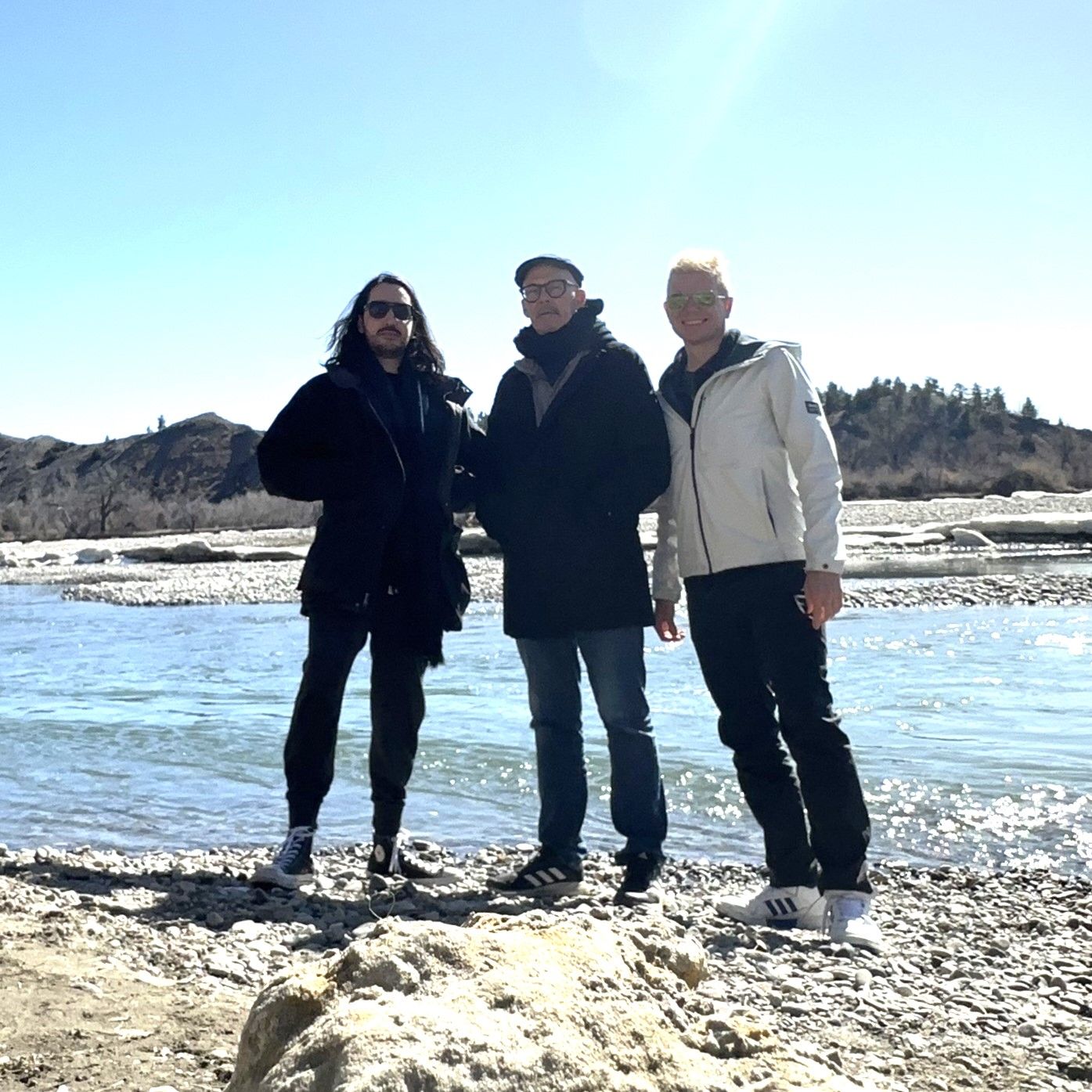
Published
Name: David Bixler
Nationality: American
Occupation: Saxophonist, composer, educator
Current Release: David Bixler's new album incognito ergo sum, featuring bassist Dan Loomis and drummer/percussionist Fabio Rojas, is out now.
Recommendation for New York City, USA: I've lived in NYC for a long time now, but am so ensconced in my thing, that I don’t always check out all that there is to do and see. A couple of weeks ago I had some time in the East Village before an appointment and as I walked I came across and entered Stuyvesant Square Park, which I had never seen before and it was amazing. Highly recommended.
Topic that I am passionate about but rarely get to talk about: I’m tired of the political fighting and divisiveness. Protesting is cool, protesting is American, but hating the other side, in my opinion, is not.
There is a gentleman in our neighborhood that my wife and I have gotten groceries for sporadically over the past five years. After not seeing him for a few months we were on the same train and we had time for him to share his story. It turns out that he had been homeless, but now thankfully has an apartment, but because of a technicality in the system he doesn’t qualify for food assistance. He has no teeth and walks in a labored fashion with a cane.
Maybe as a society if we spent less time on Facebook rants, which are easy and instead focused the outrage and energy for justice we could actually take care of a human being. I can do more myself. Talk is cheap.
If you enjoyed this David Bixler interview and would like to know more about his music, visit his official homepage. He is also on Instagram, and bandcamp.
What were some of the musical experiences which planted a seed for your interest in jazz?
My parents were in college in the late 50s and early 60s, a time when jazz was still part of the American mainstream and my folks had some jazz in their vinyl collection.
Ahmad Jamal’s Happy Moods is one that I remember that I thought was pretty cool.
I started playing the saxophone at age ten and was taking lessons with a local saxophonist, Curt Hanrahan, who lent me LPs which really turned me on to this music.
The “thing” though that I look back on that got me completely hooked was my dad taking me to hear Dexter Gordon and Johnny Griffin at the Pabst Theater in Milwaukee when I was 16.
I had no idea what was going on, but it was the coolest thing I had ever experienced musically and I wanted to try and make music like that.
What does the term jazz mean today, would you say?
It depends on who you are because it covers a large swath of real estate.
On one hand, I know it when I hear it. However, I feel that any restriction used to define jazz is antithetical to the spirit of the music and has the potential to stop it from developing. Does jazz need to swing? Yes. Is blues saturation integral to jazz? Yes.
But there is also so much creative music, music that I love that is more influenced by other things and it is coming from another place. Some wouldn’t consider some of this music jazz, but if it contains improvisation and experimentation that is fueled by soul and intellect I want to check it out.
As of today, what kind of materials, ideas, and technologies are particularly stimulating for you?
During the pandemic I embarked on a serious pursuit of studying/playing traditional Irish music on the flute. There is an earthiness of that music, a spirit that to me is not unlike the spirit of jazz.
Irish music, like jazz, was born in a crucible of oppression and I believe that is evident as you listen to the masters of Irish music. A lot of traditional Irish music is in three keys, but the fact that there are hundreds, thousands of beautiful tunes based on either a seven note diatonic scale or a pentatonic scale without much chromaticism is mind blowing.
As a jazz musician I feel that I sometimes am looking for the most difficult path and Irish music has given me the agency to lay into a triad. Immersing myself in this tradition has changed how I think about music. It has spurred me to revisit my group Auction Project with Arturo O’Farrill where the material is primarily Afro-Cuban versions of Irish tunes.
We actually presented the music with his Afro-Latin Jazz Orchestra at the Irish Arts Center here in NYC back in February and I hope to record it soon.
Where do most of your inspirations to create come from – rather from internal impulses or external ones? Which current social / political / ecological or other developments make you feel like you need to respond as an artist?
Social, political, ecological developments-not always encouraging.
I don’t necessarily feel prompted to create music in order to protest something I find troubling, but I do feel responsible to produce something that offers an alternative to all the negativity and darkness that is part of this world.
Art in itself is protest as human beings create and breathe life into a world that often feels that is fueled by greed and injustice.
What role do electronic tools and instruments play for your creative process?
I am intrigued by electronics.
In the not too distant past it became a thing for wind players to start running their sounds through effect pedals and I was intrigued, paying attention. On trio incognito’s first recording, Inside the Grief, I wanted to make an attempt at playing with my sound. My problem was that I had no background in electronics; I didn’t know where to begin.
I told the engineer that I wanted to incorporate electronics, so he worked with my sound in post-production, giving me a couple of options. I eventually settled on some electronics that felt natural and they can be heard on the track “Vote.”
There is nothing crazy, but I like what happened, so for the next record, The Langston Hughes Project Vol. 1 I wanted to dive in and explore electronics.
I had recorded four of the eight tracks with the nonet, but I got advice that the four tracks were too short to release as a recording. I was disappointed by that assessment and after I voiced the situation to two musician friends, they both had the same idea that it would be cool to improvise solo saxophone to use connect the four tracks.
I then met with a saxophonist friend of mine that had been using pedals for a while and he gave me a crash tutorial on his pedals.
I was pondering investing in some equipment, but then it dawned on me that the years, the decades it took me to develop my sound, it would probably take me a similar amount of time working with electronics for me to get beyond a surface level understanding of what was possible. I was concerned that it would be elementary and would sound like I was simply slapping something on my sound without a why.
I turned to my friend, electro-acoustic composer Elainie Lilios and explained what I was looking for. What she ended up doing was taking my completed recordings and while I don’t know how she describes her process, it sounded to me like she put my music in a blender and created soundscapes that bridged each of the four tracks.
When I heard what she had done I was blown away and confident that I had made the right decision in inviting a collaborator that creates in that world and has a vocabulary.
I then improvised on the tracks that she created and then she went back and painted my sound. The recording consists of the four original tracks and a continuous track of all four with the sonic landscapes connecting them all.
Thanks to technological advances, collaboration has become a lot easier. What have been some of the most fruitful collaborations for you recently and what approaches to and modes of collaboration currently seem best to you?
The HUGHES project with Elainie would be number one, and while not part of my performance, I am excited about a podcast that I have been producing called LINER NOTES with David Bixler that will begin year number eight this July.
I started the podcast to shed light on musicians and their music, but I am always amazed by my personal take away after talking to the guest. I started speaking with the guests in a studio, then I moved in person with a hand held zoom recorder, but when the pandemic started we moved the show to online recording which engineer Marco Mendoza puts together brilliantly each month.
Jazz has always had an interesting relationship between honouring its roots and exploring the unknown. What does the balance between these two poles look like in your music?
I came up wanting to learn bebop and I did what all of us do to learn this music, in my case learning Bird, Stitt, and Cannonball solos. I love that music and feel that will always be the gold standard, however I never completely sounded like those guys.
There are great instrumentalists on the scene today who have made it a career of upholding that tradition, and I have respect for that. But for me it was more that through the study of the harmonic, rhythmic, and melodic aspects bebop gave me the discipline that created an infrastructure to shape the music that I feel that I am supposed to create.
How much potential for something “new” is there still in jazz? What could this “new” look like?
I believe that the potential for something new in art, music, and jazz is without limit which is how the artistic community has gotten to where it is now. Human beings were given a mandate to create by their Creator-this is what we do.
However, I don’t think I could answer “what could this “new” look like?,” because as something new is happening one would only have a vague awareness of it being new in the moment and it wouldn’t be until the dust settles that you would be aware of the outcome of an organic process.
How, would you say are your live performances and your recording projects connected at the moment? How do they mutually influence and feed off each other?
Ideally the recordings should reflect what is happening on the bandstand, but unfortunately for me it is not always the case.
With trio incognito the new record incognito ergo sum is very reflective of what was happening on the bandstand, as most of the recording was recorded while we were on tour and the music reflects that vibe. We were comfortable in the process and it's all there on the record, blemishes included. I love that.
However, the Bixtet recordings Blended Lineage and The Langston Hughes Project vol. 1, only exist in the studio. The Hughes was performed one time, but otherwise they only have existed in the studio.
I wish that there were opportunities to play that music, but maybe because there are nine musicians, it is too costly to make it happen. I also want to record the last four pieces of the Hughes. Money/opportunity-I would like to change that.
Ímprovisation is obviously an essential element of jazz, but I would assume that just like composition, it is transforming. How do you feel has the role of improvisation changed in jazz?
I appreciate and am excited when improvisation changes in both the “where“ in the musical event as well as “how.” Tune, solos, trading, head out.
I don’t think that is going away and I don’t want it to, but for me, I look for opportunities to manipulate that structure as well as manipulate within that structure, being open to the idea that it might not work.
As I respond to this question I realize that I can only speak for myself, but I am at a point of being most content as a player when I wait for what I am supposed to play next to reveal itself.
What, would you say, are the key ideas behind your approach to improvisation?
I think we tend to do and play things in a way that is safe without questioning what is appropriate in the present tense.
For example, if a standard is played, does the ending have to involve tagging the last phrase three times? How much can we deviate from what is supposed to happen?
That is where I like to go, even in the context of playing “straight-ahead.” I want to pursue the idea of a conversation that can go anywhere rather than a skillfully composed and expertly executed script.
The Montreux Festival intends to preserve its archive of recordings for future generations. Do you personally feel it's important that everything should remain available forever - or is there something to be said for letting beautiful moments pass and linger in the memories of those that experienced them?
There are a handful of performances that I cling to that were transformative for me. Gigs where I happened to be in attendance and witnessed something extraordinary. At these events there was an electricity and a sense in the room that we are all in the presence of something special. Two come to mind.
One was when I was first in NYC at the now defunct Sweet Basil where Charlie Haden’s band was playing. Dewey Redman took an extended solo over a shifting landscape that in my memory lasted forever. It was brilliant and I didn’t want it to end.
More recently I heard Kenny Barron’s quintet at the Vanguard-it was killing, but when the set was finished he came back for an encore and played Monk’s Reflections solo. It was effortless and I felt it was complete and perfect. There wasn’t one thing that could have been changed to make it better.
After thirty years later for Redman and five years later for Barron, I don’t know if I would want to watch/hear a recording of either of those performances again as I don’t think it would have the same effect on me.
It is potentially important from an archival perspective, but the "je ne sais quoi" of being in those clubs in those specific times would be missing for me.