Published
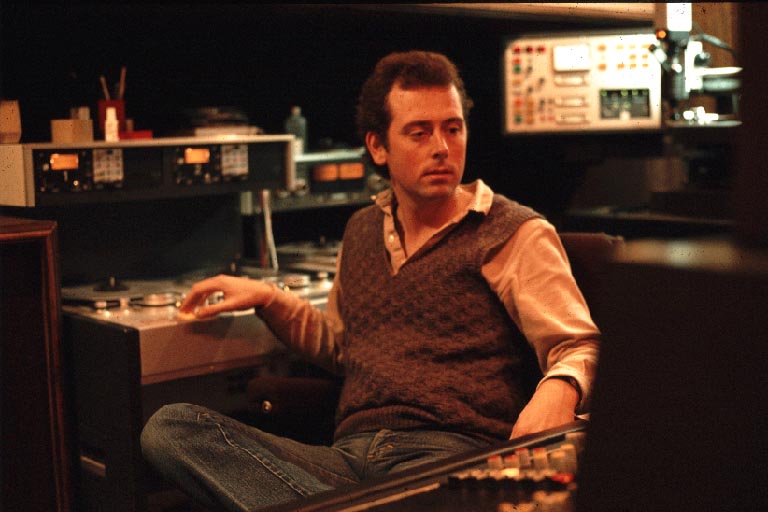
Name: Denis Blackham
Nationality: British
Occupation: Mastering engineer
Current events: Denis Blackham moved his studio and life from Britain to Thailand recently, but is still active mastering releases from a wide range of styles.
If you enjoyed these thoughts by Denis Blackham and would like to know more about his music, visit the official homepage of his mastering company Sky Mastering.
For a deeper dive, we recommend our earlier Denis Blackham interview, and our more recent interview about his involvement with Kraftwerk and Mike Oldfield.
On your website, you’ve described your mastering life as a happy one. What made this such a great job for you?
When I left school in July 1967, I became a silk screen printer. I really enjoyed that job as it was hands on, very creative and I was usually covered in paint. I’m glad I moved on as it’s all automated these days and I would not have liked it.
I guess I might have ended up having my own small business hand printing bespoke pieces of work, but in 1969 I became a mastering engineer and never looked back.
I think I was born to master music. It feels totally natural to me.
In our email conversation, you told me that you sold your entire mastering equipment recently and are actually quite content with your new set-up – were there no emotional attachments to the machines you worked with for such a long time?
I had a set of excellent outboard units that gave me the adjustments I wanted for mastering. Every project is different, so the equipment I had needed to be versatile. Most of what I had I bought in 1996 when I first set up on my own. I tried various units at the time, but it all comes down to what your ears and brain is happy with.
For instance, when I was trying EQ units, I had a Manley EQ, a Focusright EQ, and another one that I can’t remember the make. I listened to various tracks, and there was one in particular that I felt needed a couple of db at 4k. Two of the units didn’t do it for me. The adjustment I was looking for wasn’t quite right, but when I put 2 db at 4k in the the Manley, the sound my ears and brain were looking for was there straight away.
So I bought the Manley; the choice was made. I also bought the Manley Vari-Mu Compressor, which is an excellent piece of analogue outboard gear.
When I was setting up my room, I did all the acoustic treatment myself from the knowledge I had acquired over many years of mastering in different rooms. My initial monitor choice was PCM and had a set delivered, but I wasn’t happy with the sound. They are obviously an excellent monitor speaker but maybe they didn’t suit my room’s acoustics or my way of listening. There were several adjustments on the back of the monitors but I couldn’t get them sounding how I expected. I sent them back and bought a pair of ATC 100A’s which had no external adjustment, but they were perfect.
Several years later I took them back to ATC to get checked. They put in new tweeters and a redesigned bass port system. Everything else was fine, and we even met the lady who made the superb mid-range units.
I bought a beautiful Studer A820 two track quarter inch tape machine, and also a half inch conversion kit from Studer. It only took five minutes to change the headblock and tape guides from one to the other. The only modification I made was to drill a hole in each headblock above the screw to align the playback head. You need to be able to adjust the head to same alignment of the tape’s original machine’s record head. This is called Azimuth adjustment and a very important part of a perfect playback.
In terms of the gear, what did your Sky mastering room look like in Scotland?
I had a detached house 20 km (12 Miles) from a shop, and surrounded by fields. So although I had air-conditioning, I could work with the window open a little if I wanted, plus I looked out across fields to the sea. A very calming view for working.
I converted a spare bedroom to my mastering studio, plus I converted a small adjoining walk-in storage room into a machine room for my two computers, outboard equipment, printer etc not needed in the mastering room. Having no fan or machine noise in my mastering room gave me a silent environment to work in. I hate to see cables laying on the floor, so all the cabling went through the wall into the machine room.
Both rooms had a separate power supply and spike protectors from the main house to avoid any electrical clicks for household appliances.
You've now switched to an entirely digital set-up. What, specifically, are you using and what are some of the specific benefits? Are there nonetheless sound aspects of a “hardware” or “analog” studio that can not be emulated digitally?
I currently master on a Mac Laptop which also has Bootcamp to allow me to switch to Windows for the Sadie mastering software I use. The newer Macs don’t have Bootcamp, so I may need to change to a Windows based PC. I did try Parallels on the the mac, which allows you to run both mac and Windows at the same time, but you need much more power to run the mastering software and plug-ins, so better the machine only runs one operating system at a time.
I have several plug-ins, Waves, Abbey Road, FabFilter, Izotope etc, but I choose whatever combination I need for a specific track. The lack of analogue noise gives me a cleaner sound, but I have some analogue emulation plug-ins that work well if I need them.
Sometimes I’m sent two mix versions, one from tape and another digital. I usually master from the digital if I have a choice, and the artist or producer have always approved the final result. I do not miss my old analogue based mastering system at all, and think I deliver a better final master with my current system.
In our earlier interview you said that always liked trying new things in your approach to mastering. What were some of the most important changes for you personally over the years?
I don’t think there has been anything that stands out. I just do what I feels suits the project. I have no rules. If it sounds great heavily compressed I’ll do it, or maybe the mix Is great, and I leave it. I don’t feel I have to do something.
Sometimes I’ll set up plug-in one way, for a particular sound in my head, and another way to achieve a different result.
In the same interview, you also mentioned that the sixties will forever be in your blood. Do you think this has also influenced your approach to mastering?
I was brought up listening to late 50s and 60s music, so it’s in my blood. I get requests from some people to master because I know that sound, and that’s what they want. But I can switch my mastering head from a 60s sound to a modern sound, so I master all types of music.
I’m also known for mastering alternative electronic projects. I enjoy those because you cannot work to a normal band formula of bass, drums, guitar etc. They take me to another dimension which is refreshing.
Maybe there’s something in the way I work that relates to those times, but I’m not conscious of it. Actually, there is one thing I do in the old way, I don’t use automation. Any level and eq changes within a track are done manually and edited. This may sound very old fashioned to some people but I prefer working this way. I can make un-noticeable crossfades for levels and eqs to get tracks smoother.
It’s a common fault with some mixes starting very quiet and then building to a much louder section towards the end. An easy fix is to put a compressor and limiter over the track, but I don’t do that. I re-balance the mix first, and then add whatever I feel works.
When I started mastering it was a mono cutting room and a solid mono sound coming from a mono cutting lathe, mono cutting head, and a mono cutting amplifier. One large monitor in the corner of a room without any acoustic treatment. I had a Fairchild compressor and a Pultec EQ, so you had to struggle a little bit back then to get a good result.
When you started out at IBC, the way I understand it, mono was still very important - or even the standard. As you experienced the transition to stereo first hand, would you say that stereo is merely an expansion of the spectrum or an entirely new art form?
Yes, when I started in 1969, mono was still the default format for singles (7 inch 45s), and LPs (albums) were cut either in mono or both mono and stereo. We often had separate stereo and mono mixes, so there were differences between the two. As an example, mono and stereo releases by The Beatles were often quite different to each other. Stereo quickly took over as the default medium, and by about 1971 everything was stereo.
I like stereo as you can hear the instruments and production in more clarity. Instruments can sit within a left to right picture allowing more interesting production techniques.
Instruments can be panned from one side to the other, and if you’re clever, when you pan something left to right and back again, you dip the level slightly into the middle and back up to full volume as the sound gets to the other side. On the return pass, you raise the level slightly in the middle. This can make the brain think the sound is going round in circle, in front and behind you, even though it’s just left to right, right to left.
Surround sound seems to be the magic word of the current production and mixing/mastering landscape. Compared to stereo, where do you see its potentials and how you personally see stereo as the default playback format?
I like listening to good surround mixes. Some are excellent and others not so good.
All movies and most TV production is in surround, so listening to an album in 5.1 surround brings everything into the room more, and often a pleasurable and satisfying experience.
The parameters of mastering, as you pointed out in our previous interview, are quite limited. Why does it still make such a huge difference?
It really depends how good the playing, recording and mixing is. I sometimes get asked to make a client’s album sound like so and so. You can try but it’s rarely possible. The band are probably not as tight and experienced as what they want. The recording and production isn’t as good, and they haven’t spent a quarter of a million GBP making it. You can only do so much.
However, now many home studios have excellent plug-ins, and providing whoever operates them has a decent ear, they can make a great sounding album on a minimal budget.
As the saying goes “You can’t polish a turd”, but there’s not so many of them these days.
Looking into your expansive mastering discography, your credits will sometimes read “mastered by” and sometimes “lacquer cut by.” I never truly understood the difference or if there is one at all. What did cutting the lacquer to Jarre’s Zoolook, involve, for example, or to Vangelis’s Spiral?
“Lacquer cut by ...” is the engineer who cuts the grooves for the vinyl release. Mastering is getting the sounds and levels right. The two can be performed by the same engineer if they have a cutting lathe. They can make the vinyl master cuts, and provide mastered digital files for other formats like CD, downloads and streaming.
I don’t have a lathe, so provide mastered A and B sides for a vinyl cut, which goes to a cutting engineer, who basically cuts the album or single flat; i.e. they don’t add any extra eq, just cutting the sides at the correct level to get an undistorted transfer.
What changes, would you say, in terms of the result, if you're in the same room with the artist as opposed to doing things remotely? What does this say about the potential of AI to take over mastering from humans completely?
I’ve mastered remotely since 2002 and before that I often mastered alone as clients would send me the masters and trust me to do what I do. It takes time to adjust your ears to a room you’re not used to, so letting me get on with it, and them checking in their home environment is often the best way.
Sometime they give a few notes of anything they’re worried about, or fade times if needed. I usually decide on the spacing between tracks, and ten adjust if needed once they’ve listened.
Hopefully AI won’t take over, as mastering is a very personal thing. I’m feeling my mastering, the sound, the way it affects me. Although there are some folk who go for the cheapest option, there are people do listen and know the difference.
Do you feel as though writing or performing a piece of music or mastering it is inherently different from something like making a great cup of coffee? What do you express through your work that you couldn't or wouldn't in more 'mundane' tasks?
There’s always something special in something that’s made with care, love and experience.
A great sandwich made with superb homemade bread and excellent ingredients. Coffee made with the right beans for the type of coffee you want. One bean is not right for different types of coffee, but so many coffee shops use the same bean. A good Barista knows what bean is best for an Americano or a Latte. The difference is amazing.
I think I’m the same with sounds. I can feel how something should be and that, like the right bean or bread, makes the difference.