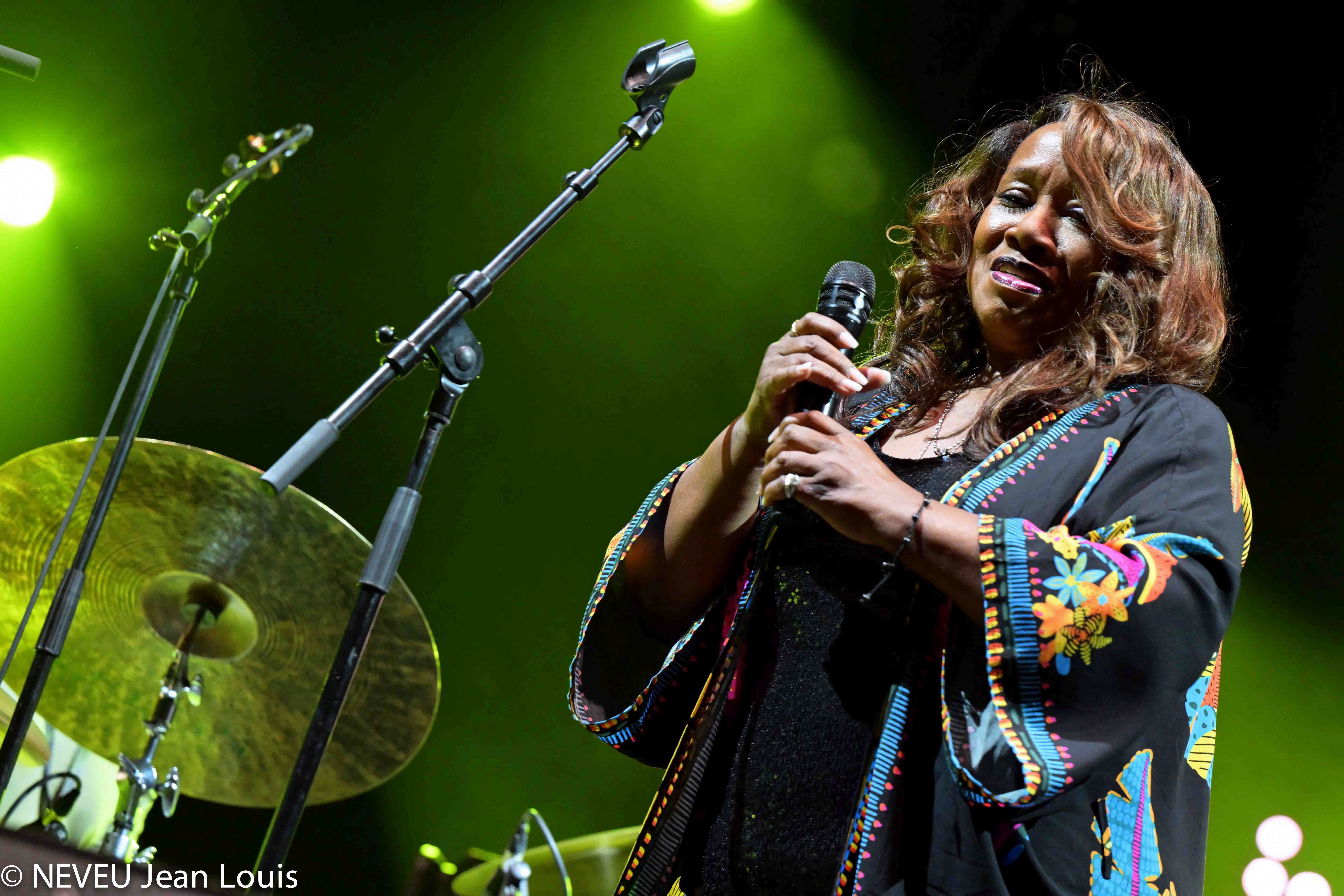
Published
Name: Denise King
Nationality: American
Occupation: Singer, songwriter
Current release: Denise King's new album People Get Ready is out via Jazzbook.
Recommendation for Philadelphia, USA: There are two places in Philly that I absolutely love.
In the middle of Fairmount Park on Chamonix Dr is a horse stable and a work to ride program. I would go out there every day to hang out with the horses. Feed them apples and sometimes sing to them. The joy I felt/feel being around those horses is beyond explanation. They also have a polo team of young African Americans. I believe they appeared in Vogue magazine. I'd watch them train, was something to see.
My second favorite is Kelly Drive. There you'll find The Waterworks, Boathouse Row, the three Angel statues, a picturesque view and a promenade by the river. I used to have lunch there at least twice a week.
If you enjoyed this Denise King interview and would like to stay up to date with her music, visit her official homepage. She is also on Instagram, and Facebook.
When did you first consciously start getting interested in singing? What was your first performance as a singer on stage or in the studio and what was the experience like?
When I look back, singing actually found me.
As I was doing some Spring cleaning outside of my house, a friend walked by and heard me singing. We grew up in the same neighborhood and he, at that time, was a guitarist and writer at Philadelphia International Records. He was shocked and surprised by my singing and offered to audition me for a gig.
I had no idea what he was talking about. I was a single mom raising three boys. But when he said the magic words 'I will pay you', I was sold. It was a means to an end. Boys eat a lot and grow very fast. Extra money was definitely a win. All I had to do was sing songs that I had been listening to since I was a teenager. Standards and Jazz. I auditioned, got the gig and … bombed.
That was my first performance in front of an audience. It was, quite frankly, terrible ... but I didn't give up. This gig lead to studio work at PIR and eventually a gig as featured singer with Dexter Wansel. I didn't get serious about singing until I was a few years in.
If you're also playing other instruments, how does the expressive potential of these compare to your own voice?
As much as I wanted to, I don't play any instruments. If I did, it would be piano.
Singing is an integral part of all cultures, and traditions. Which of these do you draw from – and why?
I've always had rather eclectic taste in music. So I listened to everything.
Whether it was melodic and soulful African singing or a beautiful Puccini Opera. I learned from it all. Jazz standards and the great American songbook were a part of my playlist. Latin and Brazilian rhythms had an impact on me as well.
Combining all of these genres was much like cooking a delicious meal. Each is its own seasoning and brings a unique flavor to the music.
What were some of the main challenges in your development as a singer/vocalist? Which practices, exercises, or teachers were most helpful in reaching your goals – were there also “harmful” ones?
The biggest challenge for me was shyness and confidence or lack of confidence. Early in my career I was afraid to sing out. I held back a lot. That changed after my first gig overseas. No one knew me, and I had nothing to prove.
Being shy was another issue. I didn't know anything about being on stage and performing. Remember, I was a mom raising kids. I didn't go to music school and am self taught. I don't read music although I've had teachers who tried to teach me. I just figured it was a cognitive issue and continued to allow my recordings to teach me.
I spent hours listening to Frank Sinatra, Sarah Vaughan, Nina Simone and Tony Bennett. Those were my professors, my teachers. That's how I learned phrasing and lyrics. That was my method. It's how I learned the words to so many songs. My learning style was listening, repetition, and actually being able to attach my life experiences to the music or songs that I loved most.
What are the things you hear in a voice when listening to a vocalist? What moves you in the voices of other singers?
Sincerity and believability are what I listen for and what moves me. Not vocal gymnastics. The ability to to tell the story.
I've heard singers that reduced me to tears or filled me with joy. Unfortunately, some singers seem to focus on technique, and forget the story. In my humble opinion, It's the story that makes the music come alive or sells the song. I was sometimes guilty. I would sing words … detached from the meaning of the words.
One day I happened to really listen to “Fly Me To The Moon.” I was blown away. I thought to myself you mean to tell me that if I hold your hand or kiss you, you'll be transported to Jupiter or Mars, playing among stars. It blew me away. It made me look at lyrics and storytelling in song a different way.
This is why when I'm coaching singers, I listen to them and if they don't nail the lyrics, I tell them I didn't believe a word you sang. Read the words.
How would you describe the physical sensation of singing? [Where do you feel the voice, do you have a visual sensation/representation, is there a sense of release or tension etc …]
Singing is medicine as is music. It's a great stress reliever. A healer. Psychiatrist. A lover.
It's a place to put emotion. Good and bad. I've poured bad breakups into my singing. Everything I've lived goes into my singing.
It's the closest I can be to God without going to heaven. There are times when it feels like a very spiritual out of body experience. Felt in every fiber of my being.
We have a speaking voice and a singing voice. Do these feel like they are natural extensions of each other, ends on a spectrum or different in kind?
Oh heavens! My singing voice and my speaking voice are as different as an apple and an orange.
My singing voice feels bass heavy and more fluid while my speaking voice doesn't feel as strong.
It's amazing to me that my voice, as I've matured, has actually gotten deeper.
How do you see the relationship between harmony, rhythm and melody? Do you feel that honing your sense of rhythm and groove has an effect on your singing skills?
I think Duke Ellington said it best. It don't mean a thing if it ain't got that swing.
What are the potentials and limits of your voice? How much of your vocal performance can and do you want to control?
I wish that I could say that my voice is limitless but there absolutely are limits. I can bounce between an alto and soprano easily but I know my cut off points.
Pushing too hard can cause serious damage to the voice. But I do go as far as I can without hurting myself. I might hear a note in my mind and try to reach it whether it's high or low.
I really attempt to go where the music takes me. There have been times when I surprised myself.
As a singer, it is possible to whisper at the audience, scream at the audience, reveal deep secrets or confront them with uncomfortable truths. Tell me about the sense of freedom that singing allows you to express yourself and how you perceive and build the relation with the audience.
You can get away with a lot on stage lol. Connecting with my audience is very important to me. I like for people to feel relaxed and comfortable. Like I'm entertaining friends in my living room.
I learned a long time ago to just be yourself. That's where freedom lies. Don't be afraid to show your humanity or vulnerability. I've told stories of crushing heartbreak and had the audience weep with me and laugh with me. I've asked people to be kind to each other. Addressed issues of being different, handicapped, other.
Most of the times I avoid politics and religion unless it's absolutely necessary. Depending on what's happening in the world. I try to create a space where people can leave their woes and worries at the doorstep. A safe space.
I've never screamed at an audience nor would I. What I have done, especially if someone or several audience members are being loud and rude, I've gone directly to their seat or table and sang in front of them. I might say something like “I came closer because I didn't think you could hear me …” over the talking. Doesn't happen often but I find ways to address it.
As it pertains to my audience, I know what I look for when I go out to a show. And I imagine myself in their spot and try to create something memorable or special.
I'd love to know more about the vocal performances for People Get Ready, please, and the qualities of your voice that you wanted to bring to the fore.
My latest project was really quite a bit of serendipity. A chance meeting with the president of JazzBook Records, Seydou Barry, set everything in motion.
I learned that the project had been on the shelf for about three years. The music had been recorded. They were searching for a singer to bring the songs to life. And boom, we met in Aix en Provence. The rest is herstory.
I was concerned because I primarily sang Jazz. I didn't know what to expect. But the songs were absolutely some of my favorites. They spoke to the activist in me as well as addressed some of my spiritual beliefs. My main concern was making those songs come alive and to convey the messages that originals did.
One funny story about “Throw It Away.” I had to do that song in several takes. It was like the spirit of Abbey showed up and said if you're gonna do my song get it right. Between having to take my inhaler and mega doses of hot tea, I got through it.
When you're writing song lyrics, do you sense or see a connection between your voice and the text? Does it need to feel and sound “good” or “right” to sing certain words? What's your perspective in this regard of singing someone else's songs versus your own?
When I'm writing lyrics I'm more focus on the words than the story ... not necessarily putting my voice to the story. But creating a space accessible to anyone who wants to sing them.
Singing someone else's lyrics is easier for me because it's just a matter of interpretation. Making that writer words come to life. A bit more difficult with my own words because I ask myself … what are you attempting to say. What's the take away.
I've listened to some of my lyrics and found myself smiling. Never fancied myself a lyricist. A writer perhaps - a songwriter not so much.
Strain is a particularly serious issue for many vocalists. How do you take care of your voice? Are the recipes or techniques to get a damaged voice back in shape?
Rest, rest - and more rest.
I developed a technique for myself when my voice is tired. It can involve key changes, less belting, careful song selection. Years ago, I was doing an extended engagement in Turkey, and because I was having waaaaaaay to much fun, partying, drankin', hanging out, I seriously damaged my vocal chords. I developed a lesion. That was terrifying. A trip to the ENT made me aware of just how serious it was. I was at risk of never being able to sing again.
As a result, I try to be really careful. This is one of the things I stress with my students and during master classes. As vocalist we use our instruments all of the time. The only time we get to rest is when we have self-imposed time. No speaking, no singing.
How has technology, such as autotune or effect processing, impacted singing? Has it been a concrete influence on your own approach?
The problem with technology is that it has created a generation of people who might not be great singers. If you can fix those clunker notes in the mix, you're not really getting the true voice of the artist.
I remember doing a session and I hit some bad notes. The engineer said no worries we'll fix it in the mix. I emphatically said: "Absolutely not! I'm going to fix those notes."
When I was growing up singers sang. They hit the notes live or during recording. Too many times I've heard listeners say one artist or another didn't sound anything like the record.
Motherese may have been the origin of music, and singing is possibly the earliest form of musical expression, and culture in general. How connected is the human voice to your own sense of wellbeing, your creativity, and society as a whole?
Music is Medicine … soul food if you will. It has provided a space for me to put emotions I couldn't express. Help me through trauma and tragedy.
For society in general it's a balm. To be transported to a place of peace, solace and comfort by music is other worldly. I marvel at the impact that music has on different audiences. It's beautiful. Sometimes spiritual.
I don't allow music with negative messages in my space. Some music can and does impact people negatively causing them to respond sometimes violently or negatively. Music is a gift.