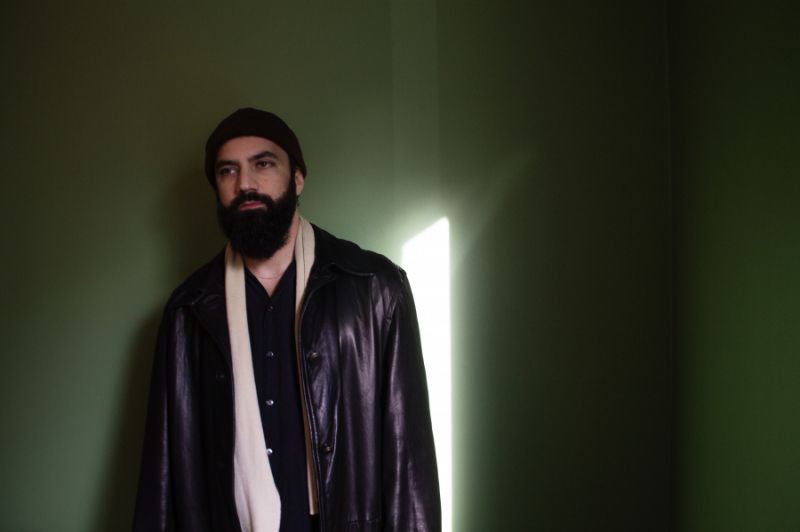
Published
Name: Dennis Egberth
Nationality: Swedish
Occupation: Drummer, percussionist, composer, improviser
Current release: Dennis Egberth's new album with his sextet, The Dennis Egberth Dynasty, is out via 577. It features himself on drums as well as Fredrik Ljungkvist (tenor saxophone, clarinet), Niklas Barnö (trumpet), Alex Zethson (wurlitzer), Linus Hillborg (electronics) as well as Joe Williamson (double bass).
[Read our Alex Zethson interview]
[Read our Linus Hillborg interview]
If you enjoyed this Dennis Egberth interview and would like to find out more about his music, releases and upcoming live dates, visit him on Instagram, and bandcamp.
For the perspectives of one of his collaborators, read our Vilhelm Bromander interview.
What were some of the musical experiences which planted a seed for your interest in jazz?
I think it started with me listening and playing 60s rock music, often played by drummers with a jazz background. Since I was very young I always thought the music was magnetic. I just got drawn in to it.
I started to dig deep into it when I started studying music in high school and met other people with similar taste and interest to explore the music.
What does the term jazz mean today, would you say?
I would say it's a way to approach the music where freedom and improvisation are the main components.
As of today, what kind of materials, ideas, and technologies are particularly stimulating for you?
Small or big things you come across while reading, speaking to people or listening to music. Mythical stuff and natural phenomena for example.
Where do most of your inspirations to create come from – rather from internal impulses or external ones? Which current social / political / ecological or other developments make you feel like you need to respond as an artist?
I think it starts with external experiences that have internal effects. Like different emotions I can get from different places.
Also my kids give me a lot of inspiration, just from being around them.
There is a lot of crazy stuff going on politically right now and I think that makes it even more important that we continue to do what we do.
What role do electronic tools and instruments play for your creative process?
I think it can be a great spice to add an extra layer and texture. In some contexts it works great, in others not.
But I am really oldfashioned otherwise. I handwrite with paper and pen and try to avoid computers in my workflow.
Jazz has always had an interesting relationship between honouring its roots and exploring the unknown. What does the balance between these two poles look like in your music?
That's a tough one. I don't really see myself as an tradition bearer. I like to find inspiration in older music but have no interest in copying what is already done. It's already there.
But with that said, I still have a lot of respect for the tradition and what the people before me have done for the music.
How much potential for something “new” is there still in jazz? What could this “new” look like?
As long as you're not trying to replicate what's already been done, I think you're doing something new. Everything moves in cycles.
I don't think it's a good approach to try to create music that's completely new just for the sake of it being "new.”
How, would you say are your live performances and your recording projects connected at the moment? How do they mutually influence and feed off each other?
I have often seen them as different things. Like different ways to approach the music. You play the music one way on record and another way live. Same way as you play a bit different in different venues. But I like to capture the live tension on record.
For me, most projects starts with making a record - so that is my first focus. But then the music often comes alive in another way when you start playing it live and it often gets better and better the more you play it.
But there is also something special when you capture the first moment you do real versions of the music.
Ímprovisation is obviously an essential element of jazz, but I would assume that just like composition, it is transforming. How do you feel has the role of improvisation changed in jazz?
Yes definitely, I agree. I guess it has to do with all the music and other stuff that circulates around us and comes part of the improvisers' subconsciousness.
You take inspiration from everything around you and we do not live in the same world or hear the same music as the people living 50 years ago did. I mean, you could still try to sound like you lived back then, but in that case you'd need to filtrate away all the stuff that have happened since then..
What, would you say, are the key ideas behind your approach to improvisation?
Sounds and contrasts.
The Montreux Festival intends to preserve its archive of recordings for future generations. Do you personally feels it's important that everything should remain available forever - or is there something to be said for letting beautiful moments pass and linger in the memories of those that experienced them?
I like the idea that its available forever. But it can take away the spontaneous feeling and wiliness to take risks from the musicians if they know it is recorded.
There is also a really special feeling in a room during a concert that is very hard to capture. But I do like the idea to record for documentational purposes.