Published
Name: Deron Johnson
Nationality: American
Occupation: Composer, pianist, producer
Current release: Deron Johnson's Free To Dance is out June 28th 2024 via Colorfield. It features several guests, including Mark Turner, Mark Guiliana, Gretchen Parlato, Alan Hampton, Sam Gendel, CJ Camerieri, Jonathan Pinson, Joey Curreri and a voice recording of Miles Davis.
Recommendations: Two pieces of art: Willem De Kooning: Woman 1; Sergio Leone: Once Upon A Time In The West
[Read our Mark Guiliana interview]
If you enjoyed this Deron Johnson interview and would like to stay up to date with his music, visit his official homepage. He is also on Instagram.
Over the course of his career, Deron Johnson has worked with or appeared on releases by Miles Davis, Trevor Horn, Pokey LaFarge, Alanis Morissette, Stanley Clarke and Seal.
[Read our Trevor Horn interview]
[Read our Pokey LaFarge interview]
Where does the impulse to create something come from for you? What role do often-quoted sources of inspiration like dreams, other forms of art, personal relationships, politics etc play?
Creative impulses that are meaningful in the end, mostly come out of nowhere. I’m always listening to music, so often times a song might lead me down a path. A lyric might lead to somewhere. Generally, I don’t follow messages that pop into my head.
In my quiet time, music doesn’t normally show up, mostly it’s story ideas. I’ve never been into politics so that doesn’t really inspire me either.
I do follow painting closely, and I think that has been a source of quite abstract ideas that I have made into musical form.
For you to get started, do there need to be concrete ideas – or what some have called a 'visualisation' of the finished work? What does the balance between planning and chance look like for you?
For me to get started, it’s just about showing up. I don’t need to see or “hear” an ending before starting. I don’t make large works, so maybe planning could possibly be helpful in that case.
When I made this record, it was about having nothing prearranged at all. It was put down as fast as possible, and the overdubs were kept to only a few takes.
When I score music it’s the generally the same. I make tracks away from the movie that have the feeling of what the film is about. I also improvise against dialogue, bobbing and weaving as if the music is another character.
Is there a preparation phase for your process? Do you require your tools to be laid out in a particular way, for example, do you need to do 'research' or create 'early versions'?
My prep phase is simple. I do like to have tools laid out. If I have instruments in sight, I’m one step ahead of my brain and conscious mind. It kind of shows respect to the muse, and says that you are willing, and ready.
A great story I like to follow is the rabbit in the hole metaphor as stated by Neil Young … ”you know it’s there in you peripheral vision but you never look at it directly.”
Pete’s studio was THE perfect place for this. The setup was clear, every take that I did was captured in the best possible way.
Do you have certain rituals to get you into the right mindset for creating? What role do certain foods or stimulants like coffee, lighting, scents, exercise or reading poetry play?
My rituals are few. I keep many inspiring books around, and may look at some footage from a movie that relates etc.
With the Free To Dance record I had photos sometimes, books, dance related material because of it being an ode to my mother in a peculiar way.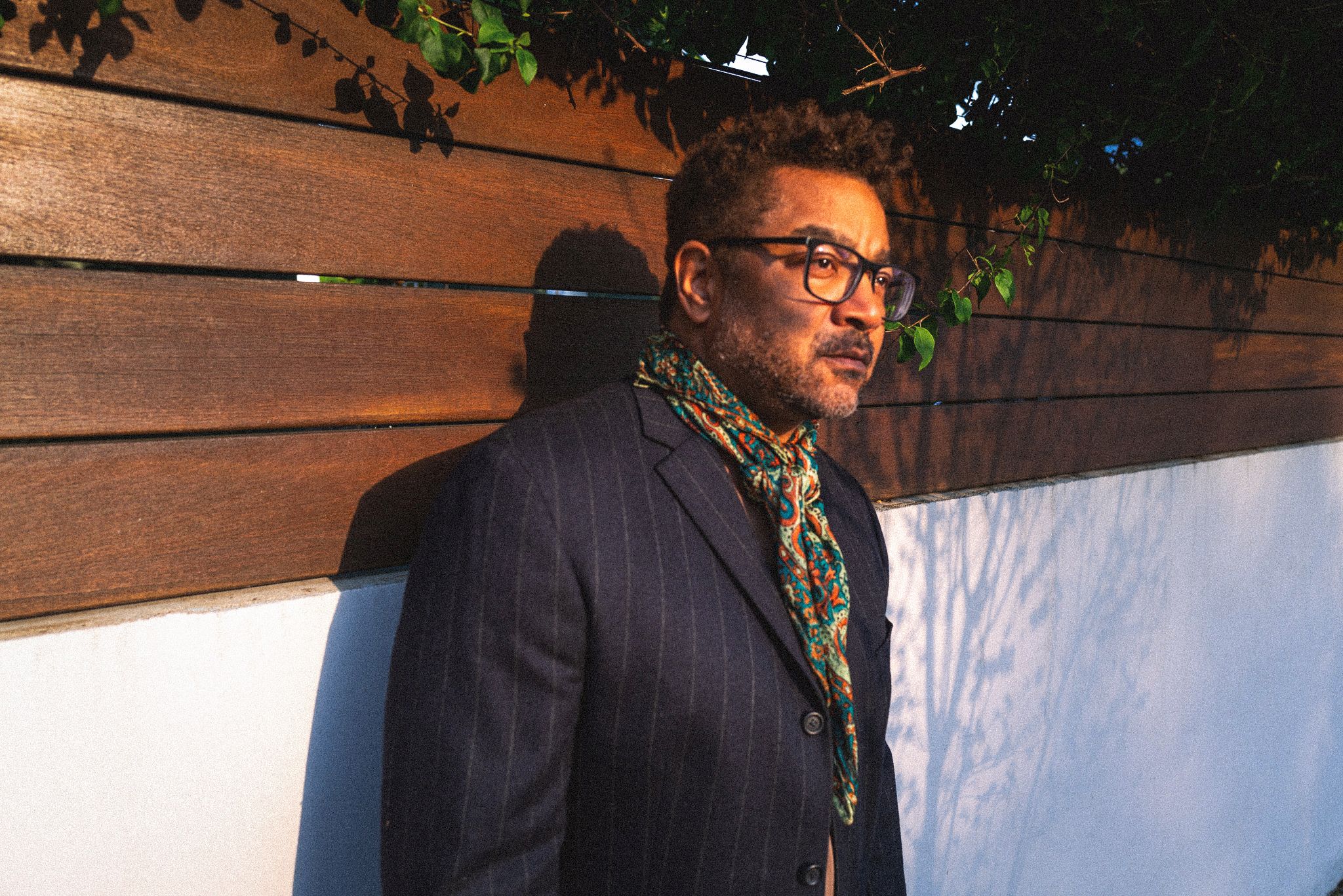
Deron Johnson Interview Image by Charlie Weinmann
What do you start with? And, to quote a question by the great Bruce Duffie: When you come up with a musical idea, have you created the idea or have you discovered the idea?
I like to start with a restriction often times. I can only play this chord and its variations or I can can only use these intervals.
The discovery for me is what comes out of those restrictions. Most of the time they are truthful and can stand the test of my left brain wrath.
Many writers have claimed that as soon as they enter into the process, certain aspects of the narrative are out of their hands. Do you like to keep strict control or is there a sense of following things where they lead you?
When I enter the door to the process of composing, it’s all out of my hands until many days later. I follow where it leads me. Then, of course, you start to trust it and you can work along with what came out.
The second song “Call Me Back” was improvised at the piano. We ended up editing one section out, other than that it’s a one take through composed piece of music.
My pitfalls are in the analysis, which is why I needed the people in the room (Pete, Jasmine) to keep me honest. As a producer Pete really gave me the freedom that I needed!
Once a piece is finished, how important is it for you to let it lie and evaluate it later on? How much improvement and refinement do you personally allow until you're satisfied with a piece? What does this process look like in practise?
Once a piece is finished, I do let it sit for a few weeks to see if I’m still thinking about it later on.
I’ve done a lot of overthinking that can suffocate a work, so I will employ a friend or colleague, I trust, to help the process.
When you're in the studio to record a piece, how important is the actual performance and the moment of performing the song still in an age where so much can be “done and fixed in post?“
The actual performing of a piece in the studio is crucial. The moment something is recorded, especially a first take, is the most honest representation.
Even if a piece is difficult, to have players play it for the first time without a chart a lot of times is really special. When you’re in the studio with two or more people, I cannot overestimate the value of that energy.
To be able to fix in post these days is also valuable, however, not at the cost of trying to perfect something and losing out on the “in studio performance” imperfections.
Even recording a solo song is usually a collaborative process. Tell me about the importance of trust between the participants, personal relationships between musicians and engineers and the freedom to perform and try things – rather than gear, technique or “chops” - for creating a great song.
The importance of trust. Ha, what a word .... trust! Trust is make or break for me. Yes, the musician choices are crucial, but, as important is the production team. Producers/engineers that know how to be there, but not there.
There was one song called “Can A Song Save Your Life” that was really about relationship woes, and presented itself with me singing through a vocoder synth.
It was perfectly depicted because of the robotic sounding voice being my alter ego, and the female vocal not actually having any lyrics to say. It said so much about my actual relationship. It would have sounded a lot different if I didn’t have a producer in there helping to realize a vision.
Producers make an environment for an artist to be free … Think Rudy Van Gelder, Teo Macero, Rick Rubin.
Music is a language, but like any language, it can lead to misunderstandings. In which way has your own work – or perhaps the work of artists you like or admire - been misunderstood? How do you deal with this?
Music I’ve liked has always been misunderstood at first. From Miles records, to Monk’s playing style and The Rite Of Spring, going out on a limb has always been a foreign language experiment.
The language of music needs to grow and change, we need to find new ways to play chords. Most of us in America are so “Western” in our experience that we miss out on the rest of the world.
I’m looking for more expansion and integration in all forms of music and sound.