Published
Name: Dina Summer
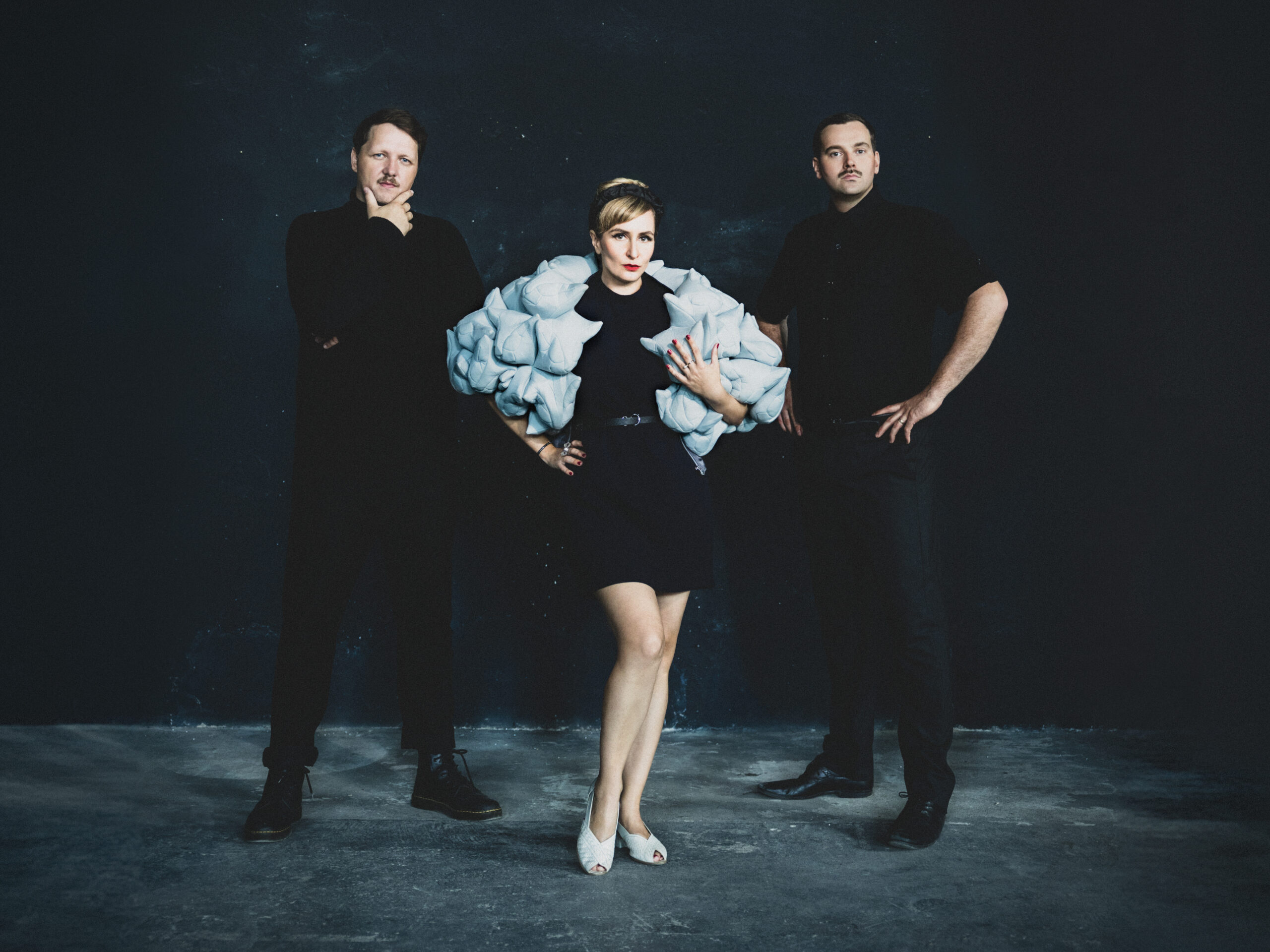
Members: Jakob Häglsperger, Dina Pascal Brudi, Maximilian Brudi
Interviewees: Jakob Häglsperger, Maximilian Brudi
Current release: Earlier this year, Dina Summer released their new full-length album, Girls Gang. Now, they follow up that LP with two sets of remixes by acts like Joyce Muniz, DJ Hell, The Populists, Moderna, Karassimeon, Boys’ Shorts, Karla Lynch, Stockholm Syndrome, JG Outsider, Nici Palm, IBÄ, The World Domination and Etane.
Recommendations:
Max: This is completely unrelated to our album writing process etc but I recently re-discovered the British nature-sculpture artist Andy Goldsworthy who (unknowingly) deeply influenced me as a child as my parents had loads of his books and posters at home. There are a few great documentaries about his work online.
I also am very interested in (80s + 90s) music & skateboard videos by artists such as Ty Evans, William Strobeck & Hype Williams, Joe Castrucci, Spike Jones, Anton Corbijn & Michel Gondry. That’s another huge rabbit hole if you wanna get into it!
If you enjoyed this Dina Summer interview and would like to stay up to date with the band and their music, visit their official homepage. They are also on Instagram, Soundcloud, bandcamp, tiktok, and Facebook.
What were your very first active steps with music technology and how would you rate the gains made through experience?
Jakob: At some point in the early 90s, my parents gave me a small cassette recorder with two decks. I used it to record melodies and beats with a small, trashy Casio keyboard by dubbing them from one cassette to the other. I did this until the first recordings became completely inaudible. That was my first contact with music production.
A few years later, I started experimenting with the first cheap music programs like Music Maker and eJay - and that's how I really got hooked. The whole thing became more and more of an obsession and developed further and further until at some point I was able to make a living from my music.
Generally you could say that the technical hurdles have become lower and lower and it is now much easier to make music and express yourself musically. Nowadays, it's enough to write a good prompt and artificial intelligence creates entire songs within seconds. I think that's perfectly legitimate, but it means that the “eye of the needle” of attention is getting narrower and narrower.
Musicians and artists have to specialize more, have a clear emotional identity and absolutely have to do the weird, independent shit that an AI might not be able to do. Because when the time comes that AI music is better received and listened to by the public, then it would actually be selfish to oppose it just because the music wasn't composed by me or other people.
Max: I started learning various instruments in my childhood and youth, but never really had the attention span and stamina to master them properly. The first time I really got interested in making music was through Music 2000 on the first Playstation around 2001 which was quite crappy. I then fiddled around FL Studios for a while and made some basic hip hop beats but also never really mastered it.
Around 2005 I was working for a local radio station in Munich where I had access to more professional software and got much better at audio editing while cutting interviews etc. But it took me until 2010 when I got a free version of Ableton that I got really into production. I watched countless tutorials and learned a lot from befriended producers like Rodion, Mijo, Theus Mago, Franz Matthews, Curses, Alejandro Paz, Skelesys and in the recent years Kalipo.
Making music, in the beginning, is often playful and about discovery. How do you retain a sense of playfulness and how do you still draw surprises from tools, approaches, and musical forms you may be very familiar with?
Max: For me personally it still is mostly about discovery and random things happening as I can only re-create sounds to a certain level (and was never really interested in that).
I’m not the kind of person who spends countless hours mastering a synth or software or reading a manual and our studio is full with random gear that we play around with and - if liked - then tweak until it fits.
From the earliest sketches to the finished piece, what does your current production workflow/process look like?
Jakob: I often have an idea for a song on the road or at home. Sometimes a vocal melody comes to me in the shower or while driving. Bit by bit, the song develops in my head - until I can hardly wait to finally go into the studio and record it.
It works best if I already have the vocals ready, or if someone else already has a clear vocal idea. Then I can look specifically at which harmonies fit and how much space is left between the vocals for the instrumental. I've adopted this “top-down” approach over the years because it's the most effective for me.
I try to finish the production as quickly as possible. Maybe I'm a bit impatient, but it's more important to me to capture the moment and the performance than to perfect everything technically. That's why I often record vocals with open, loud speakers, for example - simply because it feels better and the focus moves away from the technology and towards the emotion.
It's usually the first takes that work best. This often results in two or three complete songs in one session. The tracks that stand the test of time are then mixed and mastered and released. If an idea doesn't quite convince me later, I don't want to get lost in it - then I'd rather work on something new.
What, to you, are the respective benefits of solo work and collaborations and do you often feel lonely in the studio? Can machines act as collaborators to you?
Max: I don’t think there is even one track which I did solely on my own in the studio from the beginning to the end.
I love collaborating with others musically and learn from them or show them my tricks.
Rhythm, sound design, melody/harmony, something else – when do the different elements of a piece come into play for you?
Jakob: That has changed over the years. I used to follow the classic logic of many music programs: First the tempo, then the drums, the bass, the chords, then the melody - and maybe vocals at the very end, which are then often the most important element when listening. That somehow defines the idea of a song.
But I often didn't finish a track with this approach or got stuck somewhere. The pieces were too full, not consistent or got lost. Today, I've learned to work the other way around. I start with a clear idea: What song do I want to write? What sound aesthetic would be exciting? What mix would work well?
If the song is to contain vocals, it's best to start right away. What mood do the lyrics set? What rhythm and melody do they carry?
I can then work systematically from there - starting from the most important element and working downwards - without losing focus.
In relation to sound, one often reads words like “material”, “sculpting”, and “design”. How does your own way of working with sound look like? Do you find using presets lazy?
Jakob: The question is: what exactly do we define as a preset?
I hardly ever work with software synths where I simply click through the presets until I happen to find something suitable. That's too time-consuming and annoying for me - I usually already have a clear idea of what I want to realize, what sound I need, what's missing.
That's why I go straight for the instruments that are suitable for the sound I want. And yes, of course I have certain presets that serve as a starting point. From there, I shape the final sound. With analog synthesizers, I often get the sound I want faster if I simply build it myself instead of clicking through countless presets. In this sense, presets can be both an obstacle and a shortcut.
It's important for me not to interrupt my creative flow with technology. If I go into the studio motivated but have to spend an hour plugging cables together, all my creative energy is gone. That's why I pay attention to an ergonomic way of working that allows me to concentrate on the essentials - the euphoria of making music.
To some, the advent of AI and 'intelligent' composing tools offers potential for machines to contribute to the creative process. What are your hopes, fears, expectations and possible concrete plans in this regard?
Max: I’m very curious where this is gonna end. It’d be amazing to have smarter AI tools to help with time-consuming boring tasks and use data to improve certain aspects of the music.
We’ve tested loads of different tools for vocals, lyrics, melodies, mixing etc while creating music in the past few years, but never really saw any benefits as it’s all still very basic and unusable.
Late producer SOPHIE said: “You have the possibility with electronic music to generate any texture, and any sound. So why would any musician want to limit themselves?” What's your take on that and the relevance of limitations in your set-up and process?
Jakob: I've found that limitation can inspire and lead to the goal more quickly. For example, if I only have one synth and seven tracks, I try to get the most out of it and get to the point. Then it's much more about the idea itself - and that's exactly how my sessions are actually finished.
If, on the other hand, I always keep all my options open and don't set myself any limits, I often find it difficult to make decisions. I'm also not the type of person who records hours of synth sessions and then picks out what sounds good by chance afterwards. That takes too long for me.
The idea usually comes to me before I go into the studio. Then I try to realize it as quickly as possible. It's not necessarily about reinventing the wheel, but about creating an emotional moment that really touches me.
How and for what reasons has your music set-up evolved over the years and what are currently some of the most important pieces of gear and software for you?
Jakob: In the beginning, I worked exclusively “in the box” with a laptop and Logic because I could hardly afford any external equipment. Over the years, I've collected more and more outboard gear and now work almost exclusively with analog devices.
Of course, I still use a DAW - mostly Ableton Live, because I find it the fastest and most intuitive program. However, the central elements of my music are almost always created on real instruments - be it synthesizer, guitar or vocals. There are two reasons for this: Firstly, I get to the desired result much faster with a haptic instrument, and secondly, it inspires me when I stand in front of a beautiful and good-sounding instrument.
Speed is a decisive factor for me. I work very quickly and lose interest if I am slowed down technically. Each of my instruments therefore has certain sounds that I quickly fall back on.
I usually play the synth bass with my Moog Voyager. Pads and melodies are often created with the Prophet 6 or the Moog One. I like to make distorted, brute sequences with the Korg MS-20 or Roland 303. I also record a lot with my Fender Jazz Standard Bass. For vocals, I almost always use the Shure SM7B because I prefer dynamic microphones to condenser microphones.