Published
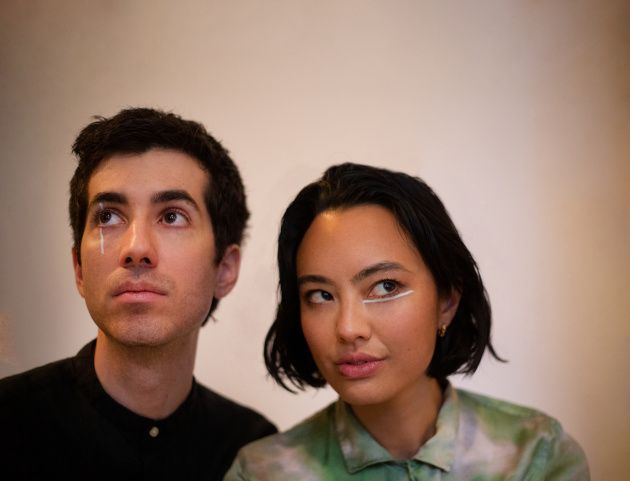
Name: Dream Brigade
Members: Lesley Mok, Phillip Golub
Nationality: American
Occupations: Pianist, improviser, composer (Phillip Golub), percussionist, interdisciplinary artist (Lesley Mok)
Recent release: Dream Brigade's self-titled debut album is out via Infrequent Seams.
Global Recommendations:
LM: Take electric scooters down the Hudson River during the sunset.
PG: Museum of Jurassic Technology in Los Angeles
If you enjoyed this Dream Brigade interview and would like to stay up to date with the duo and their music, visit them on bandcamp. Find out more about the performers by visiting their official homepages: Lesley Mok; Phillip Golub
For a deeper dive, read our earlier Phillip Golub interview.
Tell me about your instrument and/or tools, please. What made you seek it out, what makes it “your” instrument, and what are some of the most important aspects of playing it?
LM: I felt an immediate kinship with the drums when I started playing them. I connected to the physicality and the visceral nature of playing drums, and there was a certain power that I wanted to learn how to yield.
I’m interested in melodies, phrases, textures, and resonance, and experimenting with how I can translate ideas that are not conventionally thought of as language for a percussive instrument to find the spaces where the instrument can speak.
I’m also interested in the folkloric aspect of the drumset–the idea that each drum was played by a single person, and to recreate the feeling of a drum ensemble where each limb can have its own impulse. I think my favorite drummers all have that particular sensibility.
PG: I didn’t really seek out the piano by choice. My parents started me on lessons when I was five years old. It’s just something I’ve always done and been a central part of my identity since before I can remember much of anything else.
The piano is a special instrument for a lot of reasons. One is that even though it’s one of the most limited instruments timbrally speaking – you can basically make one sound on it louder or softer and that’s (mostly) it – it can play perhaps the most variety of music. It can be a whole orchestra. A lot of early piano music imitates other instruments: flutes, drums, cellos, guitars, voices, etc.
Something I’ve thought about a lot recently is how specific the envelope of notes on the piano are. Nothing else is quite like it: a percussive and energetic “ping” with a long decay. For me personally, how notes blend in the resonance and sustain of the modern piano is totally unique and special and can be very beautiful. The sustain pedal on the modern piano is a huge part of manipulating that resonance.
Sibelius once said “the primary difference between writing for orchestra and piano is that the orchestra has no pedal”, a quote which Feldman repeated in his program notes to his piece Coptic Light.
I like to play with these extremes that at first seem out of reach with the piano’s seemingly limited sound-production mechanism. Ran Blake is a pianist (and former teacher) who I feel takes advantage of these extremes on the piano like no one else before or since.
Here he is playing Smoke Gets in Your Eyes.
I think these things are part of why I love playing duo with Lesley: they are also a musician who is very attuned to timbre, resonance, and articulation and I think they hear some of the same things on the drumset that I hear on the piano.
How would you describe your own relationship with your instrument – is it an extension of your self/body, a partner and companion, a creative catalyst, a challenge to be overcome, something else entirely?
LM: I’m very influenced by the principles of martial arts and how that affects the way I apply force to the drums and how I get around the drumset.
In that sense, the drumset feels like an extension of my body–energy travels from my hips towards my shoulders and through the tip of my fingers to create a sound. I try to be fluid yet precise in my execution and I feel most in tune with my instrument when I can embody this concept.
My instrument is a companion, catalyst, and a challenge, too. It’s a challenge to feel connected on a metaphysical level. I don’t always feel like the ideas I have are best expressed on the drums, but that’s also sometimes when the best ideas come.
PG: It’s all of these things at different times. There are always challenges to overcome: making the human hand fit the shapes and arrangements of notes on the keyboard of the phrases you want to play.
But just as often as the physical limitations are a challenge to overcome, they can be a limitation to exploit. The hands sometimes know shapes on the keyboard that the ear or the mind could never have conceived. I think there is a strong tradition of exploiting this possibility in the jazz / improvised music / Afro-American tradition of piano playing.
The other thing, though, is that as pianists, we’re always playing different instruments. There is no abstract “piano” in my mind, nor is there one single piano that is above others in my mind. We play this piano on this day, then that piano on that day. And all pianos have different characters. Instead of trying to overcome the differences between the pianos and reach some ideal sound or expression, I find myself wanting to play to the character of the instrument I find in front of me.
In that sense, pianos can feel like ephemeral companions. But we are bound to a piano while we play it, and to actually play it, we have to learn about it and what it's been through. It’s a strange pact: a piano allows expression to pass through it only if we recognize its particularities.
Do you feel as though there are at least elements of composition and improvisation which are entirely unique to each? Based on your own work or maybe performances or recordings by other artists, do you feel that there are results which could only have happened through one of them?
LM: It’s been said that improvisation is real-time composition. I pretty much agree with that. The practices are often very different, even if the results are similar. I think the main difference has to do with process and what you are choosing to value in music.
To me, composition is an opportunity to spark a dynamic or a way of engagement within an ensemble that might not organically happen. But if composed material hinders one’s ability to synthesize, interpret, or act on instinct and intuition, it defeats the purpose of pre-conceiving an idea.
PG: At the core they’re the same thing but in practice they are different, and I think it’s important to understand those practical differences when deciding what to use where in one’s music.
I think sometimes too much is made of this question/topic. To me, it's self-evident that some things could only happen through composition and some things only through improvisation. Of course, there’s a big grey area where sometimes it’s not obvious, or an effect could be achieved multiple ways, but when we people take the extreme view that there is no difference and you can never tell, I think that’s a bit silly – it feels like asking me not to believe my own eyes and ears.
I think one big reason that composed music often sounds different from improvised music has less to do with the fundamental elements of the music and more to do with the tradition and reference points of the musicians playing. The way musicians produce sounds and convey ideas and emotions – even what emotions are generally found in a musical context – is all very tradition-specific.
Michael Finnissy’s (also a former teacher) performance of a couple of his Gershwin Transcriptions (a word he elects to use instead of “arrangement” to place his work in the tradition of piano transcriptions of other music by composers like Liszt and Busoni) is a really interesting case.
I find a lot of Michael’s music touches that tradition-sensitivity nerve, aiming for the alleged “sound of improvising”.
Another case-in-point example from Finnissy, is the Midsummer Morn movement of his English Country Tunes.
Even though I do feel that ultimately there are clear and distinct differences, even what I might call “use cases” for each in music, composition and improvisation cannot exist without each other. There is intuition involved in both and structure involved in both.
Composition means literally “putting things together” – composing always has an element of following your intuition, relying on your muscle memory, discovering what you didn’t yet know you could write, all things we might associate with improvisation.
Meanwhile, there’s no such thing as pure, “free” improvisation. You’re always limited by what you know and what you’ve heard and what you’ve played. The improviser you become is a life-long process of composing yourself.
When you're improvising, does it actually feel like you're inventing something on the spot – or are you inventively re-arranging patterns from preparations, practise or previous performances? What balance is there between forgetting and remembering in your work?
LM: I don’t think it’s entirely possible to “invent” something on the spot. There are ways we practice executing an idea–on a musical, spiritual, and physical level, so to me, the idea of acting on instinct is one that still draws from our memory and sensibilities that we craft and hone over years and years.
PG: For me it’s much more about remembering – using what you know, what you’ve done, what you’ve prepared and practiced – than about pure invention on the spot. There is no music without other music and improvising is the same.
But there are different parts of yourself that can know something. The ear can imagine a phrase or a pitch, the hands can feel something on the keyboard, the body can feel a gesture or a rhythm, the mind can wish for something to happen in the music, the experience of playing in a certain idiom or with a certain person can lead to a certain awareness.
These different parts of the self then need to be aware of each other and make a decision about what to do. Like anything, you get better at that decision-making the more you do it.
Taking your recent projects, releases, and performances as examples, what, would you say, are the key ideas behind your approach to improvisation?
LM: I resonate with music that is emotionally complex–music that can be joyful, chaotic, uncomfortable, mysterious, and unpleasant even.
I try to find balance within these emotions and strive to expand or widen the emotional “scope” of whatever situation I’m in. I think I’m attracted to dissonance and simultaneity for this reason.
PG: I always ask myself “Why improvisation?” And at the core, I think we’re all after roughly the same thing by incorporating improvisation in our music: something more personal can be captured and expressed when important elements (or all of the elements) of a musical performance are not predetermined. Why that is, is actually not totally obvious to me, but I know it from experience and observation to be true.
I also ask myself “Why composition?”, for what it’s worth. Although they may boil down to the same core elements and processes, we do choose to use them at different times in our music because each can give you something that the other cannot.
In your best improvisations, do you feel a strong sense of personal presence or do you (or your ego) “disappear”?
LM: I’m often thinking when I play so I would say I feel a strong sense of personal presence. I think I like for the music to feel like there’s a sense of egolessness but that often requires a fair amount of ego in my experience.
PG: I find myself attracted to the improvisers that give you the sense that they are “undressing” on stage or in front of the microphone, that we hear who they are and peek into their soul.
On the other hand, some improvisers display profound mastery of their instruments or their ability to interact with each other.
Stewart Copeland said: “Listening is where the cool stuff comes from. And that listening thing, magically, turns all of your chops into gold.” What do you listen for?
LM & PG: Personality and authenticity.
There can be surprising moments during improvisations – from one of the performers not playing a single note to another shaking up a quiet section with an outburst of noise. Can you tell me about such situations from your own performances and how they impacted the performance?
LM: I think the feeling of surprise is about honoring your own sense of expectation and taking delight in those moments that defy your expectations. What makes this duo particularly fun is that we share many reference points and often hear a moment in similar ways, so it feels quite effortless to make surprising decisions.
The moments that surprise me the most are ones that are constructed in reference to a larger form where a decision that might expand on an idea that was played 40 minutes ago or re-contextualize the emotional arc of a section that might come afterwards.
I feel when playing with Phillip that he has this sensitivity and hyper-awareness of form that can make an improvisation feel quite complex and surprising.
PG: Surprise in improvisation can be one of the most wonderful things, but it cannot be done cheaply or easily. I believe it takes great care, courage, and trust to play something actually surprising. Sometimes, it can be about committing to an idea and taking it further than you thought was possible.
When listening to improvised music, I am most surprised when I hear an ensemble make formal decisions collectively. It seems almost like it shouldn’t be possible, and yet great improvisers do it all the time. For example, knowing how long to do something, when to move on, whether change should be gradual or more abrupt – essentially, formal compositional decisions – can be hard to get right.
One of the great joys of playing with Lesley is that we can improvise in a compositional way, with an awareness of what we played five minutes ago and what we could play three minutes later from now. The tiniest elements can grow in importance over time and become central structural elements.