Published
Name: Duo Falak
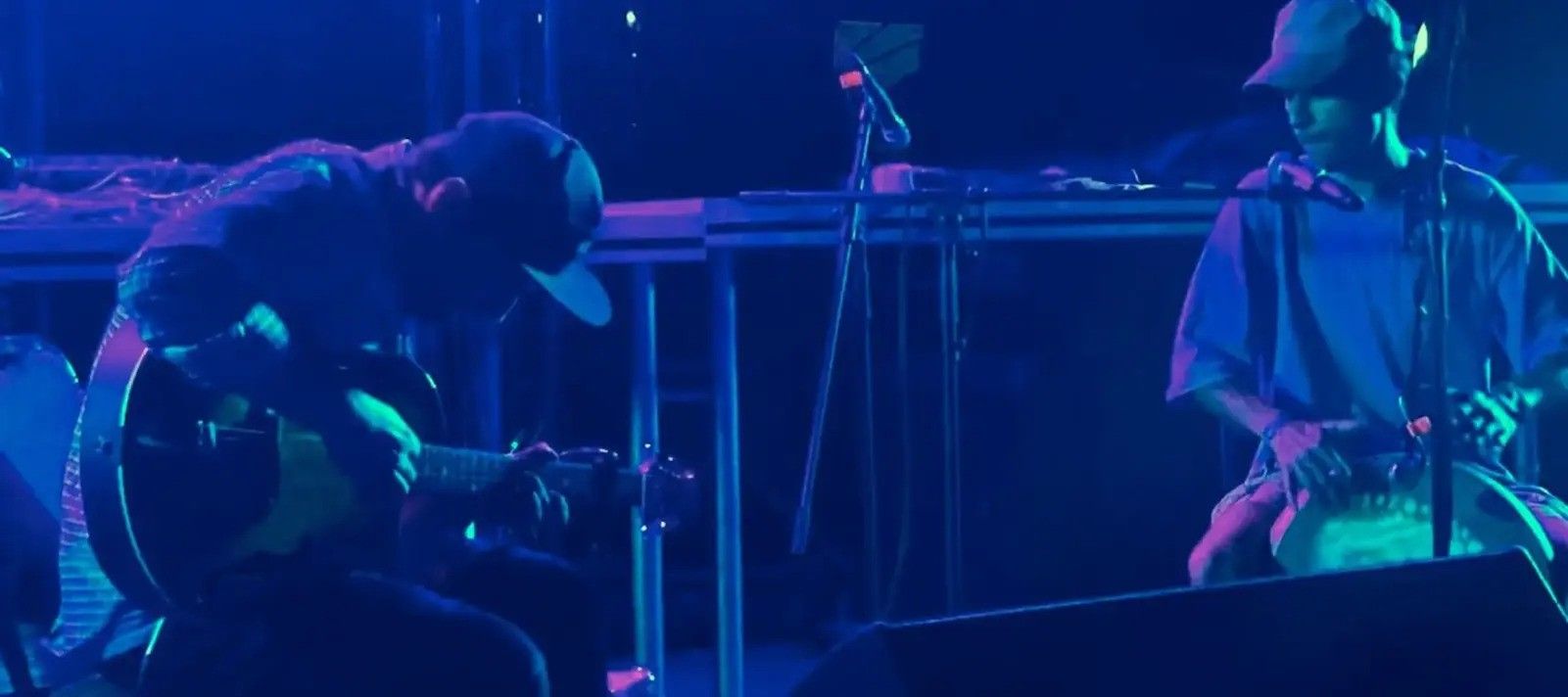
Members: Denis Sorokin (guitar), Shohin Qurbon (percussion)
Nationality: Russian (Denis Sorokin), Tajik (Shohin Qurbon)
Current release: Duo Falak's new album Tira-Tira is out via ТОПОТ.
If you enjoyed this Duo Falak interview and would like to know more about the duo and their music, visit Denis Sorokin on tumblr, and Shohin Qurbon on Instagram.
Do you think that some of your earliest musical experiences planted a seed for your interest in improvisation?
Denis: Yes, of course. Since I started to play avantgarde music like Brouwer on classical guitar many years ago.
But maybe the first inspiration happened when I was on a classical guitar concert where was performed piece of Stepan Rak in which guitarist Mikhail Goldort played with a spoon. I was very impressed by it.
Shohin: Since I found and realized the semi-rhythms and the unpredictable pulsation in music while improvising.
When did you first consciously start getting interested in musical improvisation? Which artists, teachers, albums or performances involving prominent use of improvisation captured your imagination in the beginning?
Denis: It was in 2000, I bought the double CD Radiance by Keith Jarrett on top of which I played solo improvisations. Since then I started to listen more and more to this kind of music.
Shohin: When we founded our first rock-band in Dushanbe where my friend David Yusupov showed me that pulsation and “narratives” on doing this every time as the music-law.
Then my personal observations and collaborations in art and music in the jam-sessions, etc.
Tell me about your instrument and/or tools, please. What made you seek it out, what makes it “your” instrument, and what are some of the most important aspects of playing it?
Denis: I played mostly on guitar because I have been educated as a classical and jazz guitarist. But I also use trumpet and live electronics like no-input pedals effects.
I don't know what I try to seek. Sometimes I think - "yeah! I found it!" But later I realize that it was just a step. Also I try to reduce my setup - use only pick-ups instead of the guitar, a mouthpiece instead of the trumpet. I even use pitch pipes that are usually used for tunings and tuning forks. I like simple things.
Shohin: My “absolute” instrument is the Doyra, frame-drum. It can produce special vibrations and overtones.
How would you describe your own relationship with your instrument – is it an extension of your self/body, a partner and companion, a creative catalyst, a challenge to be overcome, something else entirely?
Denis: I did not think about it so deeply. I play if I can play and if I like the sound of the instrument. An instrument is just an instrument, I think musicians can play on anything, or even not play on anything. The main point are your ideas and being open-minded I think.
Shohin: Definitely I reproduce what moves me inside me via the Doyra.
Derek Bailey defined improvising as the search for material which is endlessly transformable. What kind of materials have turned to be particularly transformable and stimulating for you?
Denis: My thoughts and ideas. But material is very important for me. I started to work always from material I have, thinking about what I can do with it. Any material is fit to work.
Shohin: Repetitiveness of patterns. i.e. rhythm, chords; one “harmony” like from the Indian sitar and the album Africa by John Coltrane.
Do you feel as though there are at least elements of composition and improvisation which are entirely unique to each? Based on your own work or maybe performances or recordings by other artists, do you feel that there are results which could only have happened through one of them?
Denis: Yes, absolutely! improvisation as act is always a result of your own experience, knowledges, tastes and culture.
When you're improvising, does it actually feel like you're inventing something on the spot – or are you inventively re-arranging patterns from preparations, practise or previous performances? What balance is there between forgetting and remembering in your work?
Denis: It depends of many factors. Each performance takes place in a different situation. I’m happy when my set sounds unexpected. But of course that does not happen as often as I'd wish.
Shohin: I prefer to always remain a pupil. The iterations are so spontaneous even if I rehearse and even if I’m trying to remember. Between forgetting and remembering there is nothingness.
Are you acting out parts of your personality in your improvisations which you couldn't or wouldn't through other musical approaches? If so, which are these? What, would you say, are the key ideas behind your approach to improvisation?
Denis: I think improvisation is just one part of my musical activity, and it's not like an outside thing when I can be really "free." It's just what I can make right now - that's why I love improvisation.
Shohin: For the vibes of dancing I mostly use the electronic music compositions I made in the “program”; for the vibes of nothingness - I mean the feeling of emptiness – I use acoustic instruments.
The concept of "remembering” is particularly relevant in my electronic music especially in live-performances. With this music, I can remember what I will dobe cause I do not spend my physical energy on performing - which is important for remembering the next actions.
In contrast, in acoustic music, what comes next must be be forgotten as the law of free will.
In terms of your personal expression and the experience of performance, how does playing solo compare to group improvisations?
Denis: It’s the same, maybe because I play with good musicians and they understand what I play or what I’m going to play next, or what we can play next, it's a strong feeling of closeness. But I prefer to play improv with someone else because I can find some new ways in playing faster then alone.
Shohin: If people fit, it can be a group act. If they don't, it should stay as a solo of one player without anyone else. If …
In your best improvisations, do you feel a strong sense of personal presence or do you (or your ego) “disappear”?
Denis: I don’t know what ego is. Me is me always when I play. Maybe a good performance depends on control, but control of what? I don’t know. There are many aspects of control and the balance between them.
Shohin: Generally I am the groove so I can feel presence of myself. Disappearing of me is something WOW-WOW-WOW. You can find many disappearings in the latest album we recorded as Duo Falak, when the rhythms occasionally turned to chaos. But you need to listen carefully to hear them.
In a live situation, decisions between creatives often work without words. From your experience and current projects, what does this process feel like and how does it work?
Denis: I don’t know. It's magic.
Shohin: We sat down and became acquainted to our surroundings. Then we produced the first sound, then started to look in each other's eyes. After the entire hall was flooded with music, we started to listen to the overtones. Yes, it’s magic.
Stewart Copeland said: “Listening is where the cool stuff comes from. And that listening thing, magically, turns all of your chops into gold.” What do you listen for?
Denis: I listen to the world and myself.
Shohin: Sometimes I start to listen to my quiet singing when playing the drums. It gives me the field for the “beat”.
There can be surprising moments during improvisations – from one of the performers not playing a single note to another shaking up a quiet section with an outburst of noise. Have you been part of similar situations and how did they impact the performance from your point of view?
Denis: It's good situation, I like the hooks in improv sets.
I have always been fascinated by the many facets of improvisation but sometimes found it hard to follow them as a listener. Do you have some recommendations for “how to listen” in this regard?
Denis: I am not a particularly deep listener.
Shohin: Depends on your mood as it should be. Anyway, it is cool stuff when you can put on your ears something to reduce “noise” or make attempt to hear - it is vibrant to you.
In a way, improvisations remind us of the transitory nature of life. When an improvisation ends, is it really gone, just like a cup of coffee? Or does it live on in some form?
Denis: I don't mind that. Improv is about the here and now, so it does not matter what is next. In any case, everything you've heard and played stays in your experience. That's enough for me.
Shohin: If you're singing a semantic text, it can be remembered, if it’s without semantic singing, it can only barely be reproduced in the mind at a next similar “show”.