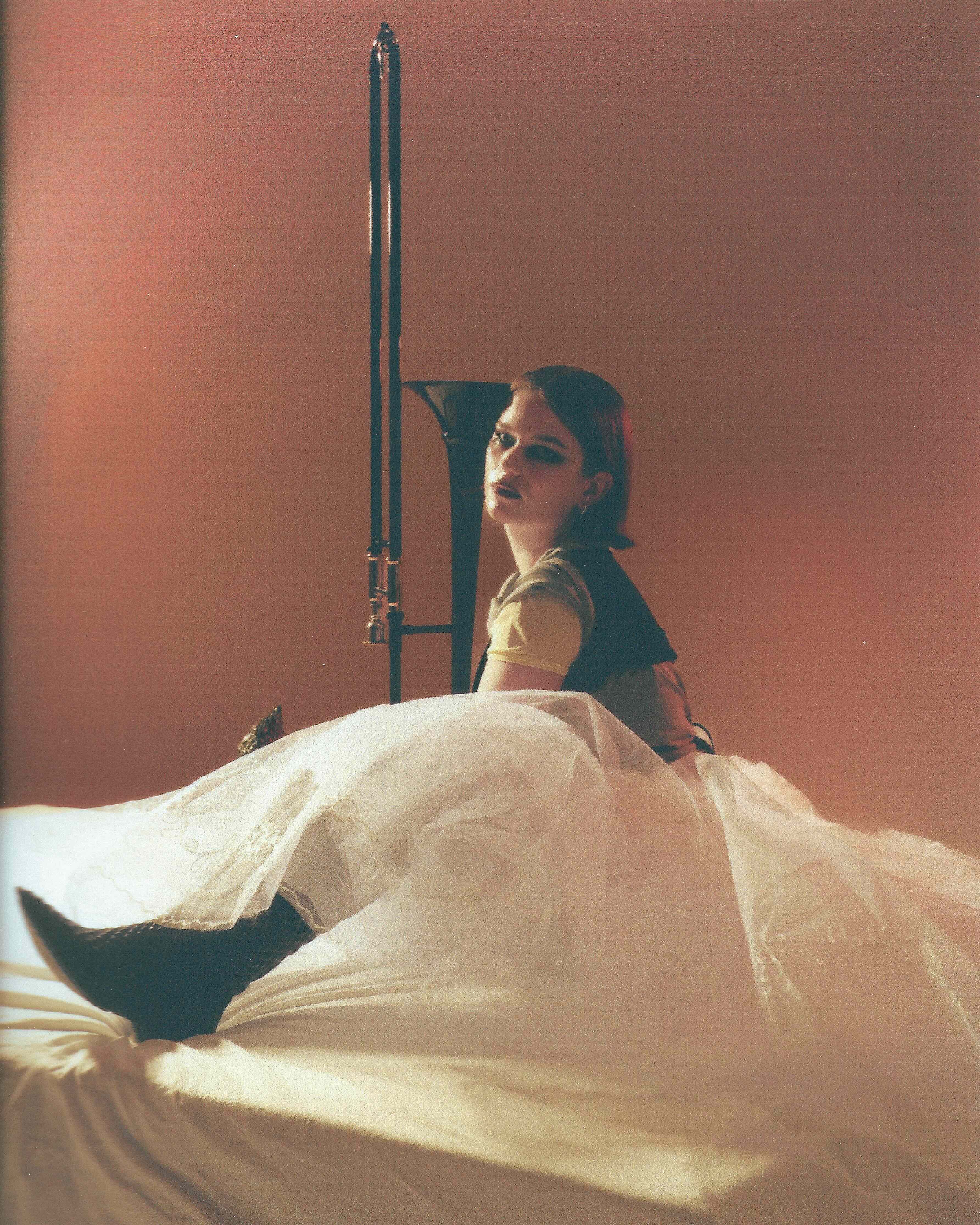
Published
Name: Ebba Åsman
Nationality: Swedish
Occupation: Trombonist, songwriter, producer
Current Release: Ebba Åsman's new single "Did I Go?" is out via Dorado. It is taken off her upcoming full-length album When You Know, slated for release March 21st 2025.
If you enjoyed this Ebba Åsman interview and would like to know more about her music, visit her on Instagram, and Facebook.
What were some of the musical experiences which planted a seed for your interest in jazz?
My first musical experience was when I was 7 years old and had just started playing trombone.
Jazz was something that was never played in my home, so I formed my own relationship to it when I heard Nils Landgren play for the first time. I was mesmerized by the freedom he was expressing through the music and knew that I wanted to express myself through improvisation too.
What does the term jazz mean today, would you say?
Jazz for me is freedom; a mindset. To be present in the moment and interact with people you trust.
For me, it is also something fluid that changes and evolves with time where you can take inspiration from history and the jazz heroes, but also allow yourself to follow your own path.
As of today, what kind of materials, ideas, and technologies are particularly stimulating for you?
My diary has always been an important part of my creative process, but my new album When You Know is the first time I’ve incorporated lyrics in my music. I feel closest to understanding myself and my thoughts when I get to look at it and try to sort out what I’m feeling.
My pedalboard is also an important tool for me when I’m creating on and off stage. Nice effects really help me tap into a place where I can create from emotion and presence rather than routine and technicality.
Where do most of your inspirations to create come from – rather from internal impulses or external ones? Which current social / political / ecological or other developments make you feel like you need to respond as an artist?
For me it’s mostly internal. I would say that I’m a little bit of my own bubble whenever I’m writing, and for me it’s like a necessity to cope with life. It’s like therapy for me.
However, I also get inspired by people that surround me, people that are unapologetic about how they live their life. Especially if it stands out from how society wants us to live. It could be a conversation, an energy or just being in nature.
I feel most myself and alive when I play and create, there is no facade. I hope people that see and listen to me also feel a sense of safety to be themselves. As a queer person, that is very important for me.
Music has become a lot more global, and incorporating elements from other parts of the world or the musical spectrum is commonplace. Do you still think there are city scenes with a distinct, unique sound? How does your local scene influence your work?
I think it’s truly amazing how we can get access to so much music nowadays, and how fast music can travel all over the world.
It also brings hope, finding music that resembles your own music in other places of the world. Even though it’s quite narrow of a genre you can bond with people you never would’ve met otherwise.
What role do electronic tools and instruments play for your creative process?
For me it’s very important. I immediately get so much more feeling and presence if I have effects both on my trombone and my voice. I feel like I express myself on a whole new level, because I enjoy the sound I’m presenting.
If I play a gig with no effects after a bad soundcheck, my head is usually in another headspace.
Thanks to technological advances, collaboration has become a lot easier. What have been some of the most fruitful collaborations for you recently and what approaches to and modes of collaboration currently seem best to you?
On my upcoming album, When You Know, I’ve collaborated with a Berlin based producer named Lucy Liebe. It’s been such a great experience because she immediately understood me from the get go, so the process has been very smooth.
Our references have been from the same point of view and we have similar musical backgrounds. Starting with jazz and later embracing other genres in our careers. So, it’s just been her and I creating this album, and I’m looking forward to releasing it on March 21st!
Jazz has always had an interesting relationship between honouring its roots and exploring the unknown. What does the balance between these two poles look like in your music?
For many years, my curiosity was in the history of jazz. It’s something I’ve practiced and studied deeply.
However, when I studied at the jazz conservatory in Rotterdam, I felt that the mechanical and theoretical side of jazz held me back from expressing myself in the music. I didn’t like how they described jazz and improvisation in categories of right and wrong. I felt like I wanted to follow my ears and feel free in the music.
I still get so inspired by the jazz heroes, but I don’t think you need to try and sound like them in order to honour them.
How much potential for something “new” is there still in jazz? What could this “new” look like?
I think like in a lot of things in life, it’s important to know where it started, where it came from and how that effected the evolution of the genre.
But I also think it’s important to have fun with it. Trust your own ideas and give room for new ideas to enter.
For many artists, life-changing musical experiences take place live. How do you see that yourself?
For me, live music is when it all comes alive.
When you can expand the original idea into the core of the song, when you tweak phrases to emphasis what you feel, or extend parts to give room for all the emotions. When you have your band to back you up and an audience that listens, and you do it together.
I feel alive in those moments.
How, would you say are your live performances and your recording projects connected at the moment? How do they mutually influence and feed off each other?
On my upcoming album, the sound is quite produced if I compare it to my previous albums.
I love that we will have to take that into consideration when we play live. We will incorporate specific sounds and beats, but also let the produced sounds inspire the live part. Opening up the music and set it free but with more electronic tools.
Improvisation is obviously an essential element of jazz, but I would assume that just like composition, it is transforming. How do you feel has the role of improvisation changed in jazz?
The role of improvisation has changed quite a lot for me personally.
On my new album, I’m kind of improvising through the whole thing. Behind vocals, in between vocals, together with vocals. It has definitely taken another role for me lately; it doesn’t have to be a solo part in the score. It can be in a flow to enhance the emotion of what I’m singing or to make the sound more interesting.
When I play live, its often a transforming element. I enjoy going on a journey!
What, would you say, are the key ideas behind your approach to improvisation?
I would say, to get as close as I can to the melodies in my head.
I’ve transcribed my voice a lot, to understand the connection to the trombone for example, so that hopefully I feel just as free singing when I’m playing.
Are there approaches, artists, festivals, labels, spaces or anyone/-thing else out there who you feel deserve a shout out for taking jazz into the future?
It’s always been a dream of mine to play with my own band at North Sea Jazz Festival, think they do a phenomenal job connecting with all that jazz is. Also, my record label Dorado, does great work with a varied group of artists.
The Montreux Festival intends to preserve its archive of recordings for future generations. Do you personally feels it's important that everything should remain available forever - or is there something to be said for letting beautiful moments pass and linger in the memories of those that experienced them?
I feel like live music is best experienced in the moment. But there is a lot to learn and get inspired by from live videos and recordings.
However, I think albums are there to enjoy forever.