Published
Name: Ebi Soda
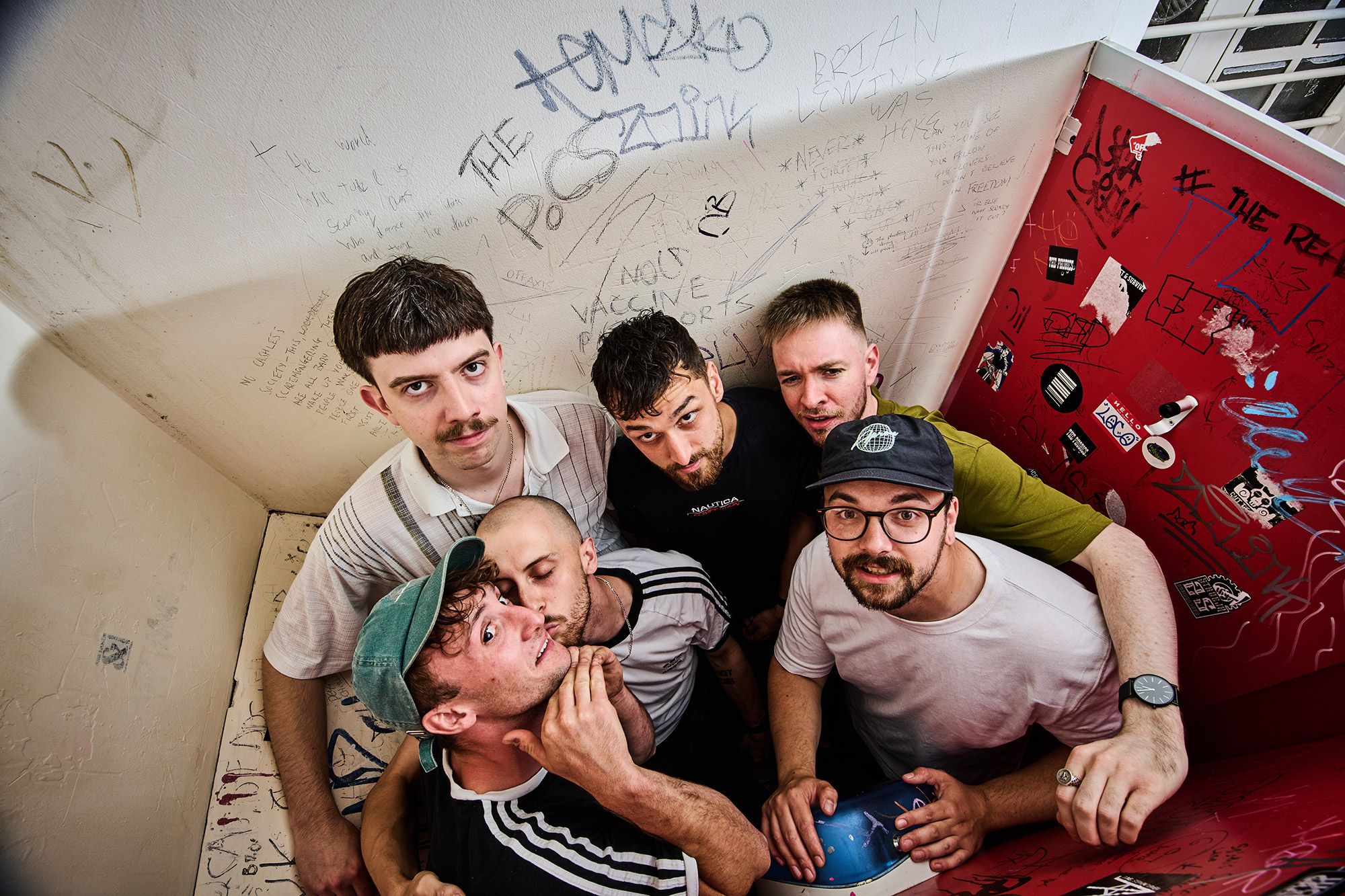
Members: Conor Knight, Hari-Lee Evans, Louis Jenkins, Sam Schlich-Davies, Will Heaton
Nationality: British
Current release: Ebi Soda's new album frank dean and andrew is out September 19th 2025 via Thru Thoughts.
Shoutouts: We Out Here Festival, Anatole Muster, Athletic Progression, Parkland, Joe Armon-Jones and Maxwell Owin, Miguel Atwood-Ferguson, Terrace Martin, Jazz Re:freshed.
[Read our Miguel Atwood-Ferguson interview]
If you enjoyed this Ebi Soda interview and would like to stay up to date with the band and their music and live dates, visit them on Instagram, Facebook, and bandcamp.
What were some of the musical experiences which planted a seed for your interest in jazz?
Most of us got our first look at jazz through hip-hop -oriented music that had jazz at it’s core.
Flying Lotus’ ‘Cosmogramma’ comes to mind, as well as Robert Glasper’s ‘Black Radio’ era was huge for innovation in jazz c. 2012, while doing the homework listening of Herbie’s ‘Headhunters’ and Miles’ ‘Bitches Brew’.
Following the aforementioned innovators’ work, we saw the 2014-2017 boom of jazz x rap intersections, with Kendrick’s TPAB and BadBadNotGood’s mixtapes culminating in ‘IV’, while we delved into slightly more off-piste improvised music with Can and Lounge Lizards.
Hearing what jazz could do (or be) from these records with their variety of approaches and sounds came at the right time for when we first recorded jams in a bedroom of a 3-bed flat in central Brighton in 2017.
Hearing that anything was possible, especially DIY (from BBNG), we just made jazz however we felt like making it in the moment, with our own tastes and interests.
[Read our BadBadNotGood's Leland Whitty interview]
What does the term jazz mean today, would you say?
Jazz is an approach to music-making, in any form. The likeness would be where rap music has the fastest “thought to word” transition, jazz has the fastest “thought to note” transition.
This especially specific ‘flow-state’ of thoughts and emotions has to be met with a certain intensity of style and harmony, these characteristics give us music that we’d call jazz as a genre. It’s why often jazz is on the search for the hardest beats and rhythms, and has it’s own distinctive harmony idiom
Jazz in it’s inception was about innovation of style, and to progress it has to carry on this tradition. It has to keep on melding with other genres or even conceive genres at the forefront, and avoid making its name with tropes.
As of today, what kind of materials, ideas, and technologies are particularly stimulating for you? + What role do electronic tools and instruments play for your creative process?
Just electronic sound as whole is what’s stimulating for us, but trying to balance its live-ness with that of playing as a band and conceiving ideas with the usual improvised flow has not ceased to yield new things and be interesting. There’s always a new sound that we can put with acoustic drums and horns, and there are also so many insane ways to push the acoustic instruments in production.
Lately in the studio we’ve been pushing the experimental sound of FM Synthesis with a Yamaha DX Reface. It’s digitally bright dimension contrasts well with our tape-delay based sound design, and it’s not heard in current jazz or fusion that often. It’s given us a new drive and gotten us closer to sounds that we like outside of jazz, such as in hyperpop or even video game music.
We have no evidence of this released right now, but the best demonstration of playing electronic sound live in our jazz band setup, would be how we’ve used 808 basses. From ‘wrap it up then’ (a joke on the Migos meme of 2017)
... to ‘Keisha Billip’ on Ugh, now up to 'bamboo’ from frank dean and andrew.
Where do most of your inspirations to create come from – rather from internal impulses or external ones? Which current social / political / ecological or other developments make you feel like you need to respond as an artist?
Our inspiration just comes from whatever we feel like playing. If we’re all naturally chaotic and absurdist, we are just letting that come out in our playing and sound choices.
At least for us, instrumental and electronic music without vocals is fundamentally abstract and esoteric, so we just let that be in all its ridiculousness and flaws and mysterious interpretations, just like how life is.
Tell me a bit about the sounds & creative directions, artists & communities, as well as the colleagues & creative hotspots of your current hometown, please. How do they influence your music?
4 out of 6 of us come from in/around Colchester, Essex. It’s a funny area, where a lot of musicians find themselves cutting their teeth on their own or in small communities in outlier towns or villages. It’s like letting musical freaks repress for years, and then when we all got out to go to the sixth form colleges we let loose.
This environment spawned a lot of musicians and projects in our immediate circle that have a certain flavour of rawness and ruggedness from DIY creation, which is where Ebi came from. Examples of projects from our circle besides Ebi include bands Ralph TV, A Bloke, singer/producer Bubba Janko, and rapper Subarudad.
A more well-known example of Colchestrian musician design would be Damon Albarn and Blur – a good benchmark for what Colchester can make of a musician, even if we don’t take direct inspiration from him.
Although the Demon Days album slaps.
Thanks to technological advances, collaboration has become a lot easier. What have been some of the most fruitful collaborations for you recently and what approaches to and modes of collaboration currently seem best to you?
We’ve done collaboration since we’ve started. On one level, technologically we’ve always overdubbed horns, which has naturally allowed to us to collaborate with many horn players over the years, starting with tenor sax player Ogg Angelkov Cummings on ‘Resent’, through our alto sax friends Jonny Poole (‘Duhrenger’) and Beth Hopkins (‘Ecchi’).
Our now full-time trumpet player Dan Gray who we first brought in to overdub for fun, giving us ‘Something to do in the Future’ and ‘Keisha Billip’, Deji Ijishakin gave us ‘Gated Community with a Public Pool’ and lately we’ve been especially enjoying working with tenor sax player James Akers of Levitation Orchestra on ‘milk in my console’, and long-time cello player friend Malachi Siner-Cheverst on ‘feely’.
We’ve done artist/vocalist collaboration also since we started, following in the BBNG/Kendrick/Glasper footsteps. Our first was ‘timewaste’ with our homies j harli and Subarudad.
We’ve gone from collabs in the same session / same day as the band recording, to recording a bunch of jams and then producing them in more traditional “artist + producer” sessions, and now we’re back to making collabs happen with the full band whenever we can.
If the natural magic of Ebi is what happens between the 6 people in a room in a few hours, the artist/vocalist will have the best time feeling the same magic.
Jazz has always had an interesting relationship between honouring its roots and exploring the unknown. What does the balance between these two poles look like in your music?
Apart from the background listening and inspiration we got in our beginning, we don’t go out of our way to “honour the roots”. The music needs to progress and feel exciting. What’s exciting about hearing what’s been done before, again?
We’ve naturally played funkier/soulful stuff in the early days from the stronger lean towards acoustic sounds, and it was what we mainly knew how to play in the beginning. But now we just want to get away from this to avoid sounding samey, as both ourselves, and other jazz, past and present.
We are trying to balance ourselves all the way to the unknown, of these two poles. Even if we’re looking at combining jazz with “known” and “non-jazz” sounds and styles that we like, how the combination will be done and sound in Ebi Soda is still “unknown”.
How much potential for something “new” is there still in jazz? What could this “new” look like?
So much new is still to be done. There are so many new genres that jazz hasn’t interacted with and vice versa. And there are so many different levels / gradations to the balance of genre-blending, and many permutations of jazz and non-jazz methodologies combining.
For example, there’s still scope for jazz to blend with drill and grime, and sound futuristic/forward-thinking, without falling back onto old-sounding jazz tropes. There’s jazz-rock, but there’s quite little fresh-sounding jazz-indie-rock that sounds really modern.
There’s also potential to hear/make hyperpop in a jazz context, inject jazz with the harmony+melody of emo music, and so on.
For many artists, life-changing musical experiences take place live. How do you see that yourself?
We’re actually a very studio-oriented band. The life-changing head-turners and stomach-churners happen in the studio.
It’s either right when we record we know something sick has happened, or when we go back to listen to a 3-hour session where we got lost in the sauce and we find a tune or jam that was amazing.
How, would you say are your live performances and your recording projects connected at the moment? How do they mutually influence and feed off each other?
Our live performances play very much like we are a jazz band, while our recorded music has been developing like crazy, especially electronically.
Our current venture is in developing our live setup to play our new ideas and sound, but in a way that still feels natural to us. Stay tuned and come to a show to follow some big developments here!
Improvisation is obviously an essential element of jazz, but I would assume that just like composition, it is transforming. How do you feel has the role of improvisation changed in jazz? + What, would you say, are the key ideas behind your approach to improvisation?
It hasn’t changed much. We can comment that improvisation is the composition now, but this isn’t new – Miles was doing this on Bitches Brew.
The amount of improvisation (and at what points in the compositional and recording process) is probably what differentiates jazz artists and bands today though. Some artists might have fully composed sections balanced with sections of improvisation (very much the Snarky Puppy model), while we improvise the fundamental composition of the tune in the recording.
There’s even full band improv vs overdub improv. In the Miles camp the whole band is improvising together. We generally record as a rhythm section and then overdub horns or other layers after this. The approaches to overdubbing can vary wildly. We might overdub straight after the rhythm section recording giving little time for pre-meditation, and limit ourselves to two or three takes. This is how we made our first two soundcloud drops ‘Mandala Profession’ and ‘Flebi Floda’, and we used this process through ‘Ugh’ as well.
To further on the “compositional” side, we make up everything we record and release first time. Extremely rarely do we sit down in the studio and say “hey let’s write something”. The improvisation makes everything.
However, for the improvisation to make actual tunes, I guess we do have an unspoken but subconscious method. We can feel the changes at every 8 or 16 or 32 bars, but this is a very fundamental music-making idea.
To say something about the role of improvised solos in jazz now though, it’s interesting seeing that we’re back to the trend of short solos, or even no solos. To go with the short spotify song trend, some jazz tunes about are fitting even under 2 minutes. We’re generally a big fan of this, and were favouring it in our early days.
The Montreux Festival intends to preserve its archive of recordings for future generations. Do you personally feels it's important that everything should remain available forever - or is there something to be said for letting beautiful moments pass and linger in the memories of those that experienced them?
We’re a big fan of recording everything - capture every moment of madness and nuance that happens.
At the end of the day, being able to look back on what we’ve forgotten when we’re older will be beautiful.