Published
Name: Ela Minus
Nationality: Columbian
Occupation: Producer, composer, songwriter, vocalist
Current release: Ela Minus's new album DIA is out via Domino.
If you enjoyed these thoughts by Ela Minus and would like to know more about her music, projects, and upcoming live dates, visit her official homepage. She is also on Instagram, and Soundcloud.
For a deeper dive, read our earlier Ela Minus interview.
Quite often, an album is not just a representation of the time it was written in, but also a response to the previous one. If you take DIA and acts of rebellion, how do you see that for these two releases?
I think that is more for the listener to say. I would be curious to know, for example what you see, as I have very little perspective on it, for obvious reasons.
But I would say I believe if you change the creative process, you inevitably change the result. And the process of making my two records were literally the opposite from each other.
When you set out to record the music, what was your idea or feeling about the kind of sound palette you wanted for this release?
I had none. I had no idea.
I never knew what I'm going to make until I made it.
So what was the point of departure this time?
I had been thinking about it for a long time, and making a lot of music of which none made it to the album.
The actual point of departure was when I made “ABRIR MONTE.” That is when I felt like I found the sound I was looking for, the feeling I was looking for, and it opened a door.
Quite a bit of the material for DIA was written while you were travelling. Tell me about the way those spaces, places, countries and experiences left their trace on the music, please.
The moving around, the not knowing where I was going to go next, the constant deadline of time (finite amount of studio days, finite amount of hotel nights paid) … everything felt finite and at the same time infinite as I guess I could have just kept going to new places and new studios.
There are some songs that you clearly hear the places on, like – again - on “ABRIR MONTE” which I made on a mountain in Mexico with nothing around me except animals and nature.
Or on “ONWARDS” which I made in the desert in California in between playing Coachella weekends - stress anxiety, the feeling of being measured.
“COMBAT” was partly made in Colombia, it makes me feel solid and my resilience comes out.
I want to make anthems for the place I am from for the people that share my background. I connect to something different when I'm there.
But in the end I think what came out the most with the travelling and working from that “place” was a deeper understanding of myself, a deeper dive into my inner workings.
When everything is a variable and constantly changing, the only constant becomes very evidently yourself, your body, soul and mind. Patterns start to emerge more clearly, reactions to stressful situations, the way I feel with constant prolonged solitude which also becomes more visible when you are far away in unknown places where you know no one …
So I think even though, of course, the physical places made it into the music, what - I feel - made it more into the music is what those places brought out in me.
What were some of the challenges and benefits of producing on the move?
Benefits; finite time made me work faster and not overthink so much or waste time obsessing over details. I worked with a lot more synths and gear that I would not have access to if I was working from my own studio.
Challenges; finite time at places, time spent on the move, stressful.
I don't know if it's good or bad: the outside world inevitably gets in.
In general, the songs on DIA seem to have undergone many stages and transformations, as you mentioned on your blog for “UPWARDS” and “ONWARDS.” What does this process of shaping and re-shaping look like in practise?
Regarding making things, making a million versions, edits and variations is all part of making records. That is just how it goes.
You are shaping something out of nothing and it takes time and you have to try so many different things and follow them through to know if they work or not, if they fit the bigger picture or not, if they stand the test of time (even if only the time in which you are working on the entire record).
During the time that DIA was written, did you also play live?
I actually didn't play at all. I cancelled all live shows and I had to focus fully on making the record. I can't do both things at the same time.
I did play a lot before I started making DIA and quickly became very stressed and anxious because I realized - I learned that about myself - that I was not going to be able to make the record while playing live. I had to make a very hard decision and decided to stop all live shows till the record was done.
You realised acts of rebellion with a very small set up. What was that like this time?
I was working from different studios and random places, so I only travelled with my laptop and one or two small synths, then used the gear that I had at my disposal when I was at studios, and edited and re-arranged a lot on my laptop.
Very different from acts of rebellion.
To me, one of the stand-out sonic elements of DIA is the creative use of extreme distortion / compression, for example on “ABRIR MONTE” or “IDK.” When and how did that enter into the production?
It started slowly. I started gravitating towards it and eventually realized it was an element used throughout the entire record.
I love distortion in all its shapes and it is something that I am very interested in to explore in sound. 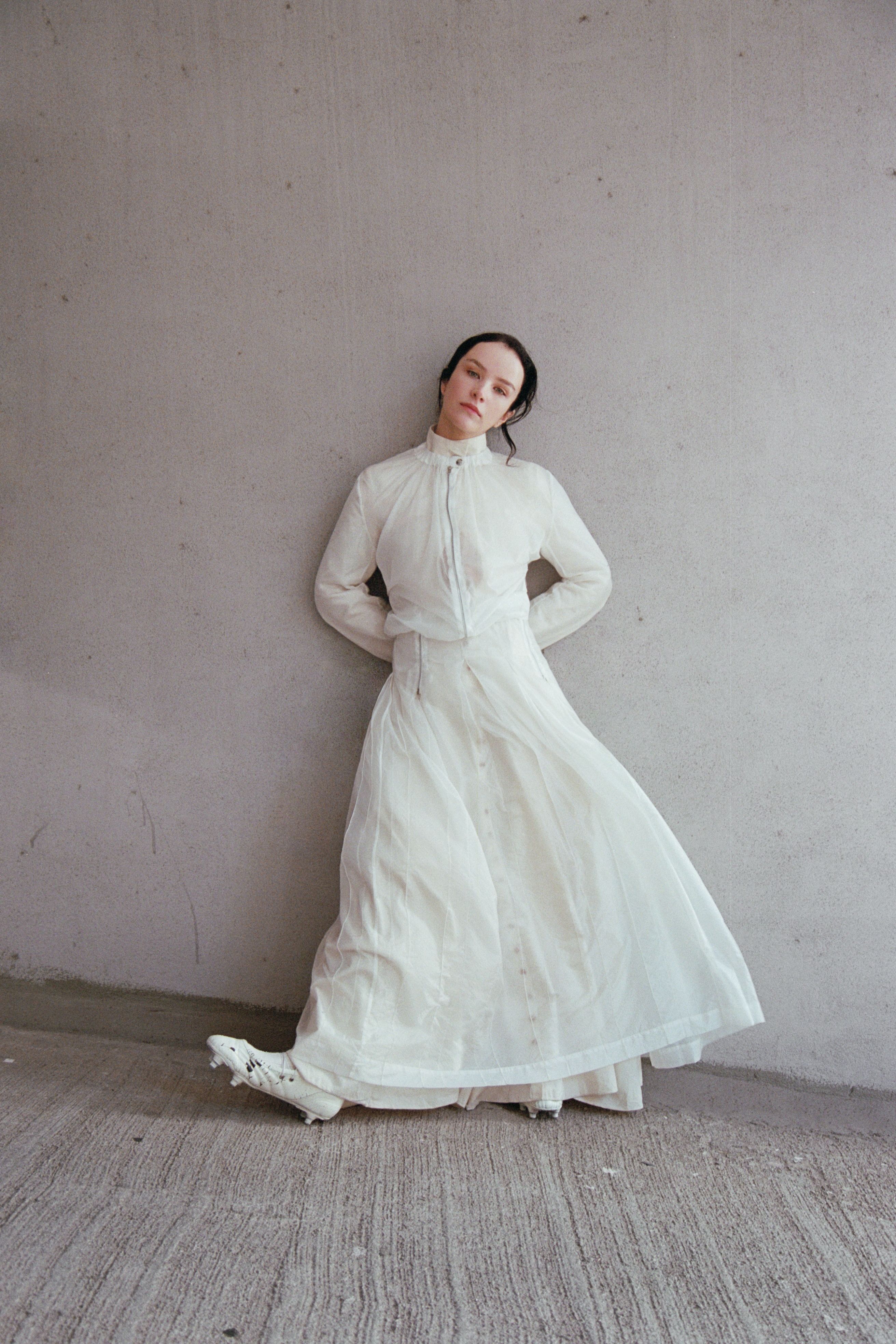
Ela Minus Interview Image by Alvaro Arisó
There are seemingly infinite parameters to change, influence and shape the sonic results. From your experience working on DIA, what actually makes a piece better and what sets a “finished” version apart from one destined to linger in the archives?
Taste and instinct. You just know, and sometimes you don't.
We make mistakes as well. You’ll listen to something that you archived years ago and you realise its amazing and you just didn't see it at the time. And that's ok, because it still exists, which is why its important to archive things.
But yes I guess in my case I try to just go with my gut.
On your blog you said: “Titles are hard to find but so important.” So what made you opt for DIA as the title of this album?
This album felt like walking into a room, and walking into myself and turning a light on, then observing.
The way I define the word is; finite period of time defined by the presence of light. And I think that is what this record is.
Creativity can reach many different corners of our lives. Do you feel as though writing song lyrics or poetry is inherently different from something like making a great cup of coffee? What do you express through music that you couldn't or wouldn't in more 'mundane' tasks?
Great question. I think the outcome is different but the intention can be the same, and I find that devastatingly beautiful and inspiring.
I hope to be an artist of whom you can say that you see me in everything I make. From a cup of coffee, to how I treat others, to the music, to the coffee, to the things I write. That they are all expressions of different parts of myself but you can see or feel me in all of them.