Published
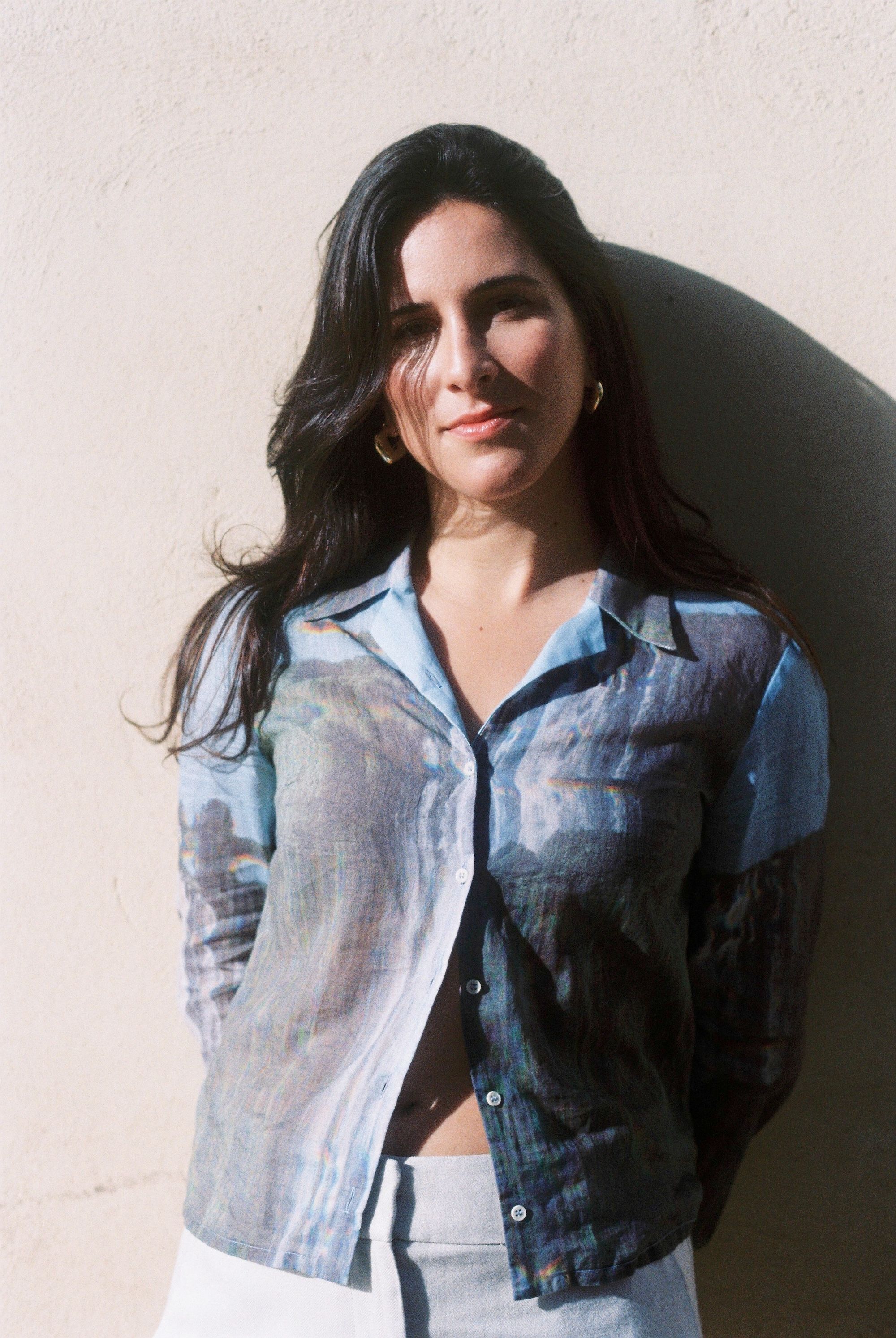
Name: Elana Sasson
Nationality: American
Occupation: Vocalist, composer, bandleader
Current release: Elana Sasson's new album In Between is out via PKMusik.
Recommendation for Valencia, Spain: I recommend visiting the CCCC – Centro del Carmen de Cultura Contemporánea. It’s a cultural center in a former 13th-century convent with a rotating schedule of exhibitions and events. There’s a beautiful inner patio with red walls and lots of greenery. It’s a great place to go on a slow day and wander or sit.
Things I am passionate about but rarely get to talk about: I did my undergraduate degree in Design Media Arts at UCLA, and back then I was really passionate about bookmaking, installation, and creative coding. I have a side of me that loves visual and tactile work—sewing, cooking, designing. I still do that kind of work and try to bring it into my music whenever I can.
If you enjoyed this Elana Sasson interview and would like to know more about her music, visit her official homepage. She is also on Instagram, bandcamp, and Facebook.
When it comes to experiencing strong emotions as a listener, which albums, performances, and artists come to mind?
The last concert that evoked something in me was when I saw Ganavya perform in London.
She holds so much emotion, intention, and humility in her voice. We were in a small space, and she created community in the room by inviting everyone to sing.
There are two live performance videos from the Morgenland Festival that I absolutely love: one is Alim Qasimov & Michel Godard – "A Trace of Grace," which stirs something in me every time I watch it.
The other is Kayhan Kalhor & Toumani Diabaté – "The Sky is the Same Color Everywhere."
Both artists have studio recordings of these pieces, but I always come back to the live videos—they carry a kind of raw intimacy that moves me deeply.
Oded Tzur’s album Isabela, and particularly the song “The Lion Turtle,” pulls me in every time I hear it.
It has one of the most beautiful melodies I’ve heard, and the arrangement with his quartet is stunning. This inspired the way we approached the arrangement of “Bahari Digar” on the album.
There can be many different kinds of emotions in art – soft, harsh, healing, aggressive, uplifting and many more. Which do you tend to feel drawn to most?
I’m most drawn to longing and introspection. Although I’m generally an upbeat person, I resonate with melancholy, (it could be something passed down ancestrally) and singing gives it a form and an outlet.
I do love uplifting music as well, and I’m trying to incorporate more meditative, hopeful, and grooving pieces into my repertoire so people don’t leave my shows crying.
The piece “Hêvî” on the album, co-composed with Santiago Bertel, holds a lot of emotional layers — hope, struggle, forward motion.
In as far as it plays a role for the music you like listening to or making, what role do words and the voice of a vocalist play for the transmission of emotions?
The voice is very transparent – it reflects everything happening in your body and mind in the moment of expression. If I’m sad, you hear it; if I’m nervous, confident, happy – it all comes through. So authenticity is really important to me, both as a creator and a listener.
The voices I love aren’t necessarily the most trained, but the ones that reach in and pull something true out.
When it comes to composing / songwriting, are you finding that spontaneity and just a few takes tend to capture emotions best? Or does honing a piece bring you closer to that goal?
I usually start with one strong idea: a melodic phrase, a harmonic passage, a poem, or a mode I’m drawn to. That initial spark carries the emotional weight, and from there I shape and refine it.
Most of my pieces go through several revisions. On this album, I often brought ideas to Santi (Santiago Bertel), and together we developed the direction.
I have hundreds of voice notes on my phone from melodies that came to me while walking. The question is always whether the idea holds up enough to revisit and shape later.
The track “In Between” started when I showed Santi an early sketch. He played something beautiful in the demo, and that ended up becoming the main melodic section. Much of the rest came together in the studio. We had saved it for that moment of exploration.
Even now, the piece is evolving—we’re adapting it for quartet and it’s taking on a new life. Often, it’s those spontaneous moments that carry the most emotional weight, even if they can’t always be recreated.
How much of the emotions of your own music, would you say, are already part of the composition, how much is the result of the recording process?
It’s in both.
The performance and interpretation are what ultimately bring out the emotion—but the lyrics, melody, and harmony already carry emotional weight. When everyone is truly connected in the moment of recording, the feeling comes across more strongly.
“Laye Laye” is a piece that’s very dear to me. Every time we perform it, it sounds a little different, but the emotional shape of the piece stays consistent.
When the Rhodes piano enters, it creates this dreamy, delicate moment that affects me every time.
For your current release, what kind of emotions were you looking to get across?
This release has a lot to do with longing.
It’s about finding comfort in the in-betweenness, about connection, and about feeling settled even with these unresolved questions around belonging and identity.
How do you capture the emotions you want to get across in the studio?
There needs to be trust in the room for the emotions to come through. With my band, we have a strong musical and personal connection, and we know each other well. That creates musical chemistry, which deepens over time the more we play.
For example, “Ay Ke Buena” was the first piece we worked on together as a band. It is beautiful because everyone contributed something of themselves to the arrangement. It is designed so that we are constantly in conversation, reacting to each other’s dynamics.
By the time we recorded it for the album, playing it had become so second nature that we were really able to lean into it and flow naturally, and I think that comes across in the recording.
In terms of emotions, what changes when you're performing live on stage, with an audience present, compared to the recording stage?
For me, performing is the apex of expression. There’s this feeling of ephemerality, and the intimacy of sharing a moment with the people on stage and in the audience.
In the studio, a kind of self-awareness and perfectionism creeps in. It can be hard to offer something fully in the moment when you know you can always do another take — and that the recording will last forever.
One nice moment from the album was “Prelude to Nerges.”
It was totally improvised—just voice and ney—and we didn’t initially plan to record it that way.
It felt closest to a live setting, because we were just trying something out and seeing what came, and decided to press record.
How does the presence of the audience and your interaction with it change the emotional impact of the music and how would you describe the creative interaction with listeners during a gig?
I love interacting with audiences and try to build a sense of trust early on, especially because this music is vulnerable and emotionally exposed.
Often I’m performing for people who don’t understand the lyrics, so I’ll explain the stories behind each piece, share a bit of the message, and use humor to make everyone feel at ease.
Once that’s there, it feels like we’re sharing this time together — I’m making an offering, and the audience is receiving it openly.
What kind of feedback have you received from listeners or concert audiences in terms of the experience that your music and/or performances have had on them?
People are often touched by the emotional content of the music and the stories behind it. There’s a kind of universality in this material — it’s built on melodies that have existed for hundreds of years, and also draws from many other genres.
I really believe that a strong melody can transmit a message, even when the lyrics aren’t explicitly understood.
Would you say that you prefer to stay in control to be able to shape the emotions or do you surrender to them and allow the music to take over? Who, ultimately has control during a live performance?
I don’t think anyone really has control in a live performance. The most powerful moments happen when you surrender, trust, and listen.
Recently, I was performing in Madrid with my band when there was a national blackout. Santi kept playing in the dark, soloing for several minutes, and the rest of the band followed. It was totally unplanned, but it felt completely natural.
I usually know what I want to express emotionally in a piece, but often the music itself takes me there.
The emotions that music is able to generate can be extremely powerful. How, do you think, can artists make use of this power to bring about change in the world?
I think music reminds us we’re human.
It can create more empathy, respect, and recognition of the other — things that feel especially needed right now. It’s a form of creation in a world that often feels destructive.