Published
Name: Eldritch Priest
Nationality: Canadian
Occupation: Composer, writer
Current release: Eldritch Priest's new album Dormitive Virtue is out via Halocline Trance.
Recommendation: My favourite book is a novel by David Markson called Wittgenstein’s Mistress. Markson’s book is truly an enigma and a feat of imagination that makes it an utterly singular work of art.
If you enjoyed this Eldritch Priest interview and would like to know more about his music and writing, visit his official homepage. He is also on Instagram.
Do you think that some of your earliest musical experiences planted a seed for your interest in improvisation?
I’d say no. My earliest musical experiences were not with improvised music. In fact, the first two albums that really made an impression on me were Genesis’ eponymous album from 1983 and John William’s score for Return of the Jedi—also from 1983.
Improvisation came much later during my adolescence, and it came as a surprise.
When did you first consciously start getting interested in musical improvisation? Which artists, teachers, albums or performances involving prominent use of improvisation captured your imagination in the beginning?
I was first drawn to improvised music, not through the way you’d expect. I began my relationship with my instrument (guitar) through a love of “metal,“ particularly the kind of metal that made virtuosity a part of its form and expressive palette. I was listening to folks like Marty Friedman and Steve Vai who, to me, were injecting a more sophisticated form of musical lyricism into the genre.
However, my “hero“ was Alex Skolnick, the guitarist for the San Francisco-based band Testament. I listened very closely to his work and followed his monthly column in Guitar Player magazine in the early nineties. One month he mentioned in his column a saxophonist named Charlie Parker whose solos he had been learning (or transcribing). My curiosity piqued, I started listening to Parker‘s music and found my tastes drawn away from metal and my interests turned towards jazz.
This all happened rather quickly as I seem to remember my initial metal phase lasting only a year or two before I passed into the world of improvised jazz. There was a bridge, of course, between metal and jazz embodied in the fucked up playing of Allan Holdsworth.
The spell of Holdsworth‘s pyrotechnics, however, gave way to the differently fucked up playing of Bill Frisell who, especially on Where in the World (1991) and later, Kenny Wheeler’s Angel Song (1997), became for me a model of what improvised guitar could be.
Tell me about your instrument and/or tools, please. What made you seek it out, what makes it “your” instrument, and what are some of the most important aspects of playing it?
The guitar, for me, is a very beguiling instrument. It’s ubiquitous, but it’s also a very strange instrument to play well.
I think what keeps me interested in it is how it’s become an instrument intimately linked to the way its sound can be altered. I mean, the idea of distortion/overdrive is really weird. What other instrument has developed such a potent form of expression based on a kind of malfunctioning of its signal? It’s not, however, that I think the instrument’s worth lies solely in its transformative potential—I love the sound of a clean acoustic guitar, too—but there’s something delightfully inscrutable about the way the electric guitar lends itself to sounding not like a “guitar.”
As for its importance, I think much of that, for me, lies in the way the mastery of the instrument is so elusive and, frankly, dependent on the context in which it’s featured.
How would you describe your own relationship with your instrument – is it an extension of your self/body, a partner and companion, a creative catalyst, a challenge to be overcome, something else entirely?
The guitar is not an extension of my “self,” or, if it is, it’s a highly mediated extension that expresses a very different self from the one I live with from day-to-day.
An extension of my body? Maybe that’s a better way to think of it because instruments are a type of technology and our technologies, as McLuhan pointed out, are prostheses that affect our organism’s capacities. So, by analogy, where the wheel extended the powers of the foot, instruments, it can be argued, extended the power of the ear.
Of course, they also affect what fingers and lungs can do, and, ultimately, what a mind capable of thinking. But maybe this is getting too abstruse.
Derek Bailey defined improvising as the search for material which is endlessly transformable. What kind of materials have turned to be particularly transformable and stimulating for you?
Harmony and melody. Yeah, I’m old-fashioned that way. But to be more precise, I’m always thinking about phrasing and how melodic and harmonic material can be articulated in ways that skew my expectations. There’s nothing more satisfying than taking something seemingly familiar and distorting it just enough to provoke a sense of wonder or astonishment.
My album from 2022, Omphaloskepsis, is, I suppose, an example of how I worked the concept of melody over and over again to the point of absurdity.
Do you feel as though there are at least elements of composition and improvisation which are entirely unique to each? Based on your own work or maybe performances or recordings by other artists, do you feel that there are results which could only have happened through one of them?
Good question! On the surface, I’d say yes, and that my practice has always been split between these two sensibilities.
But if I dig a little deeper into this, I see experimentation and play in both improvisation and composition that revolves around a shared sense of not taking one’s material too seriously. There’s something about the way I try not to make things precious in either situation that informs my approach to both.
But that said, I do think that this “insouciance” skews differently depending on whether I’m improvising or composing.
When you're improvising, does it actually feel like you're inventing something on the spot – or are you inventively re-arranging patterns from preparations, practise or previous performances? What balance is there between forgetting and remembering in your work?
There’s a bit of both going on. Just as we do in conversation, we rely on practised phrases, structures, and combinatorial patterns to generate a field of sense in which we invent novel utterances. But this sense is never directly said and, in a sense, is what’s forgotten the moment it’s established.
It’s like drawing a map and creating the territory at the same time. There’s a productive forgetting of this that feels a little like playing the future.
Are you acting out parts of your personality in your improvisations which you couldn't or wouldn't through other musical approaches? If so, which are these? What, would you say, are the key ideas behind your approach to improvisation?
No. Not at all. I don’t subscribe to the idea that music or art is an act of self-expression. Moans or cries of pain (or delight) are instances of self-expression. But an artwork is not. What’s expressed are forms of feeling that are (mis)taken as affective states.
I’m Langerian this way, which to say that I agree with the philosopher Susanne Langer’s position that art, being a composed (read “organised”) thing makes it symbolic of felt life. The reason we might think music—especially music—expresses or “acts out” part of our personality is that the act of hearing sound as “musical” (and not as noise) entails a moment of signification that can’t help but call forth an affective response.
Key to me in improvising, then, is toying with music’s affective simulacra to create not impressions of my “self” or personality, but impressions of a life of feeling.
In terms of your personal expression and the experience of performance, how does playing solo compare to group improvisations?
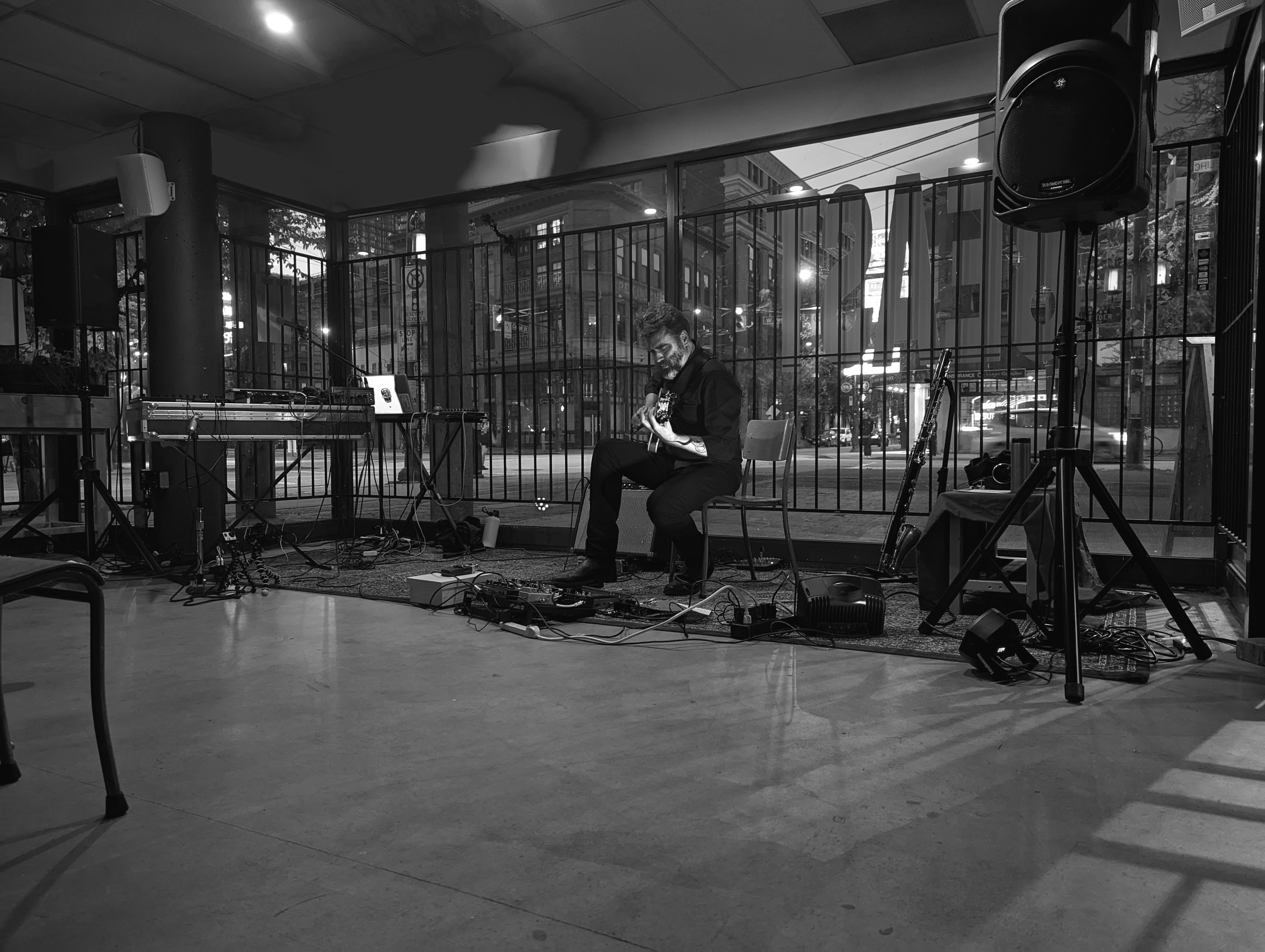
In the thirty-five years that I’ve been playing my instrument, I’ve only actually performed solo once. This show became the album Dormitive Virtue (2024), and I think it’s maybe one of the best things I’ve done.
There’s something about playing solo that allows me to hear more of the guitar than I can when playing in an ensemble. And this greater sense of the instrument encourages a different kind of nuance in my playing that I find I don’t achieve in group settings.
In your best improvisations, do you feel a strong sense of personal presence or do you (or your ego) “disappear”?
This question really tugs at the theorist in me (my day job). But I’ll refrain from indulging these impulses and just say that when it’s going well, when I’m executing things with a relaxed focus such that an “-esqueness” of sorts becomes sensible, then I find myself less “disappeared” than fully at play.
For me, it makes more sense to think about these exceptional moments as instances when we experience pure expressive value for its own sake such that the case of presence or absence is put out of play. One of the tracks on Dormitive Virtue—"A Gilded Madman”—captures something of this.
It’s not a long take, but it’s a moment where things came together—the technique, the sound, the focus—just long enough to yield a qualitative excess.