Published
Name: ELECTRIO
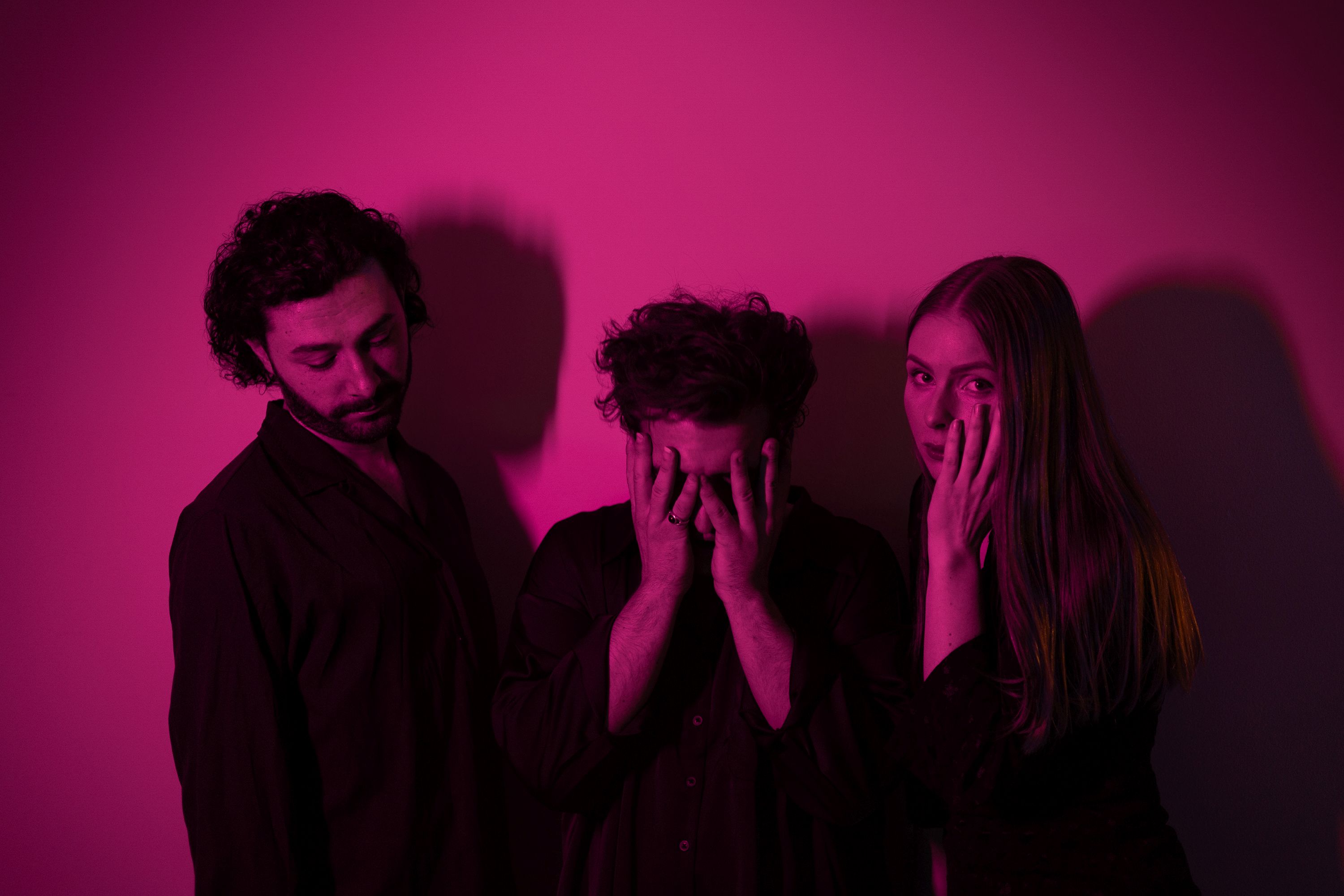
Members: Sandra Lind Þorsteinsdóttir, Francesco Rista, Simone Giordano
Interviewee: Francesco Rista
Current release: ELECTRIO's new album STABAT MATER is out via Fresh Ribes.
Recommendations for Reykjavík, Iceland: I am living in Reykjavík, and I recommend going to listen to the Icelandic Symphony Orchestra at Harpa. And why not visit the Penis Museum as well?
Topic I'm passionate about but rarely get to talk about: I love swimming and try to go to the pool as often as possible. My hero is Ross Edgley, who recently swam around Iceland.
If you enjoyed this ELECTRIO interview and would like to stay up to date with the band and their music, visit them on Instagram.
When did you first start getting interested in musical interpretation?
A few years ago, I began to dive into what is possible to play on guitar by reinterpreting works originally written for other instruments, such as works by Paganini, Bach, John Cage and others. Recording a piece is like capturing a photograph of a performance in a particular moment.
But for me, the real beauty and meaning of interpretation lies not in the recording itself, but in the process of reaching that point, the journey of shaping the music and bringing it to life. The interpretation of a piece of music is what makes it alive and profoundly human.
Which artists, approaches, albums or performances captured your imagination in the beginning when it comes to the art of interpretation?
The album Songs from the Labyrinth by Sting and Edin Karamazov.
These two unique artists created a fresh interpretation of Dowland’s songs while preserving their meaning, sensitivity, grace, and beauty. This is also what inspired us to arrange in our new album songs by John Dowland.
Another album that stands out for me is Nuove Musiche by Rolf Lislevand, in which he brought a new sense of time to Kapsberger’s Arpeggiata, adding layers and highlighting the fragility of the voice.
I also think of opera, where interpretation extends beyond music to staging and scenography.
I remember a remarkable production of Janáček’s Káťa Kabanová at the Teatro Regio in Torino by Robert Carsen, with a brilliant interpretation in which the entire opera unfolded on moving pallets, with water covering the stage.
Are there examples for interpretations that were entirely surprising to you personally and yet completely convincing?
The Violin Concerto in E-flat Major by Vivaldi, recorded by Patricia Kopatchinskaja and Il Giardino Armonico, is remarkable.
You can even hear them shouting in the recording, at first, I thought, “What is happening?” But I found it completely convincing and full of life!
What do you personally enjoy about the act of interpretation? Are you finding that this sense of enjoyment is changing over time?
I like to think that as performers we have the responsibility to bring a fresh perspective to a piece, especially when preparing a recording. This involves studying other interpretations, understanding (or trying) what the composer had in mind, and then developing our own vision.
This enjoyment is not changing over time, I have been composing more lately and interpreting our own music is simply different. I find it particularly fascinating to work on new music, where I can push the boundaries between classical music and other genres, creating something entirely new by blending old material with Baroque and Classical techniques.
That’s what we tried to achieve in our STABAT MATER.
How much creativity is there in the act of interpretation? How much of your own personality enters the process?
In baroque and early music, I believe there are no limits to the creativity a musician can bring. Adding ornaments and colors is needed, adding instruments is a plus, and improvisation is encouraged, as long as the tempo remains faithful to the character of the dance or the specific movement being performed.
In modern music, however, the situation is quite different. Composers increasingly provide detailed notations and indications. Today, it is quite common for performers to work closely with composers in order to bring out the best in the music.
Whether we perform music written today or centuries ago, it is the interpreter who gives it a sense of time and space, who brings it into the present and makes it live.
Could you describe your approach to interpretation on the basis of a piece, live performance or album that's particularly dear to you, please?
Particularly dear to me is the final piece of STABAT MATER, Amen, which closes our work.
In this short work, the word “amen” is repeated three times, symbolizing anger, hope, and finally resignation. Scored for male voices and bowed guitars with a distorted, deep sound, it contrasts with the fragility of the soprano, who carries the emotions above all the uncertainty.
What was your own learning curve/creative development like when it comes to interpretation - what were challenges and breakthroughs?
In the Stabat Mater, our intention was to give new life to the prayers of the Holy Mary in a contemporary context.
At first, our focus was on climate change. Today, it feels more meaningful to turn that prayer toward something even deeper, humanity, respect, and understanding.
Musically, we wanted to bring Baroque music into the future. Simone, our digital artist, shaped my arrangements with punchy synthesizers and innovative electronic sounds that he created and recorded. The guitars emulate the textures of the lute and harp, while Sandra’s voice remains simple and pure.
The challenge was to create a work that would not sound clichéd, while preserving the strong Baroque elements with a modern sensibility and honoring the vision of the composer Marco Rosano with our own personal touch.
In many cases, the score will be the first and foremost resource for an interpretation. Can you explain about how “reading” a score works for you?
At the beginning, I depend heavily on the score, as musical notation is the main tool I use to learn a piece. Once I have learned the music, however, the score has served its purpose. If the piece is memorized, the score can return to the bookshelf.
Once I have memorized it, I begin adding “spices” and my own personality to the music. It is like cooking a dish without a recipe: I have the freedom to experiment with new ingredients and quantities—quanto basta—until the result feels right.
One of the key phrases often used with regards to interpretation are the “composer's intentions”. What is your own perspective on this topic and its relevance for your own interpretations?
By studying music history and music theory, I believe we can come closer to understanding the composer’s intentions.
It is, of course, necessary to know these things in order to bring out the best in a piece. But in the end, the interpreter has the final word, since they are the one performing alone on stage. I believe it ultimately comes down to their sensitivity.
I am infinitely fascinated by radically different or even “wrong” interpretations – the tempi of Toscanini, Kempff's Goldberg Variations. Are there extreme interpretations that you enjoy as well? Do you personally draw a line – and if so, what happens when we cross it?
I know extreme interpretations by Patricia Kopatchinskaja and Edin Karamazov, but I use the word “extreme” in the best sense! I find their performances incredibly expressive and carefully crafted. There is a meticulous attention to detail combined with a fiery intensity that brings a rare passion to classical music.
I’m not sure if there is a clear line between “right” and “wrong,” but while some interpretations seem desperate for attention and perfection, others, become naturally charming.
When you have the score in front of you, what's your take on taking things literally, correcting possible mistakes, taking into account historical aspects etc?
I almost never add anything that requires being written down. I try to choose clean and good editions, but we shouldn’t take everything as an absolute law because some details might not even be from the composer, but from tradition or the editions.
We need to read between the lines and keep our ears open.
With regards to the live situation, what role do the audience and the performance space play for your interpretation?
They play a significant role.
As an ensemble of classical and experimental music, we draw the best energy and inspiration from our audience, from their energy. We make the music and they make the atmosphere.
We love large performance spaces, they feel majestic and spiritual.
Some works seem to attract more artists to add their interpretation to it than others; some seem to even encourage wildly different interpretations. From your experience, what is it about these works that gives them this magnetic pull?
If we are talking about the Goldberg Variations, Beethoven’s symphonies, the Bach Cello Suites, and other great works like these, I think it’s about the history, the spirituality, the small details that are different for each individual, and the strong connection that these works create with each of us.
Every great work—whether in art, music, sport, or life—acts as a magnetic force, pulling at both our minds and our hearts.
Artists can return to a work several times throughout the course of their career, with different results. Tell me about a work where this has been the case for you, please.
I feel a particularly strong magnetic pull towards the Chaconne by Bach and La Catedral by Barrios.
Playing them feels like reading a poem that can stand being re-read thousands of times.
Part of the intrigue of interpretations is that the process is usually endless. Are there, vice versa, interpretations that feel definitive to you?
Nothing ever feels definitive to me.