Published
Name: Romain Frequency aka ELECTROSEXUAL
Occupation: Producer, performer, songwriter, researcher
Nationality: French
Current release: ELECTROSEXUAL's new LIKE THAT EP, featuring Nicky Miller is out via Rock Machine.
If you enjoyed this ELECTROSEXUAL interview and would like to stay up to date with his music, visit him on Instagram, Facebook, and bandcamp.
When it comes to experiencing the sensation of “energy” as a listener, which albums, performances, and artists come to mind?
Energy, for me, always begins with the artists who first opened my imagination. Jean-Michel Jarre was probably the first to show me that sound could feel like a living creature from outer space.
Later came the emotional and darker electricity of new wave synth bands like Chris & Cosey, Depeche Mode, Coil and Soft Cell, and the whole Trevor Horn/ZTT universe: that "avant-pop," genre blending experimental, avant-garde, and electronic sounds with pop music. That’s when I realised machines had their own emotional charge.
That energy guided much of the album Art Support Machine, especially bringing sexuality to the machines on tracks like “Fetish [ASFR],” a track about Alternative Sex Fetish Robots …
... or “I’m Your Machine” feat Hard Ton about yearning and desire to be turned into a machine.
[Read our Jean-Michel Jarre interview]
[Read our Trevor Horn interview]
[Read our Cosey Fanni Tutti interview]
There can be many different kinds of energy in art. Which are you most drawn to?
I’m drawn to the energies that feel paradoxical: harsh but tender, hot synth and cold voice, mechanical yet deeply emotional. The kind of energy you find in early hypnotic house or in the raw imperfections of a Korg MS20 patch.
That’s why a track like “Hot on the Heels of Love” which I covered from Throbbing Gristle can feel both brutal and strangely warm with Hanin Elias’s ethereal voice.
I like when the edges cut and soothe at the same time.
What role do words and the voice of a vocalist play in the transmission of energy?
A huge one. The voice is electricity in human form. The most complex sound wave.
When I collaborate with a singer like Nicky Miller on “Like That” or with Hanin Elias on “Automatic People,” the voice becomes the emotional bridge between the machine persona and the human experience.
The voice tone transmit energy by combining emotional resonance with fierce vulnerability.
When it comes to experiencing energy as a creator, how would you describe the physical sensation?
Energy has to be visceral. It always starts in the chest, not the heart exactly, but somewhere between breath and pulse. It’s like pressure building, a voltage rising.
Sometimes it becomes visual: synaesthesia, colours, quick flashes, shapes that want to become notes. When we shot the video for “(how to) Change Your mind,” the director Ceven Knowles and I wanted to illustrate the energy that felt like a kind of shimmering vibration when you try to reset your mind.
Often there’s a sense of release, but only after I’ve translated enough of that internal charge into sound.
When composing, do spontaneity and fast takes capture energy best, or does honing and refining bring you closer?
Both. The very first moments.
I love when I turn on one of my analog synthesizer like the Korg MS10 and feel the raw energy of its unexpected and always variable temperament. This is pure spontaneity. That’s when it really reveals its DNA.
This spontaneity can be heard in the experimental synth lines opening “Tempelhof.”
But once the core idea exists, I refine it with almost obsessive patience. The energy of a track is usually born in the first take, but it becomes articulate during the long, slow shaping.
How much of the energy in your music is part of the composition, and how much is in the recording process?
Composition gives me the emotional map the melody, the intention, the “why.” But recording gives me the body.
Because I work mostly in audio, not MIDI, a huge part of the energy is in the performance: the unstable oscillation, the imperfect filter sweep, the way a machine slightly misbehaves.
The tension in “The left hand of darkness (feat Cute Heels)” comes directly from those small accidents.
For your current release, what kind of energy were you looking for?
For “Like That,” Nicky Miller and I were looking for an energy that felt both raw, ecstatic and forward-moving , a kind of “machine emotionality.”
I wanted the track to feel like conversations with sentient devices. An energy that is alive, but not human.
How do you capture the energy you want in the studio?
By letting the machines speak first. My studio is mobile, so every setup becomes a new ecosystem. I plug everything in so there’s no barrier between emotion and sound.
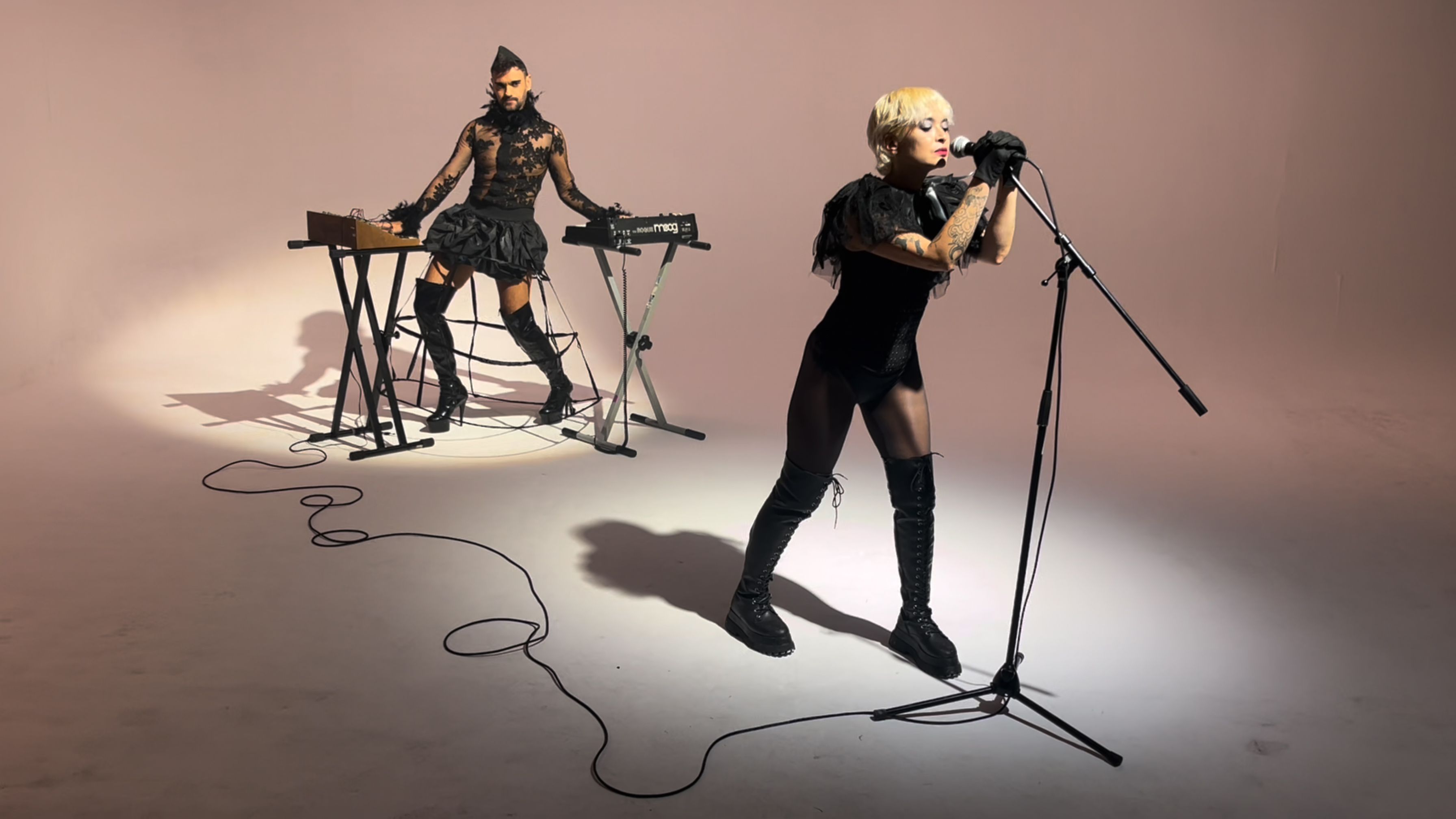
I do start with a melodic plan, even though I listen to what the synth wants. The Moog Rogue often sets the tone; it reacts like a living organism. that’s a bit unpredictable and open doors to inspiration.
What role do volume, distortion, amplification and production play in creating that energy?
Volume is physical, it shapes the body’s relationship with sound. Distortion is emotion, it exposes the cracks, the truth.
I don’t use much acoustic gear, so a lot of the energy comes from old circuitry: saturation, unstable tuning, hiss, and unpredictability. Production for me is less about polishing and more about honouring the raw voltage.
Tracks like “Hold Me” with Hanin Elias live inside that grain.
In terms of energy, what changes when you're performing live?
Live, everything becomes bigger and more vulnerable. I remix many of my tracks for performances. On stage, the machines are louder, the mistakes are real, and the energy feels unfiltered. It’s the closest I get to being inside the music physically.
I love to do collabs with vocalists too! At the moment we’re performing with multidisciplinary artist Nicky Miller.
How does the presence of the audience change the energy of the music?
The audience completes the circuit. Their reactions, even the subtle ones, feed back into the voltage of the performance. When they lean in, the music becomes more intimate; when they move, it becomes more rhythmic.
It’s a dialogue.
When we perform the ecstatic “Like That” or “Aquatic Love,” I often feel the crowd giving back a kind of emotional electricity. It’s like the audience become part of the show
What kind of feedback have you received about the energy of your performances?
People often tell me that the music feels physical like standing close to a creature breathing. Others say the performances are emotional or cathartic.
Some listeners tell me that tracks like “The Way They Make You Feel” helped them through difficult moments, or that “Free Yourself (to become yourself)” gave them the courage to break out of stagnant patterns.
I love when people find my music inspiring. Those reactions mean the world to me.
Do you prefer to stay in control to shape the energy, or do you surrender to it?
I surrender. Always.
Control creates safety, but energy thrives in danger. Machines are unpredictable, and I like honouring that. I often let the sequences mutate or the filters open too far.
It’s scary, and that’s where the real magic happens.
Ultimately, who has control during a live performance, and how can artists use musical energy to bring change?
I think no one truly controls it. Not me, not the machines, not the audience. We share it. We negotiate it.
And that’s exactly why musical energy can bring change: because it unites people in a moment where the usual borders of gender, fear, politics, expectations dissolve. Through visibility, through queer themes, through the simple act of creating space, music becomes a political gesture.
If a track like “Free Yourself” or “Darkroom” gives someone confidence, or reminds them of their own agency, then that energy is already creating change.