Published
Name: Elif
Occupation: DJ, producer
Nationality: Turkish
Current release: Elif's remix of "Silencio" by Augustin Girl and Last Men on Earth is out via Kiosk ID.
If you enjoyed this Elif interview and would like to stay up to date with her music and activities, visit her official homepage. She is also on Instagram, Soundcloud, and Facebook.
Which artists, architects, and approaches captured your imagination in the beginning? What's your take on how your upbringing and surrounding have influenced your sonic and architectural preferences?
I grew up in Istanbul, a city with -literal- layers of history. It’s effortlessly a big melting pot of different cultures and centuries and of course architectural styles. I have been exposed to many different styles of architecture from different centuries and experienced first hand the feelings of awe or respect or humbleness some of these grandiose buildings were intending to induce.
Architecture dictates. The form and function dictates a certain way of experiencing the space, creating a flow and the style and size dictate emotions.
As much as appreciating some ornaments and decoration and definitely don’t think it’s a ‘crime’, I have always found a ‘form follows function’ approach to architecture to be more honest and logical. To me the technology and engineering that made it possible to cover a huge area with a dome at the time it was built, has always been more interesting than the intricate craftsmanship of the paintings or carvings.
This for me does not necessarily mean no freedom in design or no ornaments at all, but more like it’s kind of engraved in me to be able to defend every architectural decision with a function. I also believe the human eye tends to find things that it’s not used to more interesting and I found myself more and more drawn towards modernism and even brutalism.
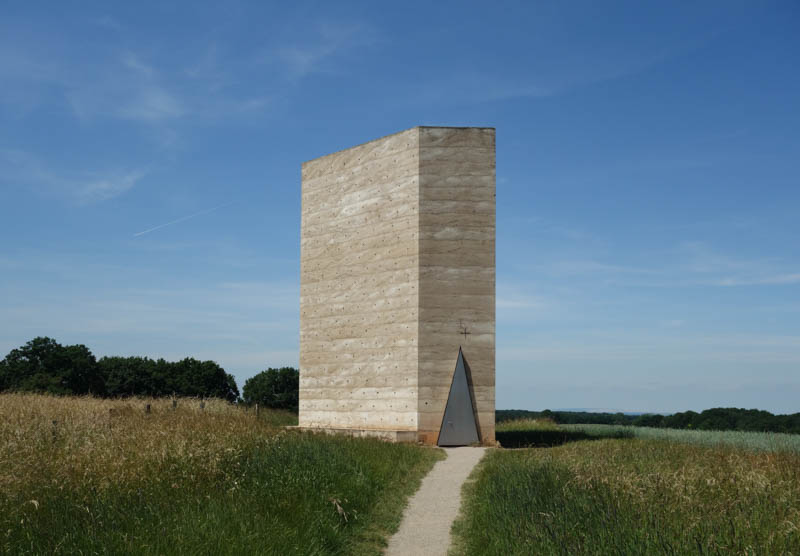
Growing up in the ornament rich ancient Istanbul and studying architecture, one of my biggest inspirations was the Swiss genius Peter Zumthor. He was proving ornaments and drawings were not the only way to create meaningful and unique experiences for users/visitors of a space.
The dance between shadow and light, different approaches to use of natural materials, like burning the wood he used in the interior of his famous Bruder Klaus Field Chapel, creating novel olfactory and tactile experiences, was for me a mind expanding approach to creativity that I think even shapes my approach to music and life in general. 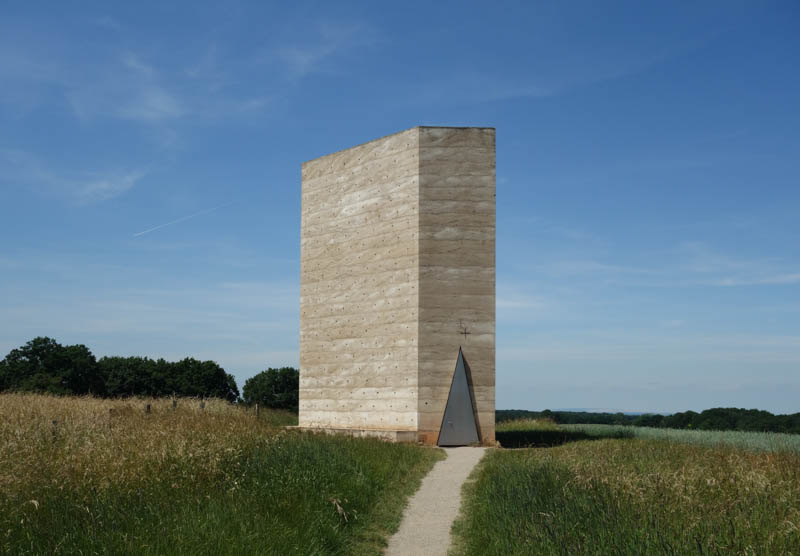
Bruder Klaus Field Chapel Image by Kenta Mabuch
His mastery at thinking beyond the traditional approaches, knowing super well the materials used and their unique properties, combining art and engineering and bringing more senses into play and doing all of this very subtle is an approach I also really appreciate in music.
What, would you say, are the key ideas behind your approach to music and working with sound? Do you see yourself as part of a tradition or historic lineage?
Honestly, I don’t like to use local and historic references of my culture in my music. I would more than appreciate the use of some traditional instruments in novel ways but as someone from Turkey I can not stand to hear duduk in a club. For me it just doesn’t belong there.
Being aware of this I also try not to play local music of a place I visit in my sets, especially if I don’t speak the language, just to look cute to them, as I know from my own experience the cultural references can be perceived differently.
Two other dimensions often associated with architecture and music are proportions and dynamics. Do these mean something for your work as well?
Always. Proportions and dynamics are a great way to create contrast and surprises, both very much appreciated in both music and architecture.
They are tools to resourcefully use the same material and create a changing experience replacing monotony.
How do you see the relationship between sound, space and performance and what are some of your strategies and approaches of working with them?
As a DJ I get to perform in many different settings and times of the day/year.
The same outdoor stage can look pretty different during sunrise or in the middle of the night, as versus indoor club rooms create an environment independent from the time of the day or year. (I recently experienced this on a Monday morning inside Kater Blau when it was hot and sunny outside and inside could be easily a cold winter Saturday night as well)
I change my approach to my performance depending on the setting, the time, the context. I want my music to match and compliment the moment. Sunrise has a different sound for me then a sunset or a club needs different music then an outdoor stage.
Creativity can reach many different corners of our lives. Do you feel as though writing or performing a piece of music is inherently different from something like designing a building?
The ‘combining art and engineering’ part of both music production and architecture is something I really love doing.
I remember in architecture school before I started to design a building I was creating stories of a person or family or group of people who’d experience the building. In a way with my planning and design I’d tell them how to move, catering to their needs, and making this experience as rich and unique as possible. It’s a very similar thing the DJ does, not with walls and corridors or negative and positive spaces but with silence and sound, with rhythm, melodies and grooves.
I am also a certified yoga teacher and I even compare teaching a Vinyasa yoga class to composing a DJ set and I find similarities as: warming up the crowd, catering to their needs, watching how they move and changing course according to that feedback, finding unique ways to move from one pose to another is comparable to transitions, a peak pose or a moment, a calm down period and a closing that will leave them happy and wanting more.
I’m sure if I was a chef I would be able to talk to you about similarities of cooking and architecture or cooking and a yoga class. I find it enriching to combine one's knowledge and understanding from different disciplines as they usually spark new approaches and ideas. Creativity is boundless.