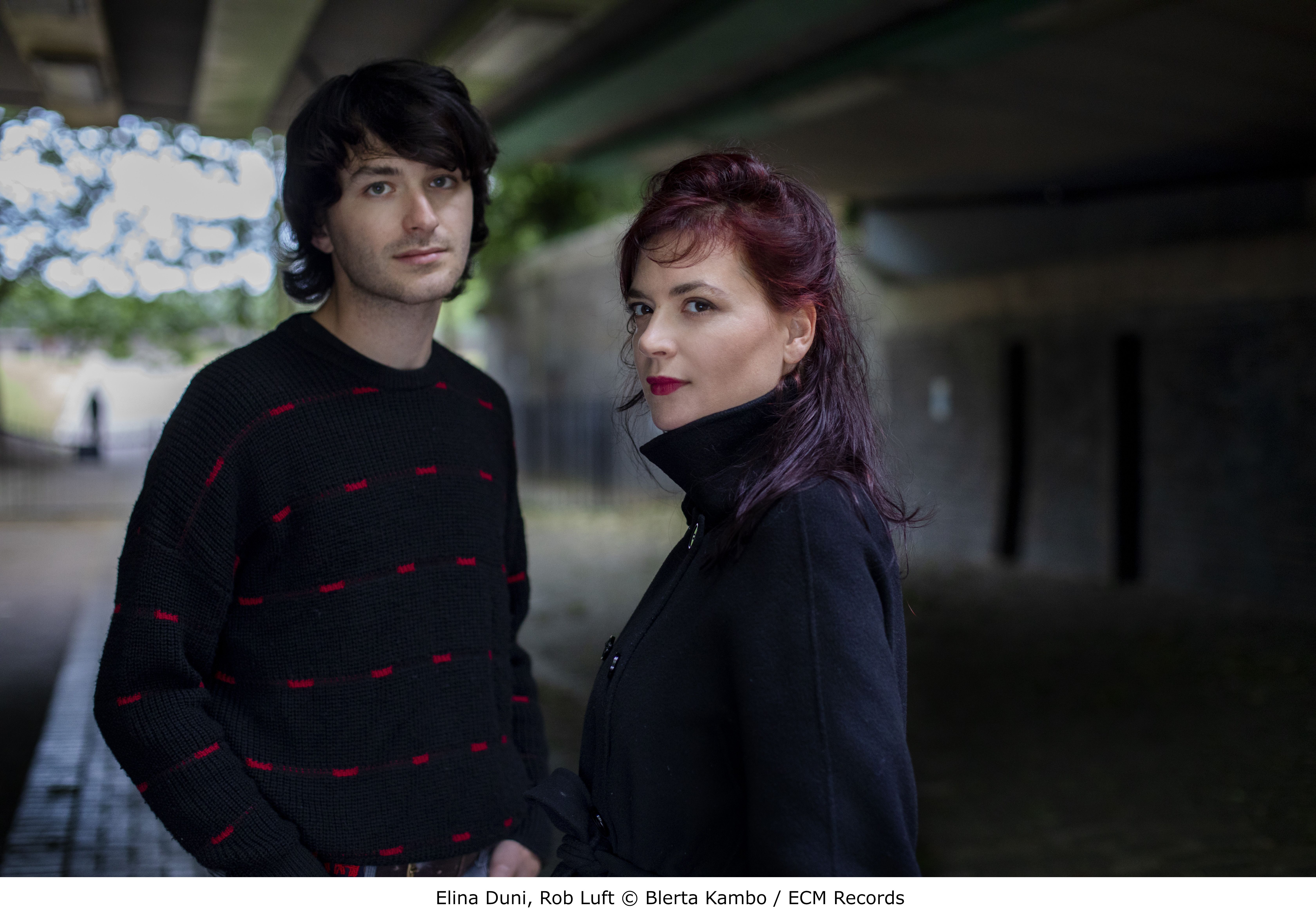
Published
Name: Elina Duni
Nationality: Swiss-Albanian
Occupation: Singer, songwriter, improviser, composer
Current release: Elina Duni teams up with Rob Luft (guitar), Reaching for the Moon, out April 24th 2026 via ECM.
Recommendations for Zurich, Switzerland: I can’t miss this opportunity to give a shout out to one of my favourite places to play in Europe - the legendary and historical Moods Jazz Club in the city centre!
Things I am passionate about but rarely get to talk about: I love to spend any time off I have going freediving (breath-hold diving) in the oceans and seas around me, namely the Mediterranean Sea and the Red Sea. I’ve been diving for over half a decade, & I just wish that people could begin to understand the deleterious impact that mass consumption, overfishing & plastics are having on the ecology of our seas. A healthy ocean is a healthy planet …
[Read our Rob Luft interview]
If you enjoyed this Elina Duni interview and would like to know more about her music, visit her official website. She is also on Instagram, and Facebook.
When did you first consciously start getting interested in singing? What was your first performance as a singer on stage or in the studio and what was the experience like?
My first experience of singing was when I was just 5 years old, singing popular children’s songs at a youth music festival in my hometown of Tirana, Albania, where I remember that I was awarded the 3rd prize for a vocal performance with string orchestra! Ever since that moment, I’ve been drawn to the stage as a means of bringing people together under one roof, and sharing music with others.
In these uncertain times that we’re living in, I am constantly struck by the healing power of music to cross divides, and to act as a unifying force despite the darkness all around us …
If you're also playing other instruments, how does the expressive potential of these compare to your own voice?
On this recording, as well as singing, I played the frame drum on two or three songs. The technical term for the specific instrument I use is the Daf or Dâyere, and it is very widely used in Persian-influenced music across South and Central Asia, as well as being popular in my native region of the Balkans.
I love to use the frame drum on the more groove-based material in our repertoire as it adds a dance-like urgency to our often sombre, meditative music! What’s more, when playing in such an intimate setting as a guitar and voice duo, it’s always great to have the possibility of varying the texture as much as is feasible.
With Rob using a whole plethora of effects and electronics to augment the sound of the electric guitar, I have tried to do the same by adding elements of percussion - both through the use of the frame drum and also the occasional deployment of vocal percussion!
Singing is an integral part of all cultures, and traditions. Which of these do you draw from – and why?
I’m a bit of a musical magpie in the sense that I’ve always been drawn to music from all over the globe, from a very diverse range of traditions!
At the core of my musicality is the deep love and respect for the twentieth century American masters of vocal jazz, in particular Billie Holiday, Sheila Jordan, Shirley Horn and not forgetting the very personification of vocal perfection, Ella Fitzgerald.
However, having initially grown up in communist Albania in the 1980s, I wasn’t exposed to jazz until I moved to my adopted home of Switzerland in my teens. As a result, my earliest musical heroes were the folkloric and popular singers of Albanian music.
I have always particularly adored Kosovar vocalist Nexhmije Pagarusha. She recorded regularly for Yugoslavian public radio in the post-war years and her work acts as a very direct source of inspiration for the Albanian songs I’ve recorded on all of my ECM albums over the past decade.
Whilst studying at the University of the Arts in Bern, Switzerland, I fell in love with two groundbreaking European jazz vocalists who carry long associations with ECM Records, namely Sidsel Endresen and Norma Winstone, both of whom have left a huge mark on the vocal jazz canon.
I could go on and on, listing hundreds more of my musical influences, but perhaps your readers will eventually get bored of that!
What were some of the main challenges in your development as a singer/vocalist? Which practices, exercises, or teachers were most helpful in reaching your goals – were there also “harmful” ones?
I was lucky enough to study with three incredible vocal professors back in my university days in Bern, and this is where I discovered the importance of classical vocal technique, also known as Bel Canto.
These days, whilst teaching at the Jazzcampus in Basel, Switzerland, I implore all of my vocal students to follow the same method, as it creates a strong technical foundation upon which to build.
The life of the modern jazz musician is exhausting and can be fairly tough on the body at times, with long travels between concerts all whilst being underslept, undernourished and running on empty. As a result, it’s absolutely sacrosanct for me to have a strong vocal technique as the cornerstone of my music-making!
What are the things you hear in a voice when listening to a vocalist? What moves you in the voices of other singers?
For me, I am mostly moved by a vocalist’s ability as a story-teller, which is why I have always loved singer-songwriters like Leonard Cohen and Nick Drake. In the realm of jazz, someone like Chet Baker springs to mind as a vocalist that moves me deeply when singing jazz standards.
As you can see by answer here, it’s not just perfect vocal technique that touches me, but a whole range of factors play in to my taste as a listener!
How would you describe the physical sensation of singing? [Where do you feel the voice, do you have a visual sensation/representation, is there a sense of release or tension etc …]
Sometimes I like to compare my instrument to the flute, and occasionally I visualise individual holes of the flute whilst singing.
The most important thing to note here is simply that the voice is an invisible instrument and requires a lot of mental gymnastics, unlike the black and white keys of the piano or the fret markers on a guitar.
How do you see the relationship between harmony, rhythm and melody? Do you feel that honing your sense of rhythm and groove has an effect on your singing skills?
As a child, my first dream was to be a dancer, and even though that dream was never realised, I still firmly believe in the connection between the feeling of rhythm within the body & the act of singing. Those that have attended my live concerts will attest to this, as I’m always moving my body somehow or even in the full flight of dance at some stage during the show!
Secondly, I would add that I hear harmony and melody to be one and the same. Some of my favourite harmonic progressions in music, such as the St Matthew Passion by JS Bach or the 5th Symphony of Gustav Mahler, sound more like a series of horizontal melodies that are woven together to create beautiful, dense harmonies.
What are the potentials and limits of your voice? How much of your vocal performance can and do you want to control?
I am a mezzo-soprano with a 3 octave vocal range. I would imagine that this is fairly normal for a trained vocalist.
As the years have passed, I have noted that the lower register of my voice is becoming warmer and stronger, and I’m embracing the darker colours of my voice, and I imagine that it will continue to darken in a similar fashion over the years.
That being said, I want to keep my head voice in shape, which will allow me to span great vocal heights whilst scatting or improvising in a live setting!
I'd love to know more about the vocal performances for Reaching for the Moon, please, and the qualities of your voice that you wanted to bring to the fore.
On this latest release, I sing in 5 different languages - Albanian, English, French, Italian & Farsi. Each language carries a unique character that brings out a different quality in my voice.
I love the romance & lilt of the Latin languages whilst Albanian and Farsi bring out a more guttural, earthy character in my singing.
English, of course, is understood by people all across the globe & I hope that this adds a kind of universality to the album, meaning that there is a song for everyone in there!
How has technology, such as autotune or effect processing, impacted singing? Has it been a concrete influence on your own approach?
I have never personally used autotune on my album recordings as ECM have a strict policy of maintaining the purity of sound of each musical instrument.
However, I must say that I find it very disheartening to see many modern pop singers these days using autotune during their live performances!
I feel like the arena of live performance should be one of the last bastions of authenticity, a place for the listener to hear genuine musicianship, and hiding behind live processing FX such as autotune seems somehow disingenuous to me.
For recording engineers, the human voice remains a tricky element to capture. What are some of the favourite recordings of your own voice so far and what makes voices sound great on record and in a live setting?
Working with Manfred Eicher of ECM Records has been an absolute game changer for me as a vocalist, as he has been able to distil the absolute essence of my musicality into my recorded output over the past decade.
I am so indebted to him and the great recording engineer Gérard de Haro at La Buissonne Studios in south France.