Published
Name: ükya
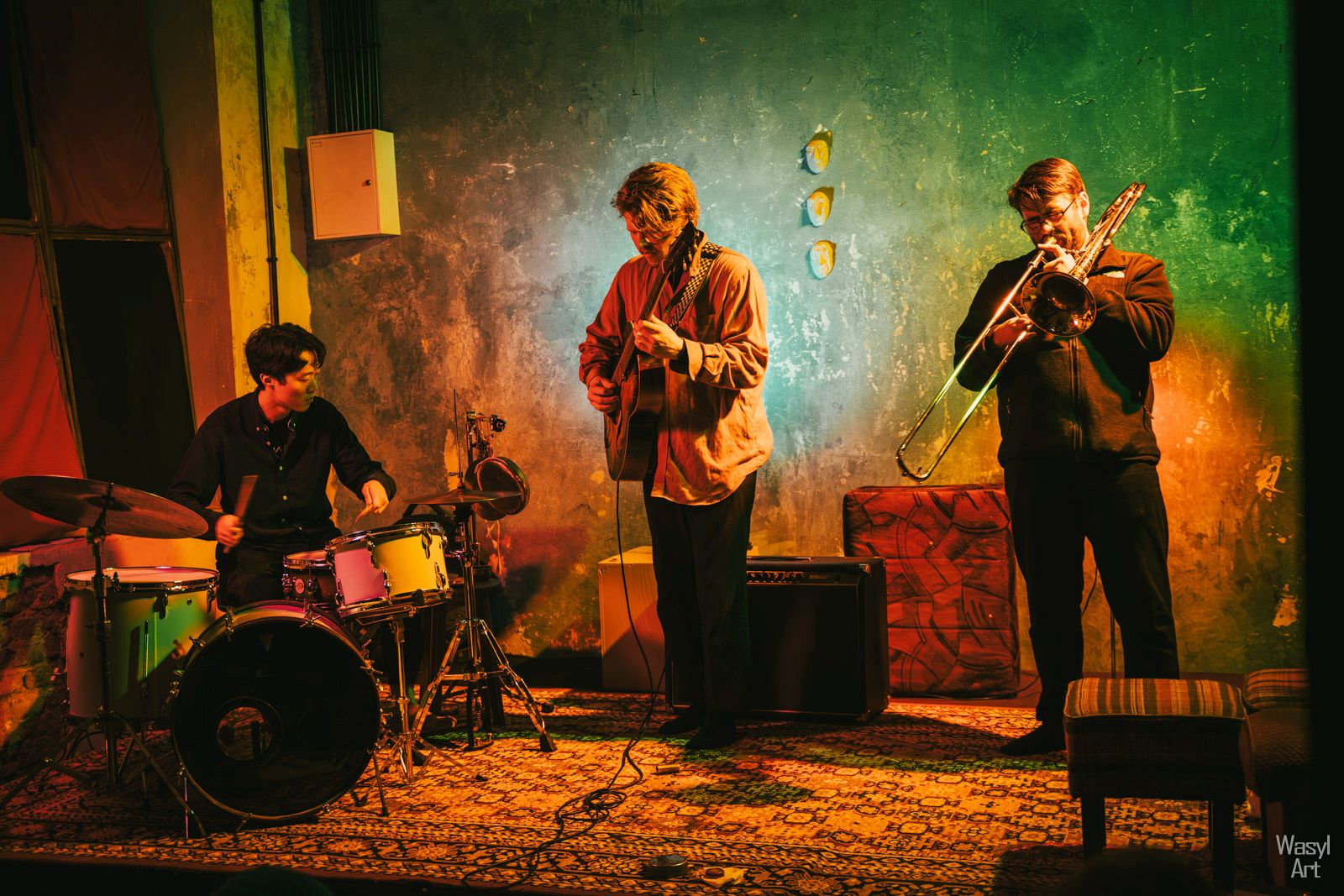
Members: Emil Bø (trombone), Kristian Enkerud Lien (guitar), Michael Lee Sørenmo (drums)
Interviewee: Emil Bø
Nationality: Norwegian
Current release: ükya's new album Soon Means Now is out via Nakama.
Recommendations for Trondheim, Norway: Baklandet Skydsstasjon and Dokkhuset.
[Read our Kristian Enkerud Lien interview]
[Read our Michael Lee Sørenmo interview]
If you enjoyed this ükya interview and would like to stay up to date with the trio and their music, visit them on Instagram. Emil Bø also has a personal website.
When did you first consciously start getting interested in musical improvisation? What was your first improvisation on stage or in the studio and what was the experience like?
For me improvisation started while I was in a marching band.
We had a teacher that was interested in jazz and he introduced us to different jazzy arrangements of tunes. That lead to starting in a youth jazz orchestra and from there I changed from playing mainly classical, to almost only doing jazz.
My first improvisation was on a type of house concert with the marching band.
Tell me about your instrument and/or tools, please. What made you seek it out, what makes it “your” instrument, and what are some of the most important aspects of playing it?
My brother played the trombone, and I think that's mainly why I play trombone today. I started playing when I was around 5 years old and trombone was of course my first choice because of my brother.
For me, the trombone is a beautiful instrument to play. I have the possibilities to do nice brass things, but also the possibility to play super loud, intense and the slide just makes everything fun. The slide brings me difficulties, possibilities and the chance to sound quite different to other brass instruments.
I also play a lot of microtonal music with Kristian's band KRISE and with that band I'm very happy to have a slide …
How would you describe your own relationship with your instrument – is it an extension of your self/body, a partner and companion, a creative catalyst, a challenge to be overcome, something else entirely?
I feel the trombone as an extension of my voice and expression.
But it's also a big challenge to overcome because of the physical challenges: Half notes can be 60 centimetres away from each other …
When you're improvising, does it actually feel like you're inventing something on the spot – or are you inventively re-arranging patterns from preparations, practise or previous performances? What balance is there between forgetting and remembering in your work?
For me, improvisation is a way of playing music and I do not think so much about it being inventing something or rearranging things I know from before.
I never remember anything from a concert I play and I think that is because I play very constantly and rarely think about what I want to play. It's more of a question of when to begin and when to stop.
My focus is on listening to the other ones playing and not so much myself.
Artists from all corner of the musical spectrum, not just “free jazz” have emphasised the importance of freedom in their creativity. What defines freedom for your improvisations?
Freedom in my playing can reflect my wish to express myself uncompromised and without any rules.
What are some of your favourite collaborators and how do they enrich your improvisations?
The best constellations I play in are the bands where playing is just an extension of how we socialise and how we spend our time together. Traveling, talking, eating, playing, drinking, sleeping, etc.
But at the same time being at 100% when playing and giving it all to the performance. Really pushing each other and not bothering to be impolite in the music, if that's what serves the music well.
In a live situation, decisions between creatives often work without words. From your experience and current projects, what does this process feel like and how does it work?
In improvised music I like to follow my instincts from the music, also when creating contrast, not thinking. Fill rooms in the ensemble, blend nicely. All these aspects make the music. Music for music’s sake.
I also like to make tunes of concepts when I improvise. Finding a small form like a cell or a larger form with A’s and B’s.
Stewart Copeland said: “Listening is where the cool stuff comes from. And that listening thing, magically, turns all of your chops into gold.” What do you listen for?
I listen for energy and tension.
I'm not into all that theory and academic stuff when listening, but I listen for the nerve and direction in the music.
There can be surprising moments during improvisations – from one of the performers not playing a single note to another shaking up a quiet section with an outburst of noise. Can you tell me about such situations from your own performances and how they impacted the performance?
It can be very very frustrating when people lay off. Often people will do it because they have learned that they should do it from time to time.
At the same time I like when things get weird and unpredictable, that's when you really get to play with nerve and tension.
I do believe that you shouldn't be afraid of frustrating your band mates on stage. Just do it respectfully and with a smile …