Published
Name: Enrico Sangiuliano
Nationality: Italian
Occupation: Producer, DJ, label founder at NINETOZERO
Current Release: Enrico Sangiuliano's new Discipline EP is out now on NINETOZERO and includes signature tune “The Techno Code.” ‘The Techno Code’ Remixes ft. Charlotte de Witte, Kevin De Vries & SLVR, Avalon & Tristan will follow July 3rd 2025.
If you enjoyed this interview with Enrico Sangiuliano and would like to know more about his music and current live dates and releases, visit his official homepage. He is also on Instagram, facebook, and Soundcloud.
For a deeper dive, read our earlier Enrico Sangiuliano interview.
You told me in our previous interview that machines are essentially a means to an end for you. Still, I’d be curious to find out how far your evolution as an artist was nonetheless connected to the evolution of your music set-up — at least to a certain degree? Were there shared stepping stones?
Machines have always been a means to an end for me — tools to express ideas, not the final goal. But looking back, there were definitely stepping stones, where changes in my setup went hand in hand with important shifts in my growth as an artist.
One major moment was when I moved out of my bedroom studio and started working as an audio engineer and ghost producer in a professional studio environment. Eight hours a day, over seven years — it was a massive training camp that shaped me technically and artistically.
Later, when I no longer had access to that professional setup, I had to go back to making music 100% ‘in the box.’ It felt like having no home at first — but it forced me to be resourceful, to get the best out of whatever I had at the moment. That period sharpened my creativity in a different way.
And now, with my current studio, spontaneously called the Black Box, finally ready, I feel I’m at the beginning of my next powerful evolution. I’m getting more and more familiar with its acoustic environment, and soon I’ll know it deeply. That will allow me to push sound detail, energy, and precision to the next level.
Each phase wasn’t about chasing gear — it was about adapting, growing, and staying focused on the music.
Limitations are more important than options?
Right now, I’m working on a project together with a violinist where the entire piece is built using only the violin on his side — clean and processed — and only the Roland 909 on mine — from raw to hyper-processed sounds. You’ll hear about it soon :)
A project like this keeps teaching me that sometimes limitations create stronger, more meaningful music than endless options ever could.
Today, every tool I choose has to add meaning, not just sound. That’s the real evolution.
Tell me about the Black Box and how you’ve set it up to optimise creativity.
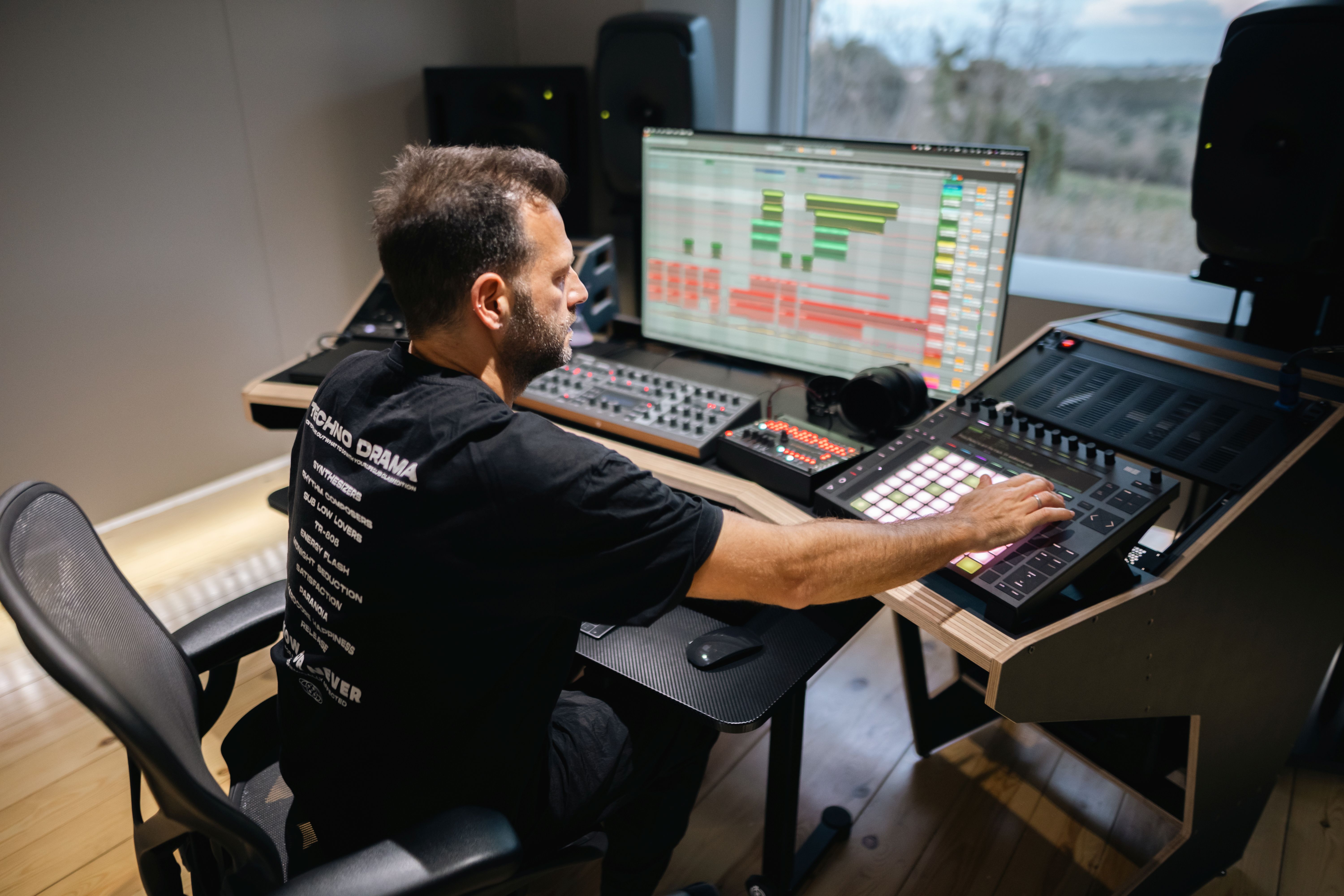
It's built inside a wooden shell, painted entirely black. From the outside, you’d never imagine what’s inside — it just looks like a mysterious black shed in the middle of the Portuguese countryside. But it’s the Black Box, ladies and gentlemen!
Inside, I designed the space to optimize creativity: bright, clean, minimal, and deeply immersive. The walls are treated to control the sound naturally, the lighting is adjustable to match the mood I want to create, and everything is within reach — keyboard, synths, effects, all ready to be played without breaking the flow. There’s a window in front of the main desk — in case you want to connect with the surroundings while being in the spaceship.
I wanted a place where ideas could move fast, without obstacles, and where the energy of nature outside could meet the intensity of the sound inside.
There are artists who can realise their ideas best with a traditional – or modified – piano interface, others with a keyboard and a mouse, yet others by turning knobs or touching screens. What’s your preferred and most intuitive/natural way of making music — and why?
It always starts with a concept in mind.
Depending on the angle I want to take, I start shaping it either through a keyboard or a drum machine. If I’m aiming for something emotional, I reach for a melody and a keyboard. If it’s more about rhythm, movement, or physical energy, I start with the drums.
When the setup is right, I barely have to think — it becomes instinctive. It’s not about controlling the machines; it’s about collaborating with them.
Sound design and effect processing is important in all of electronic music, but it seems particularly important for you. How would you describe your aesthetic preferences for picking effects like reverb, delay, compression, chorus etc? What is the role of these effects in the production of your current releases?
Sound design and effect processing are not just technical steps — they’re part of the storytelling, the elements that make a track stand out.
When I choose effects like reverb, delay, compression, or modulation, I’m not thinking in technical terms first; I’m thinking about how they can shape sensation, space, and tension.
I tend to prefer effects that sound organic, deep, and textured — nothing too shiny or plastic. A reverb has to create an interesting sense of dimension, not just blur the sound. A delay has to feel alive, almost like another voice inside the track. Compression isn’t just about squeezing dynamics; it’s about shaping the impact and making the track breathe.
Effects can guide you through the journey, highlighting details, creating contrasts, and sometimes even becoming characters themselves inside the music.
On your Facebook page, someone referred to you as “the new Mozart.” He simply meant it as a compliment for your outstanding productions, but I thought it interesting to reflect on this a bit: If you compare 2025 to the end of the 18th century, would you say that sound design and production have become as important, or even more important, than melody, harmony and composition?
Haha, well … I take that as a beautiful compliment — even though I’m not trying to be Mozart! (laughs)
It’s true that today, sound design and production have become just as important as melody, harmony, and composition — maybe even more so in genres like techno, which can often be drum-based and less dependent on traditional musical elements.
In my music, composing and producing are deeply connected. I don’t really see a clear line between them. Sound design is part of the composition itself — the way a sound evolves, the space it creates, the emotion it triggers … That’s already the story. That’s already music.
For your own music, where does composing end — and production begin?
For me, composing starts with an idea — and producing is how I give that idea a body, a skin, a soul.
They’re two sides of the same creative act.