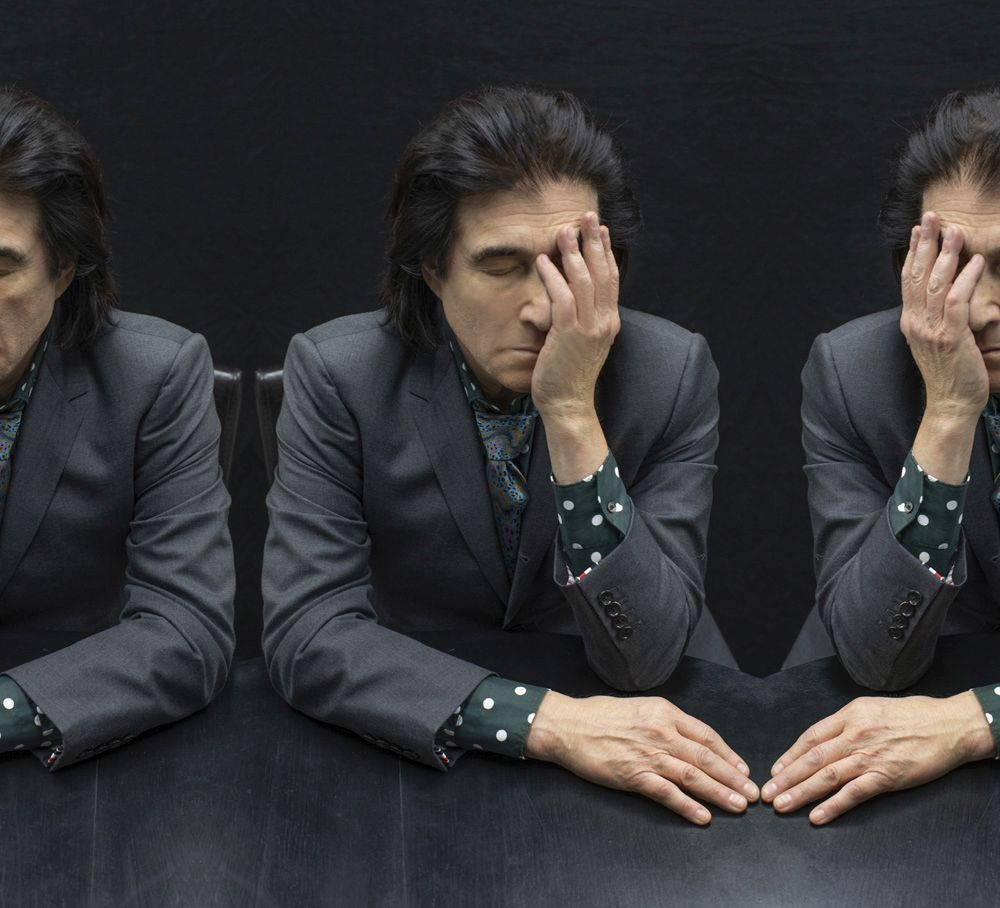
Published
Name: Ensign Broderick
Nationality: Canadian
Occupation: Singer, songwriter, composer
Current release: Ensign Broderick's two new albums Come Down and Mirror Ring are out now.
If you enjoyed this Ensign Broderick interview and would like to know more about his music and upcoming live dates, visit his official homepage. He is also on Instagram, and Facebook.
What is your interest in minimalism, if you have any, and if you did when it did it begin?
I started taking piano lessons at 3. By nature the repertoire for children was usually simple and direct. Schumann's Kinderszenen or even some Chopin preludes.
Practicing piano for hours is a solitary thing and that in itself as an approach to music becomes minimalistic over time. Me, the piano and my limited musical knowledge kept my understanding of music clear and with few ornaments. An informal concept of minimalism that informed my later appreciation of music.
If you're writing just on piano and vocal you work with the tools that you're given. Unfortunately when I was young I started to overcompensate for not having a band by playing too much and too heavy a hand.
About ten years ago I decided to break with bad playing habits I had cultivated during my life and tore my playing style down as completely as possible. And I started taking piano lessons again to relearn how to play with a lighter touch, more minimally with less notes and hopefully with more grace.
It’s always easy to play too much and much more difficult to share the playing space with silences. You need to trust the silence, or what seems to be silence.
So they were skeletal from the beginning, on purpose.
Yes, definitely some of the songs were conceived as simple uncomplicated pieces.
When I was a kid, I was a Roxy Music fan and hence Eno became a big influence. I started listening to his series of ambient records, some of them with John Hassell or Harold Budd.
I also listened to Tangerine Dream and Edgar Froese solo records. Epsilon In Malaysian Pale was such astonishing music, beautiful and spare.
[Read our Tangerine Dream interview]
The music of YMO and the 2nd sides of Heroes and Low.
When I was in my mid-teens, my piano teacher started exposing me to small piano pieces by Schoenberg and Hindemith. Beautiful sparse tone poems, very minimalistic. The tolling of church bells in memory of Mahler. And at that time I was studying serial music and listening to Stockhausen, Pärt, Ligeti, Musique Concrète etc.
When you strike a piano note, it goes on beyond the note played due to all the harmonic overtones, which you can't hear readily or necessarily, but your brain hears. Even if you play one note, there's a whole symphony of things going on. It's a different form of minimalism, perhaps a form of minimalism in nature and physics that you can't escape.
John Cage 4.33. A work that captures the ambiance of the place where it is performed. I think It was first performed in an open air structure. The continuous ambient sounds of life were the music.
As a singer songwriter there are many tangible/ material ways to express minimalism beyond apparent silence. Sometimes it's about adding stuff and sometimes about taking stuff away. Often playing less is more.
Are there any examples outside of music and minimalism?
Robert Rauschenberg and “White” painting. Barnett Newman’s z “Voice of Fire”. Japanese furniture. The use of the monochromatic in Japanese design. Noguchi furniture as an example.
Clothing by Commes Des Garçon, Undercover, Yamamoto, Number (N)one. Rick Owens. Simple cohesive palettes and colourways.
Do you feel making music is a process of adding elements until it's done, or do you chisel away from something that's already there?
I do both.
Adding pieces and then subtracting them is very interesting to me, because it’s similar a painting technique I did as a kid called scratching, where the method is to cover the canvas in bright colours and then cover over that in black. The artist will then use a fine instrument to scrape away pieces of the top layer to reveal the art underneath.
Using this sort of subtraction technique reveals the chaos beneath the minimalism. The use of light dark and shadow by Caravaggio that created these astonishing artworks. Using the positive and negative extremes to reveal an even deeper image underneath. Chiaroscuro.
As an artist gets older, are they prone to moving closer to an essence, distilling what they do into something more minimalist? Do you think that's true of your development as an artist?
Some do, some don’t.
What’s important to me is that I try to abandon the over writing, over playing and over production of my stuff and rather dig into the essence of music and make sure I am serving the music, and not ego, in the best way. And if that works by taking a minimalistic approach, then that's great. (In my opinion, you should do something in a minimalistic form that requires more instrumentation, and that only happens when you’re in the studio and experimenting)
However you can get caught up in the studio with a set ideas and then realize, after trying it out, what works or what truly doesn’t. Whatever the concept is that you have, whatever your intentions, it really depends on how valid the idea is and how it’s executed. And how the approach integrates with transparent expression
What were some other limitations for these particular songs?
We tried to limit it just to sounds we could make with a grand piano. There's obviously some other instrumentation on it but very limited. Everything had to serve the song.
If I wanted a bass drum—like I think there's a bass drum beat in “When We Were Pretty,” where it's just me banging the top of the piano with my fist, and then we could turn that into the bass drum.
I really tried to stay true to the fact that I just wanted piano and vocals.
When contemplating enhanced instrumentation, what are some of your strategies for separating what matters from what doesn't?
Whatever is appropriate. Whatever serves the song/music best. When in doubt, leave it out.
Approaching this music with just piano and voice really helped in eliminating any potential stressors. There’s nothing else to worry about except yourself.
What about minimalism in your own musical listening habits? With so much available, do you find you want to take it all in, or did you need to be more selective? How do you pick what you want to invest your listening time in?
I try to be intentional with what I listen to. There are so many wonderful things to listen to and such little time. If I’m not challenging myself with new sounds, I’m not learning.
That applies to more than just music, but works with books, films, everything.
What about neoclassical or electronic music?
As a teenager I listened to everything I was intrigued by - unconventional instrumentation and the stylistic cross pollination of musical genres and cultures.
One of my composition teachers exposed me to pieces that were written around the turn of the last century as a reaction to Romantic music, open-ended piano pieces as a reaction to how bombastic maybe Wagner was, or Brahms was, or Strauss was. They're just beautiful little pieces—that are very, very difficult to play.
The harmonic spacing in some of those pieces requires that you have, like a huge stretch in your left hand, like from a first to a 10th or 11th and stuff like that. So they look really simple, but you have to get the harmony absolutely correct, because that's what the intention was. It's like, play this chord, let it last for four bars, but make sure you play it absolutely accurately, and make sure you play each note evenly.
And that's why minimalism isn't necessarily easier. Maintaining and implementing a minimalistic disposition is sometimes actually more difficult. Everything matters and you have to make sure that if you're going to leave lots of room for silence or not striking notes, then the harmonic things that happen with the piano and the strings reverberating over each other, they have to be thought through.
There has to be some cohesion, and there has to be some uniformity, and there has to be consonance and dissonance. It's something that I put a lot of thought into.