

Names: Eraldo Bernocchi, Iggor Cavalera, Merzbow
Interviewee: Eraldo Bernocchi
Nationalities: Brazilian (Iggor Cavalera), Italian (Eraldo Bernocchi), Japanese (Merzbow)
Current Release: Eraldo Bernocchi, Iggor Cavalera, and Merzbow team up for their collaborative album Nocturnal Rainforest, out now via PAN.
If you enjoyed this Eraldo Bernocchi interview and would like to know more about his music, upcoming releases and live dates, visit his official homepage. He is also on Instagram, Facebook, and bandcamp.
For a deeper dive, read our earlier Eraldo Bernocchi interview and our interview with him about sound, as well as our Merzbow interview and our conversation with Merzbow about improvisation.
Tell me a bit about what brought the trio together and how your collaboration developed over the years.
I went to see Iggor play a solo live set at Café OTO in London. I brought him some of my records, and that’s how our creative relationship began. We share a lot musically and incidentally, Sepultura is still one of my favourite metal bands.
We started working on a duo project that may one day see the light, who knows. After a couple of years, we had the idea of involving Masami as well. I had already worked with him before, and we released an album together on Silentes.
Iggor had these amazing rainforest recordings, and that became our starting point. Masami loved the idea, and that’s how it all began.
What do you remember about the recording sessions for the album?
Iggor and I had two days of sessions, after which we sent the material to Masami, who added his parts and mixed the album. I handled the digital and vinyl mastering.
Where was Nocturnal Rainforest recorded?
Iggor and I worked in London, where we both live, while Masami was in Tokyo.
When we recorded our sessions, we went straight into the rainforest, we didn’t try to recreate it. We were there, fully present, in that precise moment.
As a listener, some of the more dramatic moments in the music are intense. On a physical level, what is it like to perform it? Is it pleasurable or painful in the moment? Cathartic at the end?
For me, it’s truly a pleasure. Live, Iggor also plays drums, which makes it completely cathartic, a kind of ritual of nature. Every night is different for at least 60% of the performance.
We keep certain ideas and themes as a foundation, but everything else is built in the moment. That’s the most exciting part about this album.
To me, this album is like a constantly shifting, textural surface of immense depth. How does the actual shaping of this texture work – especially within a group where each of you is contributing to the music at the same time?
It just happened this way, one of those rare creative moments where all the pieces of the puzzle fell into place at exactly the right time.
There’s a lot of respect in what we do; we value each other’s ideas, and in the end each of us becomes a kind of producer for the other two. It’s a balance that we nurture. It’s never noise for the sake of noise, I’d be bored after five minutes if that were the case.
Who, ultimately has control during a live performance?
Live, there’s no real control, but there is a kind of structure.
Each of us enters into it, carefully trying not to overwhelm the other two.
There's a sentence in the press release which I found intriguing: “The noise itself is used to provoke a refined level of focus.” Could you elaborate on that a bit?
I like to visualise these tracks as a layered tectonic system. The surface is what you notice immediately what endures, what can be deafening.
From this perspective, noise is fundamental: it shifts your perception from the surrounding landscape to a suspended geography where things happen. Just beneath the surface of the noise which, in a way, is comparable to what we experience in daily life in big cities, constantly bombarded by millions of stimuli, there’s an ecosystem that blooms precisely because of the noise.
It’s as if these two levels are in a struggle for prominence, but in reality, they complement each other. Noise helps you focus on the rest. Once your mind digests it, the rest of the environment reveals itself.
I have a hard time explaining that death metal or an album like this one calms me down. When you listen to a song with a particular energy, does it tend to fill you with the same energy – or are there “paradoxical” effects?
I perfectly understand it. I used to wake up and listen to Carcass or Discharge while having coffee. It calms me down.
I don’t think it’s a paradox but more a matter of sensibility. In my case this is directly linked to how I feel. The same music can make me drown in sadness or kicking me with an incredible amount of energy.
The music reminded me a bit of a statement from our previous interview where you said that a lot of the music you were creating at the time seemed to deal with “falling.” I can certainly let myself fall into this one – does that mean it is still something that informs your work or are there other themes/drivers?
I fall, constantly. There’s no bottom to my fall, except, death. Of course, there are other themes that surface here and there, but as I’ve said many times, I’m interested in music that fuels emotions, and emotions that fuel music.
So yes, I fall, and this album is helping me fall. Where to, I don’t know, and it doesn’t matter. What’s rewarding is that you fall too, through it. None of us set out looking for that result, but if it’s there, it’s certainly a gift.
There seems to be a fruitful synergy in this trio. Where do you see it going?
We all have loads of different things we are working on but after playing live in three different occasions, we kind of felt the synergy is there.
I can see the three of us going on and researching even more. I can’t obviously speak for the others but I have a feeling this is common ground.

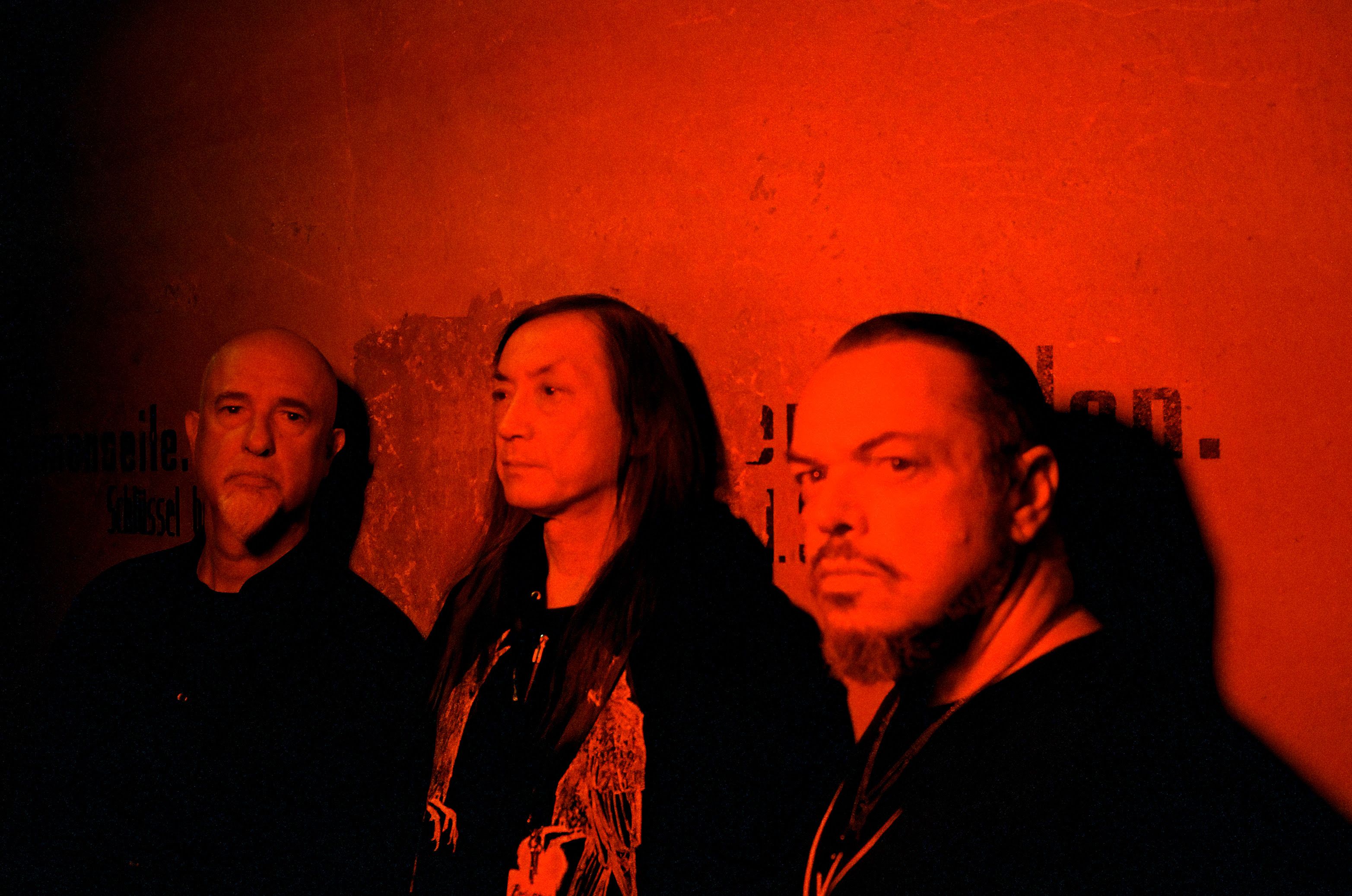 Eraldo Bernocchi Merzbow Iggor Cavalera Interview Image by Frankie Casillo
“Just beneath the surface of the noise, there’s an ecosystem that blooms precisely because of the noise.”
Video
