Published
Part 1
Name: ETHEL
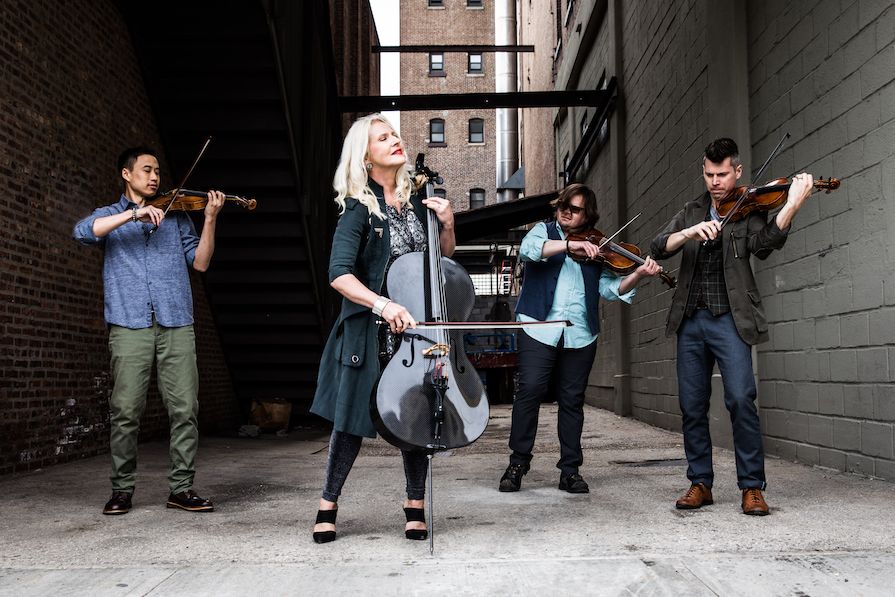
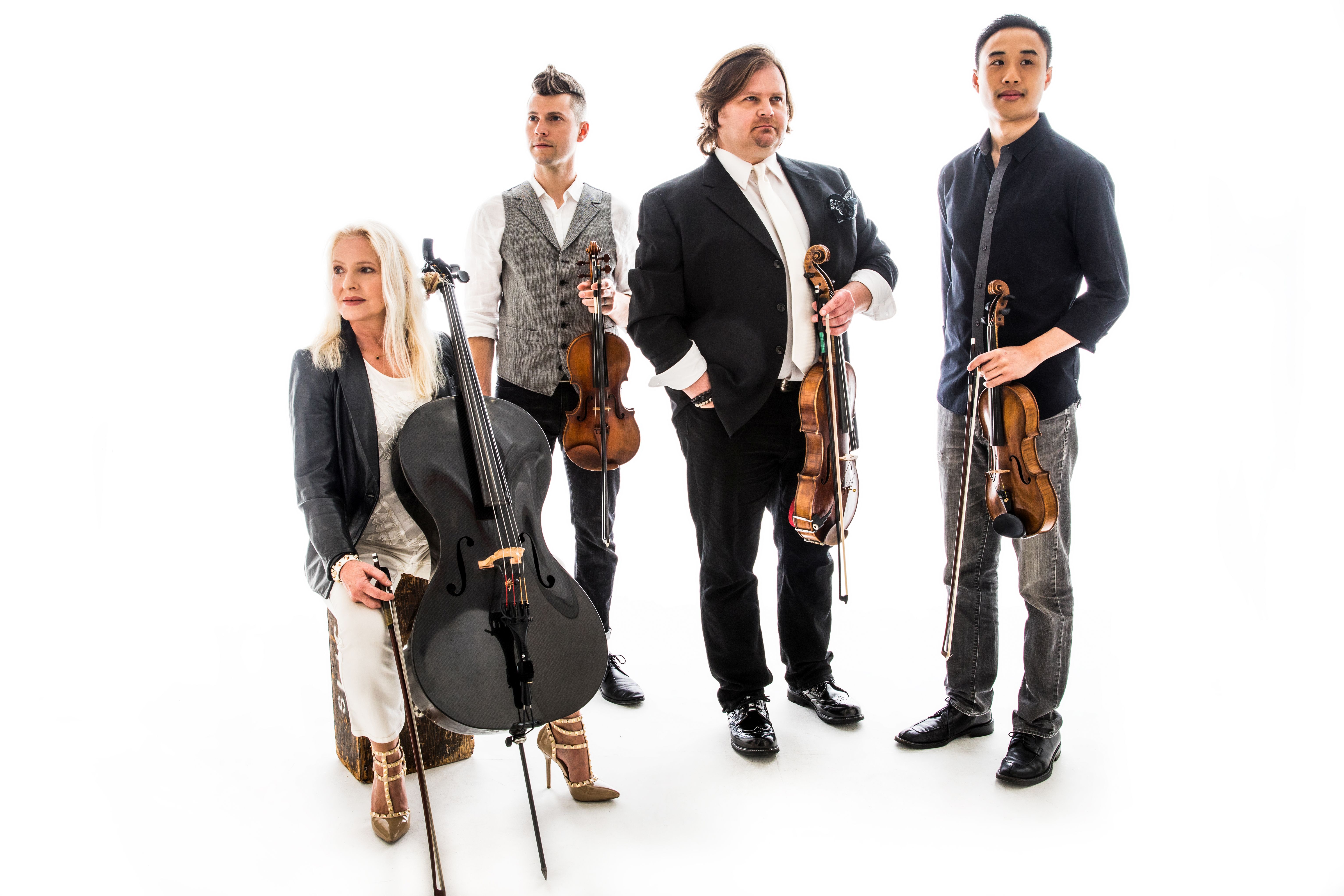
Members: Dorothy Lawson (co-founder, cello), Ralph Farris (co-founder, viola), Kip Jones (violin), Corin Lee (violin)
Nationality: American
Current release: ETHEL's new album Persist is out via Sono Luminus. It features pieces by composers Allison Loggins-Hull, Xavier Muzik, Migiwa Miyajima, Sam Wu, and Leilehua Lanzilotti.
If you enjoyed this ETHEL interview and would like to know more about the ensemble and their music, visit their official homepage. They are also on Facebook, and Instagram.
When did you first start getting interested in musical interpretation?
(Dorothy Lawson): My mother was a highly-trained pianist, who had studied with the same teacher as Glenn Gould. My father adored music, mostly classical, and prided himself on his home stereo equipment, which filled the house with glorious sound whenever he was home.
We went to live concerts all the time. My parents were knowledgeable, and would discuss the merits of certain performances with real pleasure. When I was seven, they took me to see Jacqueline Du Pré, the British cellist, who soon thereafter was diagnosed with MS and had to retire from performing before the age of thirty. She was bold, beautiful, strong and intensely expressive - a breathtaking contrast to the carefully elegant men on the stage at that time.
Her image was emblazoned on my heart, giving me a model I could love and aspire to.
Which artists, approaches, albums or performances captured your imagination in the beginning when it comes to the art of interpretation?
(Dorothy Lawson): Classical music filled our house. Glenn Gould playing Bach and Hindemith.
Mstislav Rostropovich playing Prokofiev, and Brahms with Igor Oistrakh.
The Budapest Quartet playing Beethoven.
Solo piano works, chamber music, symphonies, and operas. The names of the composers and the performers were daily household words. I realize now, how my parents’ taste shaped my own, guiding my attention to performances that were dramatically charged, and performers who lost themselves in the act. It was perfectly clear, that they held Music and Art to be among mankind’s greatest achievements.
The only pop artists who made it into the rotation were The Beatles, to whom we listened with just as much pleasure and admiration, like treasured members of the family.
(Ralph Farris): I also came from a musical family. My father was a bass-baritone and a choral director, and my mother is a pianist, organist choral director. My parents gave their lives to music, and their commitment and drive lives with me to this day, as do their interpretations.
My earliest, sweetest memory is of sitting on our living room floor, listening to my mom practicing Franck’s Prélude, Fugue et Variation on her organ. (Yes, we had a tracker in the living room!) When I hear that piece in my mind’s ear, it’s my mom’s interpretation that lives with me.
And my dad had the most extraordinary voice; he could bring you to tears in an instant. His reading of Malotte’s The Lord’s Prayer, which he would sing everywhere (with my mom at the organ) would just melt me. I’ll pull up his recording from time to time for a good cry, because no one can sing it like he did. NO ONE.
Are there examples for interpretations that were entirely surprising to you personally and yet completely convincing?
(Corin Lee): As an audience member, if an interpretation is surprising and convincing to me, most likely I have just been blown away. And when I'm blown away, I just enjoy being in that space of wonder, and I relish the moment. Kudos to the artist for bringing me there, and I don’t want to spoil it! (But if I had to, sure, I could and would look to all sorts of interpretations, both for historical context and for ideas, both good and bad.)
I will say, from the moment I started working with ETHEL, all sorts of interpretations and stylistic choices came to the fore (very convincingly!): freeing the sound from constant vibrato, for one; breaking down the fourth wall, for another; and battling it out with Kip as the violins stand in the center of the ensemble …
Lots of surprises that felt just right to me, and still do!
What do you personally enjoy about the act of interpretation? Are you finding that this sense of enjoyment is changing over time?
(Corin Lee): I enjoy it in two ways. The first is if I played the piece a million times, I don't think much and the interpretation naturally changes in the moment based on the environment and can change quite drastically as I'm not worried about technique so much.
If I play a newer piece, I enjoy that I can present my first focused and deliberate musical interpretation of the piece to an audience!
Overtime, my enjoyment doesn't change too much as sharing an interpretation is always a privilege.
How much creativity is there in the act of interpretation? How much of your own personality enters the process?
(Dorothy Lawson): The performer brings music to life. Their role is intensely, unavoidably personal, even when every gesture and nuance has been painstakingly notated by the composer. Each performer’s body, training, personality and philosophical attitude uniquely affect how they, themselves, perceive and deliver it.
The longtime accumulation of fine executions by master performers plays a role in the reputation and popularity of composers and their pieces over generations and centuries. Performers are their face to the public. The performer’s skill and charisma matter.
We are the champions of the composer, and may bring insights to the work of which even the composer is unaware.
Could you describe your approach to interpretation on the basis of a piece, live performance or album that's particularly dear to you, please?
(Kip Jones): I think of Interpretation as pattern-matching across an understood boundary or gulf.
A successful interpretation could be likened to a lossy compression process; the fundamental message is preserved, but there is some point at which details are ignored. As this intimately engages the human psyche, successful interpretations vary wildly, each choosing (by intuition and method) patterns to demonstrably translate, as well as information to wilfully discard.
Forgive me for first invoking the unbodily, but let’s consider Pierre Menard, Author of the Quixote: a story by Borges in which a 20th century individual rewrites Cervantes’ original, word for word, each line reborn by the fresh context of his modern life and perspective. Nothing is changed, and yet our perspective is ‘born again’. (I also think of Safran Foer’s The Tree of Codes, a work made by redacting most of Bruno Schulz’ The Street of Crocodiles.)
A recent favorite is Slow Beethoven by Jeff Zeigler, Lara St. John et al, who played the Op. 131 fugue at one-sixth the speed, and reamped it into a half-million gallon water tank. Each note becomes a landmark, each cadence.
[Read our Jeffrey Zeigler interview]
The Bad Plus played The Rite of Spring as a piano trio! I heard them play it, and the sense of challenge and risk was absolutely electric.
I did not enjoy the production of it, but Alarm Will Sound’s spirit and performance of Steve Reich’s Tehillim and The Desert Music is out of this world.
What this means for my “approach” to interpretation, I suppose, is that we choose a point on a continuum between Mimesis (Pierre Menard) and Original Work (The Tree of Codes), passing quickly from Mimesis through Ornamentation and Phrasing, to Structural Requirements, to Contextual Requirements, to “Covering” to “Arranging” to “Recomposing” to “Derivative Work”, to completely Original Work that demonstrably bears the imprint—a child, if you will—of the Interpreted Work.
I further suppose that any truly good interpretation will proclaim some hidden or latent facet of the original—if not an altogether new one for the whole world, at least a deep and personal one for the interpreter, who has probably sacrificed to obtain it.
What was your own learning curve/creative development like when it comes to interpretation - what were challenges and breakthroughs?
(Ralph Farris): I was raised with a certain reverence for performance practice and (especially) the printed score, that drove and served my first 25 years in music. Basically, I got to where I was when we founded ETHEL, because I was good at the Classical game. At the same time, I was painfully aware that my industry was slowly being strangled for its self-congratulatory closing of ranks.
The other three founding ETHEL members — Mary Rowell, Todd Reynolds and Dorothy Lawson — all brought with them seriously impressive histories of working in most every style of music that I had ever heard of, and they had all in their own ways come to recognize that the performer is in fact in conversation with the composer. It is NOT a one-way street! (Ask any living composer, and they will tell you the same.)
But wow, was that concept ever a challenge for me back then! I recall at one point we read a Mozart quartet, and Todd threw in an ornament on a certain cadence that just rocked my world. I was befuddled (traumatized?) for weeks—to think that a sacred Mozart score could be altered?!?
But we continued our concentrated work together and tackled big contemporary masterwork after big contemporary masterwork, and eventually it came to me, that the little dots on the page are not the sacred thing; rather, it is the conversation between composer, performer, and audience that is to be cherished and elevated. (Thank you, Todd, Mary and Dorothy, and all ETHEL members to follow, for opening my ears and my heart!)
So! To all of you who would make concert music — Bring your ornaments, your fresh tempi, your revisionist theories on performing the repeats in a minuet! And if you are lucky enough to work with living composers, open your mouth and let them know your insights and your ideas, or better — SHOW THEM! All in the spirit of collaboration and invention and keeping our work fresh for performers and audiences alike.