Published
Name: Etienne Charles
Nationality: Trinidadian
Occupation: Trumpet player, percussionist, composer, improviser
Current Release: Etienne Charles 's Creole Orchestra, featuring Rene Marie, is out via Culture Shock. Order your copy on CD and LP.
Recommendations: Book - A Map to the Door of No Return - Dionne Brand; Music - Shirley Horn - Here’s to Life
If you enjoyed this Etienne Charles interview and would like to know more about his work and music, visit his official website. He is also on Instagram, and Facebook.
Do you think that some of your earliest musical experiences planted a seed for your interest in improvisation?
That’s possible. Though my earliest musical experiences were as a listener.
When did you first consciously start getting interested in musical improvisation? Which artists, teachers, albums or performances involving prominent use of improvisation captured your imagination in the beginning?
In Trinidad we do this style of singing called Extempo. Which is where you’re called to sing a verse on the spot about a person or topic. So that, I’d say were my first improvisations.
Then soon after that I started hearing pannists as well as horn players and guitarists improvise in different settings. One of the first times I remember was at Phase II panyard and I heard Boogsie Sharpe Ramajaying (improvising).
Tell me about your instrument and/or tools, please. What made you seek it out, what makes it “your” instrument, and what are some of the nost important aspects of playing it?
I didn’t seek out the trumpet. My uncle sent one for me when I was 10. Back then there was a lot less technology for us to engage with, so for a bit of time everyday, I played my Trumpet.
Most important aspects of playing it are sound production, breath, and being as singable as possible. What makes it mine, is that the trumpet has the perfect balance of rhythmic and vocal capabilities to cause effect (dancing, emotion, spirited discourse).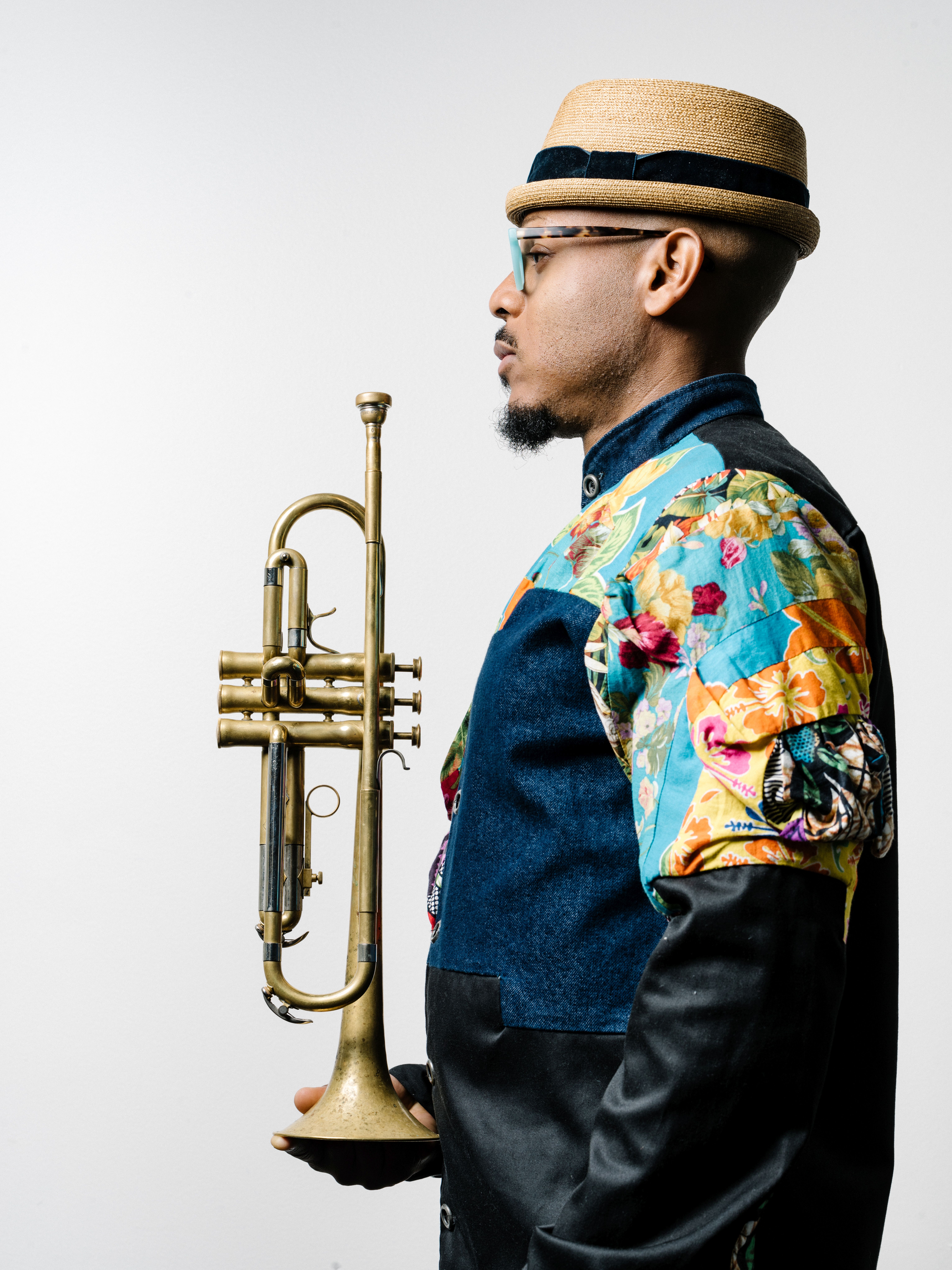
Etienne Charles Interview Image (c) the artist
How would you describe your own relationship with your instrument – is it an extension of your self/body, a partner and companion, a creative catalyst, a challenge to be overcome, something else entirely?
I think my instrument is all of the above! There are definitely challenges, but It’s always next to me.
It’s in my bed right now, next to me.
Derek Bailey defined improvising as the search for material which is endlessly transformable. What kind of materials have turned to be particularly transformable and stimulating for you?
I always start with rhythms, because they can immediately communicate with both musicians and non-musicians.
As a traveller, global rhythms and phrases are extremely stimulating for me. Understanding their history and seeing how stories are told through rhythms is always the start of something really creative for me.
Do you feel as though there are at least elements of composition and improvisation which are entirely unique to each? Based on your own work or maybe performances or recordings by other artists, do you feel that there are results which could only have happened through one of them?
I see composition as slow, micro managed improvisation, and improvisation as fast, sometimes reactionary composition that communicates in real time.
I think they feed off of the same idea and inspiration.
When you're improvising, does it actually feel like you're inventing something on the spot – or are you inventively re-arranging patterns from preparations, practise or previous performances? What balance is there between forgetting and remembering in your work?
I see this as both. There’s always the quest to say something new, or provoke a particular reaction. But then there’s the language we’ve been using for over a century.
I definitely balance the known and unknown. Depending on the vibe of the song/band it could be more or less exploratory.
Are you acting out parts of your personality in your improvisations which you couldn't or wouldn't through other musical approaches? If so, which are these? What, would you say, are the key ideas behind your approach to improvisation?
I think everyone’s personality shows through their improvisatory practice. The quick thinkers able to quote tunes in any key etc, the soulful players who emote through their lines, rhythmic folks who can develop one small nugget into a giant monster and the harmonic players who create numerous colours and shapes during their solo.
Key ideas behind my approach are rhythm and harmony, trying to be on the same page as the band.
In terms of your personal expression and the experience of performance, how does playing solo compare to group improvisations?
Both have their benefits. Group improvisations have a level of intentful interaction that is melodic that immediately spurs more creation.
In your best improvisations, do you feel a strong sense of personal presence or do you (or your ego) “disappear”?
In best improvistions yes, I do feel personal presence.
In a live situation, decisions between creatives often work without words. From your experience and current projects, what does this process feel like and how does it work?
I feel like this is our way of communicating. The decisions are based on where the music tells us it wants to go.
This happens in real time. So decisions are really based on taking yourself out of the equation and letting the music happen.
So really, it’s the decision to take yourself out of it that allows for all the other decisions to naturally be made in real time as the music progresses.
Stewart Copeland said: “Listening is where the cool stuff comes from. And that listening thing, magically, turns all of your chops into gold.” What do you listen for?
I listen, in the moment, for what was already played, to see what to play next.
In recordings, I listen for the space, and how it helps the music to breathe.
There can be surprising moments during improvisations – from one of the performers not playing a single note to another shaking up a quiet section with an outburst of noise. Have you been part of similar situations and how did they impact the performance from your point of view?
I have. They continue the many diverse elements of performance.
Silence is key from some, noise is key from some. But one note can change the direction of music.
I have always been fascinated by the many facets of improvisation but sometimes found it hard to follow them as a listener. Do you have some recommendations for “how to listen” in this regard?
Listen for conversational elements. Listen for rhythms being repeated, or transferred across the band and the development of harmony as a solo evolves.
In a way, improvisations remind us of the transitory nature of life. When an improvisation ends, is it really gone, just like a cup of coffee? Or does it live on in some form?
It definitely lives on, at the least in the effect of what was said musically on the musicians as well as the audience.
It’s kind of like words of wisdom. They live with you long after they’ve been said.