Published
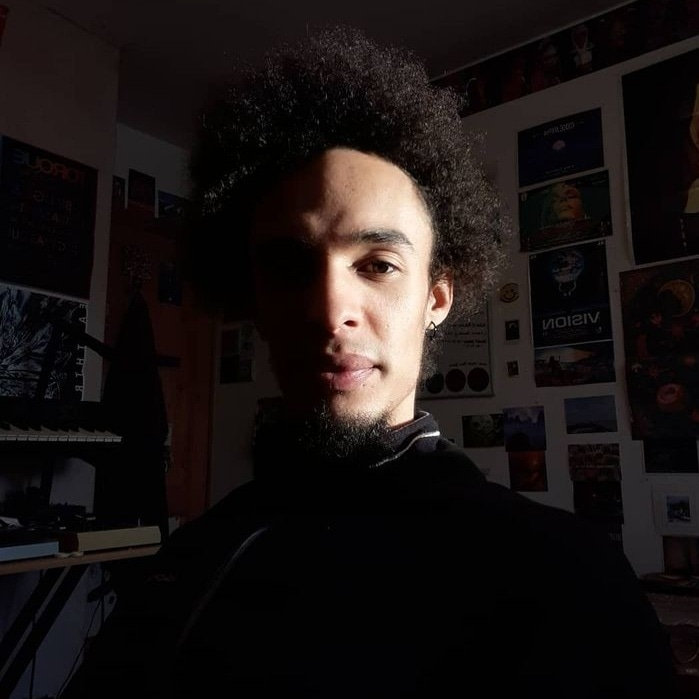
Name: Seb Uncles aka Eusebeia
Nationality: British
Occupation: Producer, DJ
Current release: Eusebia's new album The Wyrding Way is out via Livity Sound.
If you enjoyed this Eusebia interview and would like to stay up to date with his music, visit him on Instagram, Soundcloud, and bandcamp.
When I listen to music, I see shapes, objects and colours. What happens in your body when you're listening? Do you listen with your eyes open or closed?
I can’t specify exactly what happens in my body when I’m listening to music, but there is some kind of reaction.
I may either be inclined to open my eyes further and look at the environment around me more closely or intensely, or close them for a short time in a moment of surrender, understanding or catharsis before opening them again.
How do listening with headphones and listening through a stereo system change your experience of sound and music?
With headphones you experience the music similarly to how you would experience the sounds around you in nature/any given environment, but it’s more internalized and restricted to the individual with headphones.
But with listening on a stereo system you can get a more physical experience. Particularly with larger sound systems where the frequencies are more pronounced and the sound takes on a physical aspect.
This can give an added level of depth and ultimately a new and heightened experience of hearing a piece of music.
Tell me about some of the albums or artists that you love specifically for their sound, please.
All of the work from Boards of Canada is consistent but varied. I can’t think of another artist's sound that has remained so unchanged over the years, but is always interesting and ever changing.
I think this may have something to do with the types of sounds and approaches they use for their music. This creates a very timeless aspect where any definitive notion of past, present or future isn’t obviously evident, yet all three are present giving their music the ability to transcend time.
I have also sought to create music that has a timeless quality to it. For my track “Question of Time” on The Wyrding Way album, I used a synthesizer which was originally released in 1982, and created a sound which has a sonic quality of that era, but also sounds relevant today.
The aim of this was to highlight the past within the present and show how sound and emotion can be timeless which raises questions about how we perceive time and the concept of time itself.
Do you experience strong emotional responses towards certain sounds? If so, what kind of sounds are these and do you have an explanation about the reasons for these responses?
Yes, but I don’t think singular sounds typically cause an emotional response.
It’s not until you introduce some kind of melody or chord that an emotional response begins to occur, because this is where the language and magic of music/sound becomes apparent and the ability to express emotions, feelings and experiences takes place.
We have emotional responses to music because of the emotion present in the music, providing there is real emotion in there. An important role of music is to engage with the human emotional spectrum and provide refuge, nourishment and understanding and this is an integral part of music and the listening experience.
Sounds that remind us of the past, or affirm our present (musically and/or emotionally) can stir feelings within us and I feel the more that music can do this, the better.
In my track “Wyrding Way” I wanted to create a feeling of nowness and optimism with the knowledge of what came before, but with a resounding feeling of the present and a look to the future.
Have you ever been in spaces with extreme sonic characteristics, such as anechoic chambers or caves? What was the experience like?
I’m quite attracted to lots of different spaces, whether that be the interior of a warehouse or hall, or a cave, woodland or field.
Every space has its own interesting sonic characteristics especially when you take into account the space itself, and not just the things in that space which make a sound.
This is where you can begin to experience the space itself and appreciate its beauty and grandeur.
What are among your favourite spaces to record and play your music?
In terms of location, for performing - being outdoors/in nature is a great place to play - just having natural areas close by for playing/recording is much more preferable for me because I like these areas anyway.
Having said that, I am comfortable in buildings and clubs too. In terms of listening to the music, I feel it lends itself best to non/less urban environments with lots of space to take in the surroundings.
Do music and sound feel “material” to you? Does working with sound feel like you're sculpting or shaping something?
Yes, working with sound is very much like sculpting or shaping something - it’s the sonic equivalent of working with clay or paint, the medium is the only difference.
How important is sound for our overall well-being and how far do you feel the "acoustic health" of a society or environment is reflective of its overall health?
Music and sound is imperative for health and it plays a bigger part in our well being than we realize.
I like to think awareness of this is on the up, for example “quiet areas” on public transport and in buildings are a reflection of people recognizing that excessive noise/loud sounds can be unsettling for some. So steps have been taken to create a more harmonious environment for people which is great, as is the use of ambient music in certain spaces.
However, no sound or quiet sound does not necessarily equal peace or harmony, and loud music or sounds can be just as beneficial and cathartic.
Sound, song, and rhythm are all around us, from animal noises to the waves of the ocean. What, if any, are some of the most moving experiences you've had with these non-human-made sounds?
Listening to waves and wind through the trees have to be two of the most consistent and enriching sounds of the natural world for me.
We can surround ourselves with sound every second of the day. The great pianist Glenn Gould even considered this the ultimate delight. How do you see that yourself and what importance does silence hold?
It depends what form that sound comes in. Good music and some natural sounds can be welcomed almost always.
But silence can be just as important as non silence as it helps to relax us, process and hear our inner world more clearly.
Seth S. Horowitz called hearing the “universal sense” and emphasised that it was more precise and faster than any of our other senses, including vision. How would our world be different if we paid less attention to looks and listened more instead?
Unfortunately for the past 60 years or thereabouts there has been an excessive focus on image which has somewhat diminished the quality of listening and hearing for a lot of people.
Fortunately some people have been creating intently and listening properly regardless, but there does seem to be an imbalance between music/sound and image in popular music and culture that needs to be evened out.