Published
Name: Evan Chapman
Nationality: American
Occupation: Composer, drummer, producer, filmmaker
Current release: Evan Chapman's new album Reveries is out October 11th 2024 via Better Company.
Pure drumming recommendations: Glenn Kotche’s Monkey Chant is a classic and has been a longtime favorite of mine.
I have also been obsessed with Eli Keszler’s LIVE albums lately; he creates a fully immersive world that is somehow simultaneously dense and sparse.
There is also an artist named Etienne Nillesen I’ve been fascinated by, who focuses on getting tonal resonances and harmonies out of snare drums.
[Read our Eli Keszler interview]
[Read our Etienne Nillesen interview]
If you enjoyed this Evan Chapman interview and would like to know more about his music, visit his official homepage. He is also on Instagram, and twitter.
What was your first drum set like and what are you using today? What, to you personally, are factors in terms of build and design that you appreciate in drums and percussion instruments?
Aside from pots and pans, my first instrument that resembled a proper drum set was a children’s beginner kit which had a bass drum, one tom-tom, and one cymbal. After outgrowing that, I graduated to a 5-piece Pearl Forum kit in middle school, which truly endured a beating with various garage punk bands.
In high school I upgraded to a Tama Starclassic Performer, parts of which are still in rotation, and then, before I embarked on my first-ever full national tour in 2016, I got my current kit which is a custom-build made by a company called SJC. 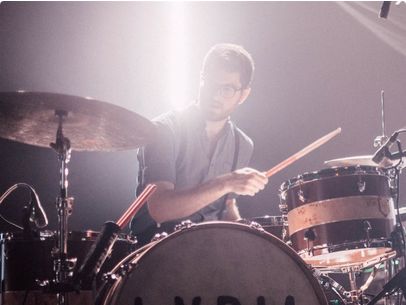
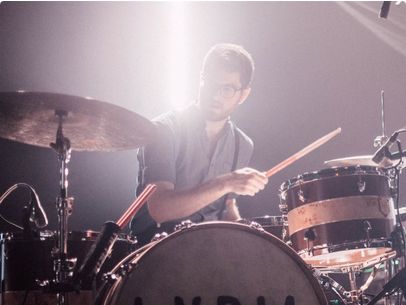
Evan Chapman behind his custom-made SJC Kit
The main thing I look for in my equipment these days is whether it is versatile and can endure drastic alterations to enable sparks of creativity and nontraditional ways of thinking/playing; I am always rearranging, adding, removing, stacking, tuning, and detuning to keep things fresh, and I need equipment that can stand up to that constant tinkering.
Late Rush-drummer Neil Peart said: “The equipment is not an influence. It doesn't affect the way I play. It's an expression of the way I play.” What's your take on that?
I think it’s a little bit of both! I find myself being influenced by the way my equipment is set up and sounds at any given moment, as it pulls me towards creating in a certain way. That said, my equipment is what it is because of the choices I made, so it inevitably becomes an extension and expression of my ideas.
An important part of the creative process for me is being surprised and excited by the tools I’m using, and always trying to find ways for them to inspire me to think outside of my usual boxes.
Drumming is an integral part of many cultures, and traditions. Which of these do you draw from in your playing – and why?
I grew up on rock and punk music, and that energy still lives very strongly inside me.
Even though I went to classical music school and now write music that leans towards “contemporary-classical”, I typically still incorporate loud, driving, rock-inspired drums however and whenever I can - whether or not I’m aware of it.
What were some of the main challenges in your development as a drummer / percussionist? Which practices, exercises, or experiences were most helpful in reaching your goals?
A developmental challenge that comes to mind is finding my own distinct style and voice.
Musicians learn through emulation - endlessly playing along to our idols’ records and learning from books/materials others have written - but there came a point in my development where I began asking myself, “why would someone specifically want to hear me play over someone else?”. This set me on a journey to become more confident in my own voice, which is often difficult but I believe is ultimately necessary.
I have been working on trusting my instincts and telling myself that what I have to say musically is valid and singular.
What do you think you're doing differently than other drummers?
My music often deals with the relationship between acoustic & electronic instruments, and I am almost always working towards finding ways to blur the lines between those two sonic worlds.
I am constantly incorporating elements into my acoustic drum/percussion playing that make the instruments sound more “electronic”, either through physical alterations or through post-production effects, and my playing is heavily inspired by DAW-based drum programming.
How do you experience the concepts of "groove," "swing," and "rhythmic feel" in music?
These concepts are very intuitive and often hard to describe with words. Every musician grooves and swings in whatever way they feel is appropriate for the musical context, which makes up the overall rhythmic feel.
With my music specifically, I am often interlocking with electronic loops and rhythms, and so I find myself molding my rhythmic style into whatever feel is being generated by the electronic elements I’m working with at the time.
How do time signatures and tempo affect our perception of rhythm?
Time signatures and tempi can mean very different things to very different people. If you are a music theory nerd, you may find yourself counting every subdivision of a particular rhythm or thinking consciously about how fast or slow something is, but if you are experiencing music as a more casual listener, the only thing that matters is how you are being affected by the sum of all the elements.
Different time signatures show up in my music, but always because they fell naturally into that particular cycle vs. because of any conscious numerical decisions I made.
What is the relationship between harmony, rhythm and melody? How do non-percussion instruments contribute to the overall rhythmic texture of a piece?
This is very dependent on the type of music that is being created - for example, maybe the harmony and melody make the rhythm feel a certain way, or the rhythm of the harmonies progress the music along in a certain way, or the way the melody rhythmically interacts with the harmony makes you hear the harmony in a different way.
Each element of music interacts with the others to result in a sum that’s greater than its parts, and instrumentation has a great deal to do with these interactions.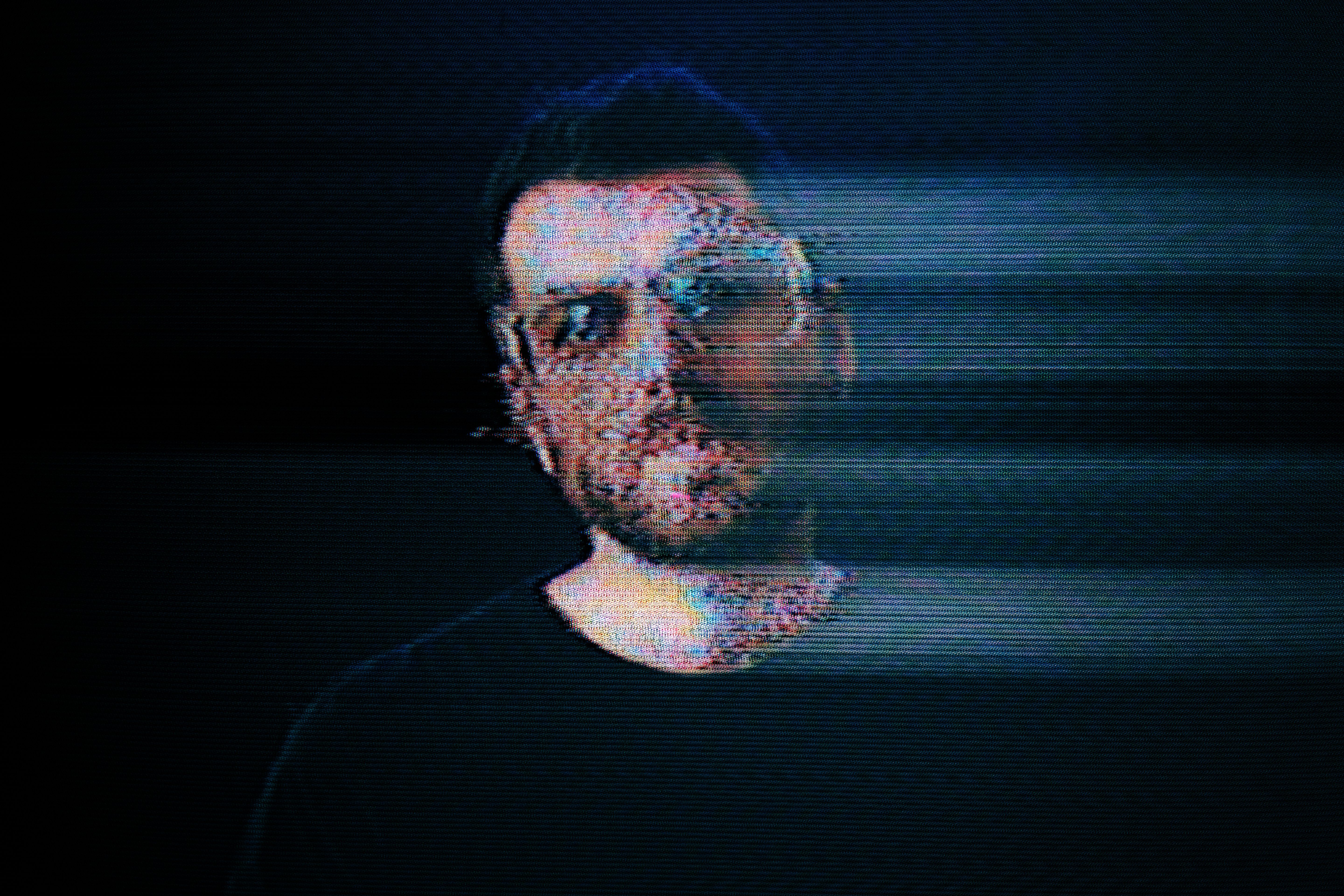
Evan Chapman Interview Image by Evan Chapman
Different drums have a distinct sound and drums and percussion are also timbral instruments. What drum sound are you aiming for and how are you making use of the timbral potentials and possibilities of your instruments?
I am aiming for whichever drum sound feels the most appropriate within the context of the music at any given moment. Like mentioned before, I am often trying to fit acoustic drums into many other layers of electronics, so I make adjustments to the drums accordingly (dampening vs. not, combining/stacking instruments, tuning high or low, etc).
I also enjoy leaning into extremes within my kit, i.e. a heavily-muffled snare drum paired with an extra-boomy kick drum or vice versa, which can achieve an effect similar to pairing disparate samples on a programmed drum kit.
In relation to drumming, Stewart Copeland said: “Listening is where the cool stuff comes from. And that listening thing, magically, turns all of your chops into gold.” What do you listen for?
I agree that all the cool stuff comes from listening! I strive to listen to the composite of all individual parts, and make decisions based on what will elevate the sum from all those parts. Often this means incorporating decisions about production and mix into my playing in addition to rhythm and melody - I am always trying to sonically match my instruments to whatever context they’re existing in.
There was a time when I was mostly concerned about the complexity and density of what I was playing, but I have since left that behind and now try to serve the music - which has more to do with my ears than my hands.
Do you feel that honing your compositional / songwriting skills has an effect on your drumming skills?
Yes, both compositional skills but also (and maybe more significantly) production skills.
Honing my mixing chops and getting to know my way around DAWs, plugins, and VSTs has supplied me with many concepts that I translate to my playing on acoustic instruments. I have gotten to know how different instruments get picked up by different microphones and respond to things like EQ and compression, and I adjust my playing accordingly whether I’m consciously aware of it or not.
Because I write all of my music on my computer, composition and production become one in the same - it is impossible to do one in a vacuum without the other, and my playing reflects this.
How has technology, such as drum machines and sequencers, impacted the way rhythm is created and perceived? Has it been a concrete influence on your own approach?
Through one lens, technology can be seen as maybe having pushed us toward a more “quantized” and stiff approach to rhythm, but through another, it can be appreciated for pushing us towards new rhythmic possibilities we never dreamed of.
I identify with the latter camp, and find myself inspired by the ways drum machines and synthesizers operate without any physical limitations and how I might be able to incorporate some of that into my own playing.
For example, transcribing and attempting to play Aphex Twin’s “Cock/Ver10” on drum kit is one of the most challenging yet rewarding things I’ve ever done, and these kinds of exercises inspire me to think outside of my usual “human” comfort zone.
Physical strain is a particularly serious issue for many drummers. How does it manifest itself, how do you deal with it and in how far does it affect your creativity?
The times I’ve struggled most with physical strain have been when I was on tour, playing ~90min sets of loud rock music every night across the country.
I found (the hard way) that there is a fine line between not being warmed up enough and being too warmed up - I subscribed to a very strict and thorough warm-up routine every night, but ended up straining muscles in my wrists and had to consider that maybe I was burning myself out before I even stepped on stage.
I have also gotten heavily into running in the past couple years, with a couple full marathons under my belt, and I think this has helped with my fitness and stamina for playing drums.
Many recording engineers have remarked that the drums can be particularly hard to capture. What, from your perspective, makes drums sound great on record and in a live setting?
That is a very subjective question and very dependent on context, but I do think that if a sensitive drummer is playing on an appropriately-tuned kit in a good room, the engineer’s job can be more artistic and creative vs. purely one of “salvaging”, which unfortunately is so often the case.
When paired with heavy electronic elements, I always find it an interesting question whether acoustic drums should be sonically juxtaposed from the “in the box” instruments - i.e. feeling especially human, and/or having lots of natural room sound in the mix - or be purposefully indistinguishable from the electronic elements, maybe by being recorded in a more dry manner and/or being heavily processed.
I have experimented with both of these approaches, and find that they can each be interesting in their own way.
Drums and percussion are remarkably often used for physical therapy / healing. What, from your point of view, makes them particularly suitable tools for this?
Drums and percussion are universal - there is a lower barrier to entry for picking up a mallet and striking a drum versus producing a tone on a french horn, for example.
Like vocalizing, the movements of striking and shaking are very therapeutic and have been ingrained in all cultures throughout history.