Published
Name: Eyvind Kang
Occupation: Composer, violist
Nationality: American
Recent release: Eyvind Kang's new album Riparian is out October 31st 2025 via Kou.
Global recommendations: In Winnipeg, I would visit the Red River. In LA visit the LA river. And take some pictures.
Things I am passionate about but rarely get to talk about: Too many. Total revolution. Things in the realm of ecology, shoegaze, nihilism. Feminism.
If you enjoyed this Eyvind Kang interview and would like to stay up to date with his music, visit him on Instagram.
When did you first consciously start getting interested in musical improvisation? Which artists, teachers, albums or performances involving prominent use of improvisation captured your imagination in the beginning?
As a kid plucking violin along with the radio in Iceland.
Tell me about your instrument and/or tools, please. What made you seek it out, what makes it “your” instrument, and what are some of the most important aspects of playing it?
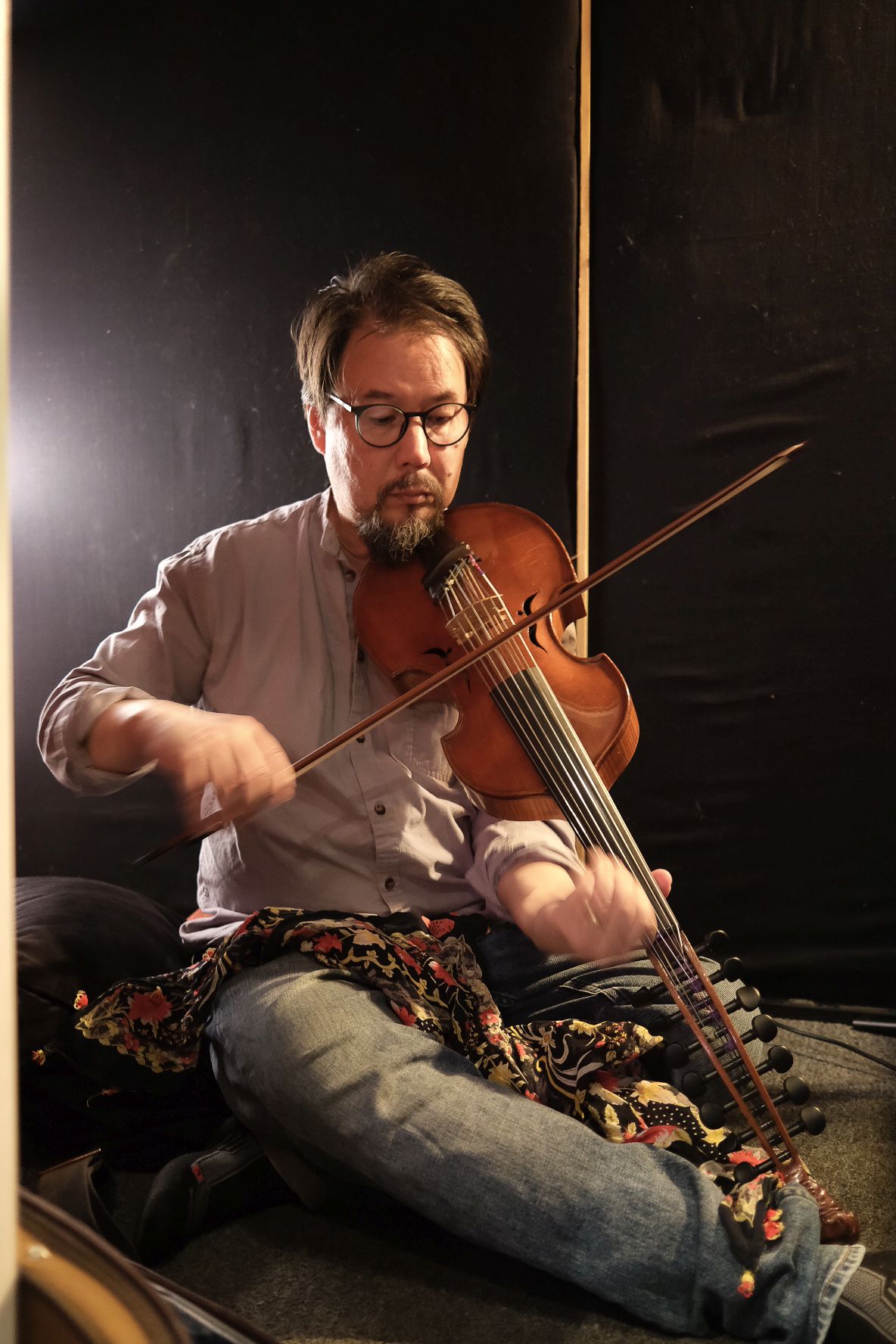
On Riparian, my instrument is the viola d’amore. It’s an instrument in which the playing strings are above, the resonant strings below, and there is a combined sound.
There is no drone per se, instead, you get these resonances which I have already tuned to the riparian modes. Its not reverb that you hear, its acoustic resonance.
How would you describe your own relationship with your instrument – is it an extension of your self/body, a partner and companion, a creative catalyst, a challenge to be overcome, something else entirely?
… not an extension, but maybe an intention?
Derek Bailey defined improvising as the search for material which is endlessly transformable. What kind of materials have turned to be particularly transformable and stimulating for you?
Pitched sound and melodies are endlessly interesting.
I used to do noise as well, but I’ve narrowed it down to notes lately
Do you feel as though there are at least elements of composition and improvisation which are entirely unique to each? Based on your own work or maybe performances or recordings by other artists, do you feel that there are results which could only have happened through one of them?
Feels like you toggle between.
But even within improvisation or “spontaneous composition” as Julian Priester calls it, there’s a difference of recognition as opposed to construction.
When you're improvising, does it actually feel like you're inventing something on the spot – or are you inventively re-arranging patterns from preparations, practise or previous performances? What balance is there between forgetting and remembering in your work?
I practiced and rehearsed a lot for the Riparian album, and came up with some kind of flow charts.
But these kinds of things went out the window in the studio, because so many new ideas came up, especially on "Riparian B."
Artists from all corner of the musical spectrum, not just “free jazz” have emphasised the importance of freedom in their creativity. What defines freedom for your improvisations?
I want to go into more detail in the vectors of the relations between notes - it seems like more and more and more space emerges there.
Taking your recent projects, releases, and performances as examples, what, would you say, are the key ideas behind your approach to improvisation?
It's a solo music practice which is similar in one way to meditation, and in another way to prayer. So I’m really interested in the relations between meditation styles and prayer styles.
In your best improvisations, do you feel a strong sense of personal presence or do you (or your ego) “disappear”?
Ideally I would want to dissolve, but then there’s always a remainder or gap between what you think you’re doing and what you do - if possible to make room for that, so much the better.
What are some of your favourite collaborators and how do they enrich your improvisations?
My fave collab is Jessika Kenney because we have a duo. We’ve been doing it for a long time, we mind meld, and we study and learn things.
Recently we have been working with a poet, Will Alexander, who kind of exploded the philosophical or poetic part of the convo, espescially those aspects concerning language, sound and imagination.
In a live situation, decisions between creatives often work without words. From your experience and current projects, what does this process feel like and how does it work?
I do it with words and without them, both. What’s important is that they are good words.
Stewart Copeland said: “Listening is where the cool stuff comes from. And that listening thing, magically, turns all of your chops into gold.” What do you listen for?
Resonance.
There can be surprising moments during improvisations – from one of the performers not playing a single note to another shaking up a quiet section with an outburst of noise. Can you tell me about such situations from your own performances and how they impacted the performance?
I’m open to surprises for sure, especially in the form of memories, resonances, emergence, codes, sudden bursts of emotion, or what have you.
As Ruben Blades sang, “life gives you surprises, surprises give you life.”
As a listener, do you also have a preference for improvised music? If so, what is it about this music that you appreciate as part of the audience?
I just want something real.
In a way, we improvise all the time. In which way is your creative work feeding back and possibly supporting other areas of your life?
I think music teaches me to listen, take time, and take things more seriously.
Just like in soccer or basketball, the athletes respond spontaneously to the situation but the ball is always under control.