Published
Name: Fabiana Striffler
Nationality: German
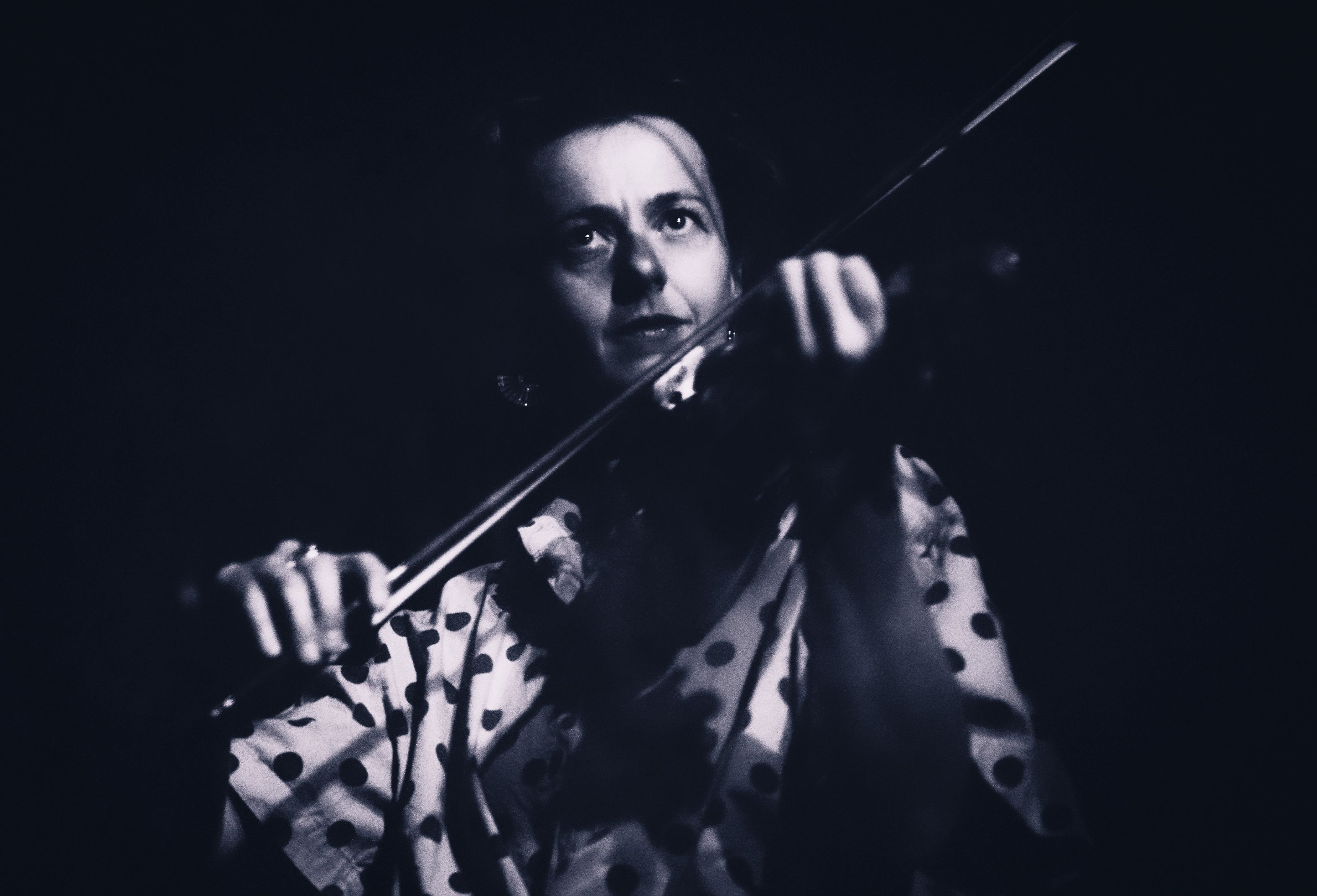
Occupation: Violinist, vocalist, composer
Current release: Fabiana Striffler teams up with Werner Neumann (guitar), and Laurids Richter (drums) aka SHRUNK for their collaborative album Pixie People, out via 577.
Recommendations for Berlin, Germany: I’d recommend Kühlspot Social Club — a small, intimate venue. It’s a place where sound truly lives in the moment.
Topic I am passionate about but rarely get to talk about: I’m passionate about the connection between music and empathy — how sound can create community. I also love bringing music into nontraditional spaces like hospitals or schools.
For me, music isn’t just about performance; it’s about communication and healing. It’s a way to remind people — and myself — that listening is an act of care.
If you enjoyed this Fabiana Striffler interview and would like to know more about her music, visit her official homepage. She is also on Facebook, Soundcloud, and bandcamp.
What were some of your earliest collaborations? How do you look back on them with hindsight?
I was born in Germany and spent the first years of my life with my family in Italy, where I discovered my love for art and music at an early age.
Back in Germany, I played the violin and piano with my sister. Making music together was very important to me, as it was here that I first realized that I could feel a spiritual connection when I immersed myself in music. We also always agreed on the musical interpretation, which was not always the case in our everyday lives as teenagers.
Later, I studied jazz violin and classical violin in Berlin at the University of the Arts (UdK) and the Hanns Eisler Academy of Music, where I began working with musicians from a wide variety of genres—jazz, contemporary music, folk, and experimental. One of my first significant collaborations was with Argentine guitarist Quique Sinesi. We explored European chamber music, improvisation, and Argentinian folklore, attempting to fuse them into a single sound.
Looking back, these experiences were very important for my artistic identity. They taught me to trust my intuition as much as my technique and to enjoy the fact that we don't have to limit ourselves to one common musical language in order to communicate.
There are many potential models for collaboration, from live performances and jamming/producing in the same room together up to file sharing. Which of these do you prefer – and why?
I feel most alive when I’m in the same room with my collaborators. Improvisation is such a physical, breathing process; the energy of being together can’t really be replaced.
But I also enjoy the flexibility of exchanging ideas when we’re in different places. What matters to me isn’t the method — it’s the curiosity and the honesty of the exchange.
How did your recent collaboration with Shrunk come about?
We recently worked together on the Album Pixie People. From my perspective:
* I had been exploring more electronic and textural collaborations beyond my usual acoustic/ improvisational settings — and Shrunk’s work, with its experimental aesthetic on electric guitar and drums, resonated with me as a space to bring my violin into new territory.
* The exchange started through mutual interest - once the possibility came up, I was excited to see how my more improvisational language could complement Shrunk’s musical approach which I could describe partly as very heavy and massive and also based mostly on groove. I love that aspect of the album.
What did you know about each other before working together? Describe your creative partner in a few words, please.
Before we began working together, I knew Laurids Richter and Werner Neumann because of their musical work, but we had never collaborated before.
I was drawn to the atmosphere of their sound — that blend of experimental structure and emotional depth. It felt cinematic yet organic, and I could immediately imagine the violin existing in that world.
When we finally connected, I discovered that both musicians are very sensitive and open collaborators who listen deeply and give space for sound to breathe. I would describe them as intuitive, curious, and beautifully precise.
What do you generally look for in a collaborator?
Openness, risk-taking, and deep listening. I don’t need someone who agrees with me — I want someone who brings their own world into the room.
I love when everyone keeps their individuality but still connects and I like working with artists who see music as an adventure, not a discipline. For me, a great collaborator is someone who’s not afraid to be surprised — who welcomes accidents and imperfections as part of the process.
With Shrunk, I felt that instantly. Their music already has a built-in sense of curiosity, and I wanted to see how my improvisational language could merge with their electronic and rhythmic landscapes.
I think we all wanted to create something that feels alive and unpredictable.
Tell me a bit about your current instruments and tools, please. In which way do they support creative exchange and collaborations with others?
My main instruments are the violin and my voice. I often use my voice like a second instrument — sometimes melodic, sometimes percussive or atmospheric. I also love exploring extended techniques, bowing textures, and spontaneous vocal gestures.
For Pixie People, I only used my violin, allowing it to become part of the electronic fabric instead of sitting on top of it.
Before you started making music together, did you in any form exchange concrete ideas, goals, or strategies? Generally speaking, what are your preferences when it comes to planning vs spontaneity in a collaboration?
We talked a little about the direction, but not about the music itself.
The first note we played was recorded immediately. We wanted to allow listeners to experience the moment of our first meeting and make the process of getting to know each other and exploring together audible.
I prefer to keep things open and let the first sounds guide me. I usually like to have a loose framework, but within that framework I rely on spontaneity. I believe that the best musical moments arise when you stop trying to control them.
Is there a piece which shows the different aspects you each contributed to the process particularly clearly?
Yes — “Wettergott wütend” is one of my favorite tracks.
You can hear the blend of worlds: the raw force from Werner, the positivity from Laurids and my pure joy of weaving through it like a thunderstorm.
The track feels very powerful to me.
What tend to be the best collaborations in your opinion – those with artists you have a lot in common with or those where you have more differences?
The best collaborations are usually with artists who are different from me. Shared vision is important, but difference creates tension and movement.
When someone comes from another tradition or sound universe, it forces me to listen differently — to step outside my habits and discover something new.
What happens when another musician takes you outside of your comfort zone?
That’s where the magic happens. Being outside of my comfort zone means I can’t rely on what I already know — I have to trust instinct.
Sometimes it’s uncomfortable at first, but it always leads to growth. I actually love that feeling of not knowing exactly what will happen next.
Decisions between creatives often work without words. How did this process work in this case?
As I mentioned earlier, we met for the first time as a trio on the day we recorded the album. We just sat down at our instruments, asked the sound engineer to press record, and played the album from start to finish.
Most of the music we played that day is on the album. There are no edits and no overdubs.
What are your thoughts on the need for compromise vs standing by one’s convictions? How did you resolve potential disagreements in this collaboration?
I don’t see collaboration as compromise. For me, it’s about transformation — finding a new space between three artistic worlds.
If there’s trust and curiosity, disagreements turn into creative energy. With Shrunk, everything felt natural; we respected each other’s ideas and gave them room to breathe.
Was this collaboration fun – does it need to be?
Yes, it was fun — the music feels raw to me. I love that.
Do you find that thanks to this collaboration, you changed certain parts of your process or your outlook on certain creative aspects?
It definitely inspired me to move more towards avant-rock and to view my instrument less as a lead instrument and more as part of a raw force generated by the three of us.
That experience shaped me.