Name: Ferdinand Schwarz
Occupation: Composer, sound artist, performer
Nationality: German, Oslo-based
Current release: Ferdinand Schwarz's new album Views Of A Sculpture is out via Superpang.
If you enjoyed this Ferdinand Schwarz interview and would like to know more about his work and music, visit his official homepage. He is also on Instagram, and Soundcloud.
What were some of your first and most incisive listening experiences?
Early ones:
Singing as a child with my family on long car rides
Listening to cow bells in the German alps
Hearing a 1-hour Xenakis piece live when I was eleven years old
Later ones:
Listening to Éliane Radigue’s Kyema, but also Jon Gibson’s Cycles and Arthur Russell’s Tower of Meaning.
I think I had always been drawn to music that allowed me to dissolve in it, whether listening or playing.
When we listen very deeply to a piece, there can be a real sense of connection with the music and the creator behind it, even if they are not present. Is this something you can relate to and how do you experience this connection?
I am sure if such a connection arises it must be primarily a projection of one’s self, a fantasy; but then it is also fantasies that open possible worlds!
I have often sensed this link through other artist’s work. What it tells me, or rather what I see in it, is a hint at how someone perceives the world; a dangerous thing to fantasize about.
When I listen to music, I see shapes, objects and colours. What happens in your body when you're listening? Do you listen with your eyes open or closed?
Eyes closed, laying on the ground, feeling the vibration in all of my body; feet, stomach, skin, bones.
Or: walking, very slowly.
Or: dancing!
I think what I am looking for is a tool to connect, to transcend, to lose ego – outside of conventional categories of purpose and profit.
I am fascinated by what sound can do to the perception of not only our surroundings, but ourselves, really. I often aim for listening to myself listening, observing myself observing.
I know that you appreciate both works performed in a physical space on the one hand the intimacy of headphone listening on the other. How do listening with headphones and listening through a stereo system change your experience of sound and music?
To me it is a lot about the social context of the music I would say.
When listening with headphones I definitely want to isolate myself from my surroundings, dissolving in sound. When listening to sound in space I am discovering my surroundings through sound, yet still aiming for a sense of self-dissolution.
Walking through static sound in space has been quite a transformative practice in my work over the past years: Movement influences what I hear, and what I hear influences how I move.
The name of your solo project Do You Hear What I Hear? is somewhat of an overarching theme for many of your works. I've also thought about this a lot and part of the 15 Questions concept is about trying to understand how many of us are, actually, hearing the same thing when they listen to the same piece.
I don’t think we ever actually hear the same. We’re too caught up in our preconceptions, expectations, and previous experience.
But this also provides the potential of us meeting through listening differently. Doing this leap of interpretation together, enjoying something immaterial together – that to me is just a beautiful activity.
So, as a composer, you create the work, but the audience even if it hears the music in the same space and at the same time, may perceive it very differently. What is it we're sharing in a performance?
We’re sharing a joint commitment to the current sound world. This may vary in intention and interest. But the beauty is that we hear and listen uniquely. It showcases our perceptual creativity.
Being jointly committed to the same situation, to the wonders of our divergent perception, is fun. I think it’s one of the reasons we humans are into music the way we are.
There is a time that we spend listening to a piece, but there is also the time we spend listening to the same piece repeatedly during our lives – some pieces have accompanied me (or I have travelled alongside them) for decades. When we do the latter, the effect of the music can change considerably as well - are there striking examples from your own listening experience and how do you explain this?
Now, I don’t have many decades of listening experience collected yet, but I love how senses can revive memories that our subconscious holds.
Similar to the memory of smell, the memory of sound, specifically if coated with emotions, feels so much further away from language than, say visual memory. I love asking friends how they remember sound. What is the material of your memory? It’s rarely words. Sound uniquely escapes words in this elegant way.
Hearing something for the first time is quite magical to me. If I like what I am listening to, say a song, I usually listen to it many many times on repeat. It’s like building a house inside a song, walking through it, discovering its interior, its rooms and shadows. When I meet this song or sound again much later, I rediscover this house – and the feeling with which I had built it.
Over the past years I have always returned to Catherine Lamb’s Descensus Trio for three celli. It always brings me to a better room.
You've written several pieces over the years guided by the thought of listening and perception. For me, personally, “Inherent” stood out – I think it's absolutely gorgeous and inviting. Can you briefly talk about this one?
Thank you. To me, it’s a rather old work but one that, maybe as mentioned earlier, connects to many sonic feelings from that time.
I think back then I already wanted to play and hear music that just is. That is not telling a story as such; a music that is not narrative, but an environment.
When composing Inherent, I was intrigued by three things: the long exhale of a relaxed breath (as in singing a very long note), the idea of imperceivable development, and the art of Change Bell Ringing.
Emerging from England in the 1600s, the latter is the practice of ringing all possible permutations of a set of church bells by memory. The practitioners use simple formulas to play all variations of say seven different pitched bells and thus arrive at all 5.040 possible patterns. It’s a beautifully simple and effective set of just three or four mathematical operations.
I translated this from melodic to chord permutations. It allows for a rate of development that gently keeps my attention afloat. The piece is also an homage to saxophonist Hayden Chisholm’s piece Love In Numbers and Steve Reich’s Piano Phase.
[Read our Hayden Chisholm interview]
Time and space clearly play an important role in “Inherent.” But, as Salomé Voegelin's liner notes indicate, they remain important for your most recent work as well. How do you see their relationship for your oeuvre? What, from your view as a composer, determines the length of a piece?
I love that you ask about the lengths of the pieces on Views Of A Sculpture, because they are in a way completely arbitrary.
I chose 15 minutes for each track just because it’s both practically achievable and a common duration. I wanted to show that to me these pieces are endless. They neither begin nor cease, and I usually feel I am just joining in when listening to them. I think of them as static or constant music, which at the same time have all these opportunities for our listenings to discover constantly new things in them and in ourselves.
Static sound or extremely slow music differs from other kinds in the way it acts upon memory. Its structure grants a mode of listening in which I can always refer back to myself and my listening at an earlier point; as the sonic abides unaltered, I can observe my changing relation to it.
Static sound is always and continuously at my disposal. I can follow the way my concentration and perception progress and can sense my state of being. Space is something I like to think of in measures of sound wavelength, very nerdy, but quite fascinating to discover and work with all the standing waves and resonant frequencies of a room.
What inspired the writing and setting up of Views Of A Sculpture?
This music is a response to states of listening and perceiving that I was longing for.
In the face of today’s information flood, and the increasing individualization of late-stage capitalism, I am looking for a “coming to senses”, a re-connecting with time, and perception. Throughout the last years, I have been continuously drifting towards ever slower musics, and just when all development comes to a halt, when all narrative ceases, a single vowel sustained, I see a place to just be with our senses again.
I recall recording some organ pieces of mine in a large brutalist church in my hometown Cologne in 2021. While sitting there, sustaining several pitches with weights on the keyboard, I was intrigued by the astoundingly passive way of playing. I was not “playing”, just listening.
With my background as an improvising trumpet player, this “playing” on one of these instruments feels so different. It is not me, my body, or voice vibrating, creating the sound. The sound is “already there”; I am only listening; myself subordinated to sound.
I enjoyed becoming more and more “passive” as an instrumentalist and while I was walking through that chord, I was confronted with an experience of both immense clarity and overwhelming complexity as the chord and its inherent interferences (rhythms & pitches) changed drastically depending on where I stood, or how and how fast I moved. I was creating my own music through only listening.
I became more interested in spatial sound and installation work. From that place came Views Of A Sculpture.
Can you very briefly explain the mechanics behind the phenomena at the heart of the piece?
I am fascinated by the phenomenon of wave interference and diffraction both sonically, but also figuratively, as a mode of thinking two ideas through each other, instead of opposing them. But it is important that I do not need any listener to know or understand any processes behind it. I am not interested in demonstration; I am interested in experience. To me it is a creative tool for experiencing.
Views Of A Sculpture works with the interaction of tones in space. When they meet they create beatings, cancel each other out in some, or add up to each other in other places in the room.
When tuning the chord for Views Of A Sculpture, I am thinking of the harmony not as pitch but as rhythmical and spatial material; different speeds of beating patterns that I tune, shape, and adjust to the current space. LaMonte Young once said “tuning is a function of time”, and it really is a temporal, rhythmical endeavour, like observing a restless ocean of soundwaves.
I could imagine that an important part of the challenge was to arrive at a sound and set-up that really brought out the qualities you were looking for most clearly … How would you describe the creative process for Views Of A Sculpture?
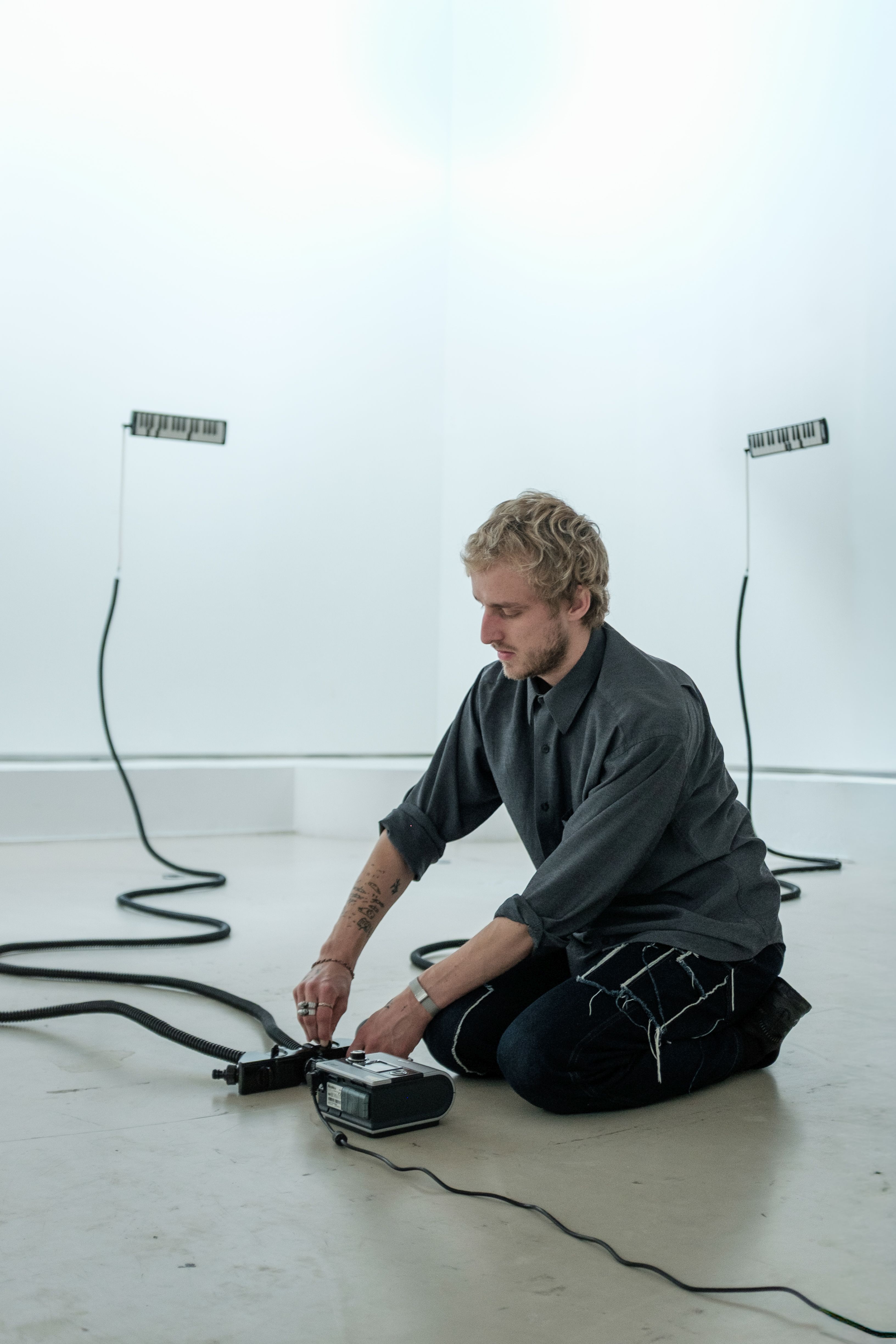
I had spent many months with different harmonic relationships with this setup. I use six melodicas, supplied with air pressure from medical-grade respiratory air pumps. The melodicas produce this quite harsh sound which brings out the interactions of tones very effectively.
While working with and listening to these, – wandering through the space, fine-tuning the instruments – I felt that simple sonic relationships bring forth the right degree of complexity hidden in seemingly plain sound. The melodica’s timbre features so many overtones that their rhythmic-temporal interaction is most apparent when it is simple harmonies like just fifths, thirds or seconds. I often like to think that I am working with tactile harmonic space, with overtones and difference tones instead of the notes that are actually playing.
So when me and sound engineer Peder Simonsen went to record the harmonic sculpture in this Pallazzo studio in rural Italy, we were mostly adjusting to the room. We spent three days on finding the right microphones, the right microphone set up, and lastly the right positions in space. Exploring the drastic changes of what beating patterns and rhythmic harmonies are heard.
The press release mentions that the piece was inspired by the creativity in the act of listening. Can you explain just a little what this creativity entails?
What I hear says much more about me than about the sound heard. We are always hearing. Our ears do not have earlids (R. Murray Schafer) and in listening we direct our hearing. We choose to an astounding extent what we hear, and how important it is to us.
Exploring our listening sensibility to me is the transformative potential of sound. Listening is creative. And I hope that listeners can become aware of this power of judgement.
If you compare the experience of the release night and the piece as captured on the Superpang release - what are we hearing on the album release?
I figured that it would be impossible to translate the experience of hearing the sound installation-performance in real life to a recorded medium. So my goal with this album was to find another artistically relevant way of hearing these spatial harmonic sculptures.
The first tracks showcase the harmonic difference of three distinct microphone positions in one single fine-tuned chord, ...
... while the next track “Turning” presents the perspective of a microphone pair slowly drawing circles in a static justly tuned chord.
The last tracks feature the effect of a resonant room (the basement of the recording studio) on the original chord.
The listener is mostly locked in one position, but each track offers a new one ready to be explored.
I'd be curious about your view of the role of the composer in the context of pieces working with non-developmental sounds – your approach seems to create a space where composer and audience come closer, but it still leaves space for a personal perspective. Can you talk about this and some of the ideas you plan to work on in the future?
To me the listener is another creator, just as the creator is yet another listener. My interest in sonic perspective stems not from a need to express something, but rather from the transforming power of experiencing one’s self in sound.
Besides composing and performing live, I am working on some projects that evolve around instrument building and sound installation-performance. I am currently developing environments where the sound sources move around the audience, e.g. speakers hanging on the ceiling as pendulums. I often like to think of concerts as installations. Or the other way around; bringing listeners and creators closer together.
Besides this, I host a monthly listening group in Oslo called Sounding Listening, where we explore communal listening practices, via texts, imagination, and sound-making.