Published
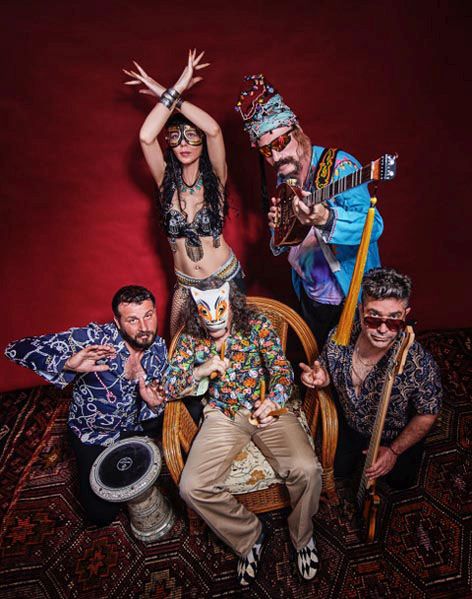
Name: Baba Zula
Members: Levent Akman (spoons, percussions, machines, toys), Osman Murat Ertel (electric saz and other stringed instruments, vocals, theremin), Ümit Adakale (darbuka, percussion), Esma Ertel (vocals, dancing)
Interviewees: Osman Murat Ertel, Levent Akman
Nationality: Turkish
Current release: Baba Zula's new album İstanbul Sokakları is out November 8th 2024 via Glitterbeat.
Recommendations: Osman Murat Ertel: Abdülcanbaz by Turhan Selçuk, Crossing the Bridge by Fatih Akın.
Levent Osman: Wall paintings from the Lascaux cave in France, dating from the Upper Paleolithic era, Ottoman Army Band musics (Mehteran)
If you enjoyed this Baba Zula interview and would like to know more about the band and their music, visit their official homepage. The group are also on Instagram, and Facebook.
When I listen to music, I see shapes, objects and colours. What happens in your body when you're listening? Do you listen with your eyes open or closed?
Osman Murat Ertel: Once my mother had a brain hemorrhage and lost her memory completely. İ did some research and found out that the brain is most active during making music and then listening to music. So I started playing her the music she loved and some that I thought it would make sense. She completely recovered and regained her memory within months.
I can close my eyes sometimes but even with my eyes open I feel I can travel in between ‘worlds,’ realms and dimensions whatever you call them. Anything can happen.
Levent Akman: When the brain structure of people listening to music is examined, it is seen that almost all parts of their brain are working at the same time. Language is an important barrier in relationships between people. I think that music will be the pioneer of a new communication between people in the coming centuries.
Sometimes my eyes are open and sometimes my eyes are closed while listening to music.
Entering/creating new worlds through music has always exerted a strong pull on me. What do you think you are drawn to most when it comes to listening to and creating music?
Osman Murat Ertel: Being and existing at the very moment without distractions and listening to your instincts, leading and carrying at the same time. Being in a state of open antennae.
Levent Akman: When I listen to or create music, I enter into different dimensions of the phenomenon we call time. Sometimes a few minutes can last for hours, sometimes a few hours can pass like a few minutes.
According to scientific studies, we make our deepest and most incisive musical experiences between the ages of 13-16. What did music mean to you at that age and what’s changed since then?
Osman Murat Ertel: I believe it started for me much more earlier which led to my crucial bond with music. Between the ages 13-16 I was doing improvisations and recorded my first album called Nightwalker with my second band called ‘Two of One’.
It was a concept album about a man who lived at night and slept during the day. We were two guys playing the same keyboard at the same time and singing and I was using sounds of things like radio and piggy bank too.
Now I also love improvising, too.
Levent Akman: I don't know what scientific research you're talking about, but music is very powerful for people of all ages. For example, I don't remember much of the music I listened to when I was 13 and 16. As I got older, the effect of music on me increased and it became a way of life.
Tell me about one or two of your early pieces that you're still proud of (or satisfied with) – and why you're content with them.
Osman Murat Ertel: This album called Nightwalker was and is such an example. İt had a strong story, very atmospheric and cinematic.
Levent Akman: Black Sounds of Freedom by Black Uhuru. It has always had a calming and relaxing effect on me. My Prozac.
What is your current your studio or workspace like? What instruments, tools, equipment, and space do you need to make music?
Osman Murat Ertel: My studio is like a madhouse full of equipment, instruments, paintings, records and books. İ can make music anywhere with a recorder or a phone with or without an instrument but at my studio I have a very broad palette I can choose from. İ also try hard to make sure everything is working and in good condition which might take time usually but I am pretty successful with that.
Levent Akman: I don't have a special space for my studio, the house I live in is my own studio. My electronic drum machines and wooden spoons come out when needed.
From the earliest sketches to the finished piece, tell me about the creative process for your current release, please.
Osman Murat Ertel: I wanted to make an album about the city I am in love with, İstanbul. So I started listening to the field recordings I did in the city. İ wanted to include them on the album. İ also wanted to use my uncle Turhan Selçuk’s drawings of İstanbul at his comics series Abdülcanbaz so I went through them choosing my favorite scenes.
About the instruments of my choice, the history of a divan saz or a Turkish cura or an electric saz designed by me. The history and meaning of the instruments within the Turkish culture and the stories of those specific instruments. All of the instruments on the album have names. The special scales I chose for each song and how the black and white cover of the vinyl album is designed within the aesthetics of a comic book.
Why we decided to make the 300 limited edition copies of the vinyl in the transparent blue colour of curucao was because when we hold the record we wanted to feel and remember the water of the Bosphorus and the golden horn.
Levent Akman: The creative process of Baba Zula doesn't develop like "heyy, let's make a new album and go to the studio". It is a beautiful process that develops over time like a slow-cooked meal. Our last album, Streets of Istanbul (İstanbul Sokakları), developed in this way.
Sometimes a few rhythms and melodies in our own studio, sometimes recording hours in a completely different studio based on improvisation. Bon appétit.
What role and importance do rituals have for you, both as an artist and a listener?
Osman Murat Ertel: Rituals are done for something that you care about and love and respect for me. Music listening and creating should be done in such a manner. İ feel we get distracted and disturbed on many occasions. Making and listening music is so important and precious for me.
Levent Akman: Believe it or not, walking is the most important ritual for me. In every way, my creativity increases, I feel good about myself and I feel like I get more into the music while walking.
Are you acting out parts of your personality in your music which you couldn't or wouldn't in your daily life? If so, which are these?
Osman Murat Ertel: Yes I can be wilder, harsher. Depends on the story.
Levent Akman: No I’m not like this. I never thought of my music as a means of escape.
Late producer SOPHIE said: “You have the possibility [...] to generate any texture, and any sound. So why would any musician want to limit themselves?” What's your take on that?
Osman Murat Ertel: I think telling a story is the most important thing for me. I don’t want limits I can use any sound I want and need to tell it through music.
Levent Akman: I don't think musicians want to limit themselves. Maybe classical Western musicians can fall into this category because they have to play the pieces of composers who lived centuries ago in the notational order they suggested. I think musicians other than these shouldn't put themselves in a certain limit, at least not me.
Do you feel that your music or your work as an artist needs to have a societal purpose or a responsibility to anyone but yourself?
Osman Murat Ertel: Anything can happen.
Levent Akman: In this regard, I think that every musician should be free, music should not be within certain limits, therefore, musicians should not confine themselves within certain limits, but of course this is something they can decide for themselves.
In my own music, I find it closer to me to address social events that I do not like politically and to draw attention to these issues, but of course it is not always like this, I also make music for my own pleasure.
Once a piece is done and released, do you find it important that listeners understand it in a specific way? How do you deal with “misunderstandings?”
Osman Murat Ertel: Everything is possible.
Levent Akman: Of course, there may not be misunderstandings but not understandings. Ahaha it is like “to be or not to be”. People can get bored.
In this case, what people should do is to stop what they are listening to or leave if they are at a concert. I think there is no point in pushing too hard or try to listen. Just stop & go.
Sound, song, and rhythm are all around us, from animal noises to the waves of the ocean. What, if any, are some of the most moving experiences you've had with these non-human-made sounds? In how far would you describe them as “musical”?
Osman Murat Ertel: We have so many of these sounds in our music. Cat sounds, walking sounds ... listen to our last album İstanbul Sokakları and you will hear the sounds of the city. Any sound can be a part of music.
Levent Akman: Sound of Silence.
We can surround us with sound every second of the day. The great pianist Glenn Gould even considered this the ultimate delight. How do you see that yourself and what importance does silence hold?
Osman Murat Ertel: No sound is not possible if you are alive. Only if you are deaf. İf you step into a fully soundproof room you will hear the sounds of your blood circling and such.
Levent Akman: Magic of Silence.
Do you feel as though writing or performing a piece of music is inherently different from something like making a great cup of coffee? What do you express through music that you couldn't or wouldn't in more 'mundane' tasks?
Osman Murat Ertel: Music is holy and magical and inspiring and it is not a mundane task it should never be.
Levent Akman: No, I don't think so. There is a proverb in Turkish that says “a bitter coffee is remembered for 40 years”. Sometimes, when necessary, even a cup of coffee can make people feel very good emotions.
The most important feature of music is that it is limitless between cultures. Different people from different cultures can be happy by listening to very different music and understand each other more easily. I think the magic of music comes from this. It seems like music is a more accurate means of communication for human beings.
What is a music related question that you would like to ask yourself – and what's your answer to it?
Osman Murat Ertel:
Q: Where am I going with my music?
A: Just play don’t think.
Levent Akman:
Q: What was the music of the Neanderthals like?
A: Unfortunately we will never know.