Published
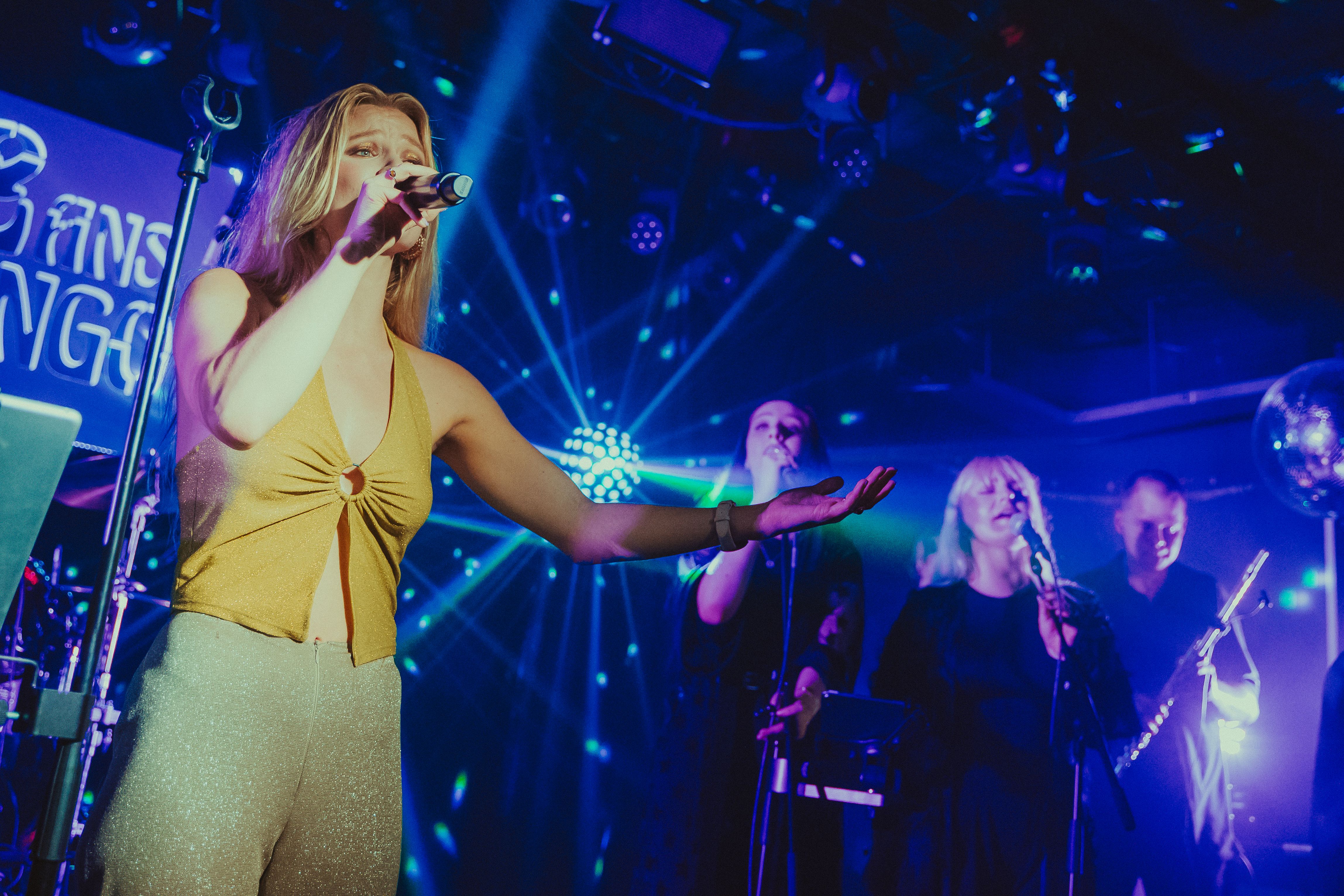
Name: Haldi & ans Flamingo
Members: Haldi Välimäe (vocals), Mattias Tirmaste (bass guitar), Henrik Leibur (drums), Kristjan Tenso (percussion), Siim Siimer (guitar), Oliver Kaljula (keys), Siim Sõmer (flute), Jaan Mesi (trumpet)
Interviewee: Haldi Välimäe
Nationality: Estonian
Current release: Haldi & ans Flamingo's debut EP Õige aeg is out via Estonian Funk Embassy. Stream and download here.
Recommendations: I recommend listening to two of my favorite Estonian artists, Marju Marynel Kuut and Vaiko Eplik.
If you enjoyed this Haldi & ans Flamingo interview and would like to know more about the band and their music, visit them on Instagram, and Facebook. Haldi also has a personal Instagram account.
When I listen to music, I see shapes, objects and colours. What happens in your body when you're listening? Do you listen with your eyes open or closed?
This process that takes place in my body when I truly listen to music is difficult to explain. I listen to music very spatially. This means that I enjoy noticing how different instruments or vocals are positioned, how they sound, and how they are mixed.
Mostly, the emotion is something euphoric. It's a pleasurable sensation felt through the body from special nuances that, when combined, create a sense of wonder and admiration.
Entering/creating new worlds through music has always exerted a strong pull on me. What do you think you are drawn to most when it comes to listening to and creating music?
I believe that music can always surprise. This world is so vast that there are no words invented to describe it.
According to scientific studies, we make our deepest and most incisive musical experiences between the ages of 13-16. What did music mean to you at that age and what’s changed since then?
I believe that, in its meaning and essence, music has always been the most beautiful artistic form of love for me throughout my life, regardless of age.
The most important thing is the music itself.
Tell me about one or two of your early pieces that you're still proud of (or satisfied with) – and why you're content with them.
If we talk about my early work, it’s probably the title track of my first solo album, “Raba.” I wrote it when I was 14.
The lyrics are timeless, and as the years go by, I continue to discover new layers in them myself. This is what makes a song's lyrics rich.
What is your current your studio or workspace like? What instruments, tools, equipment, and space do you need to make music?
Since my greatest passion is vocal arrangements and spatial vocals, I start recording when the song is still in its early stages. When I was younger, just a guitar was enough, but now I enjoy being able to produce in parallel.
In my current workspace, I have an audio interface, studio monitors, a microphone, a MIDI keyboard, and several guitars.
From the earliest sketches to the finished piece, tell me about the creative process for your current release, please.
The album Õige aeg was created in collaboration with co-producer and the band's bassist, Mattias Tirmaste. We wanted the album to sound like a golden middle ground between modern pop and 70s soul music, so part of the album's preparation was research-based.
Mattias and I delved deeply into Estonian music from the 60s to the 80s. We studied the artists, researched their biographies from interviews and various archives, and, of course, listened extensively to their music. We were inspired by all these sounds and aimed to find a golden mean between the sounds of the 60s to the 80s and a contemporary sound. It's also significant that all the songs are in Estonian.
We then began writing songs together at my home, creating demos. The music was co-written, and I wrote the lyrics. We met with the band at a band camp to finalize the songs before going to the studio to record the instruments. I recorded all the vocals alone later. Both Mattias and I actively collaborated with the album's mixer, Sten-Olle Moldau, during the mixing process.
What role and importance do rituals have for you, both as an artist and a listener?
I don't have specific rituals, but, for example, listening to vinyl is like a ritual for me. It's not like listening to a song on Spotify, where you can skip if you don’t want to listen to the track anymore, or someone might call and interrupt. It's more sacred, and you dedicate yourself more to the music.
As both an artist and a listener, it's important to have a comfortable environment, good people, a good vibe, and then everything feels just right.
Are you acting out parts of your personality in your music which you couldn't or wouldn't in your daily life? If so, which are these?
No, I am exactly the same Haldi on stage as I am in everyday life.
Late producer SOPHIE said: “You have the possibility [...] to generate any texture, and any sound. So why would any musician want to limit themselves?” What's your take on that?
Absolutely. We have all the possibilities available. In the end, it's important that these possibilities serve a purpose that you personally enjoy. The music itself is the most important.
So, for me, there's no such thing as guilty pleasures in music. Whatever you like, go for it.
Do you feel that your music or your work as an artist needs to have a societal purpose or a responsibility to anyone but yourself?
I can only speak for myself. I don't judge others' choices. However, artists have always been mirrors of society. As a thinking person, we inevitably move through life observing what’s happening around us. It all influences us and, consequently, our work. Undoubtedly, what happens in society needs to be reflected upon, and in its own way, it finds its way into our art.
On the other hand, if there are people in my beloved audience who work from 8 to 5 every day, are tired, and come to my concert, I don’t want to hit them with that same heaviness or feeling we all collectively experience in our own way. Music has the special ability to soothe people's souls.
There is certainly a responsibility to oneself and one's audience to be sincere—truly sincere. There are many forms of responsibility, really. I value my audience greatly and always want to offer them the best.
Once a piece is done and released, do you find it important that listeners understand it in a specific way? How do you deal with “misunderstandings?”
This is a traditional question in the context of cultural theory. When an author makes a work public, does it no longer belong to them, and is the author themselves still important?
I believe that one part of music's value is also what the listener brings to it. Each of us relates to everything in this world according to our experiences and what we've lived through. The same goes for music.
And if someone doesn’t understand what I’ve tried to convey, so be it. Someone else will understand it.
Sound, song, and rhythm are all around us, from animal noises to the waves of the ocean. What, if any, are some of the most moving experiences you've had with these non-human-made sounds? In how far would you describe them as “musical”?
I believe that all the beautiful sounds of summer, from birdsong to the sound of the sea, always take me back to childhood paths.
We can surround us with sound every second of the day. The great pianist Glenn Gould even considered this the ultimate delight. How do you see that yourself and what importance does silence hold?
I listen to a lot of music, and it truly is a wonderful way to offer myself a rich bouquet of emotions.
However, often silence is the key that makes everything shine even more afterward.
Do you feel as though writing or performing a piece of music is inherently different from something like making a great cup of coffee? What do you express through music that you couldn't or wouldn't in more 'mundane' tasks?
For me, everyday things and creating music are completely different; I can't compare them.
Since music has been my path since I was a little child, I have always channeled my creativity into music.
What is a music related question that you would like to ask yourself – and what's your answer to it?
I think the question is: how does music actually come into being? How does it get inside us and then come out in that form?
I don’t think I or anyone else can truly provide an answer to this in the form of a universal truth. But maybe someday I will.