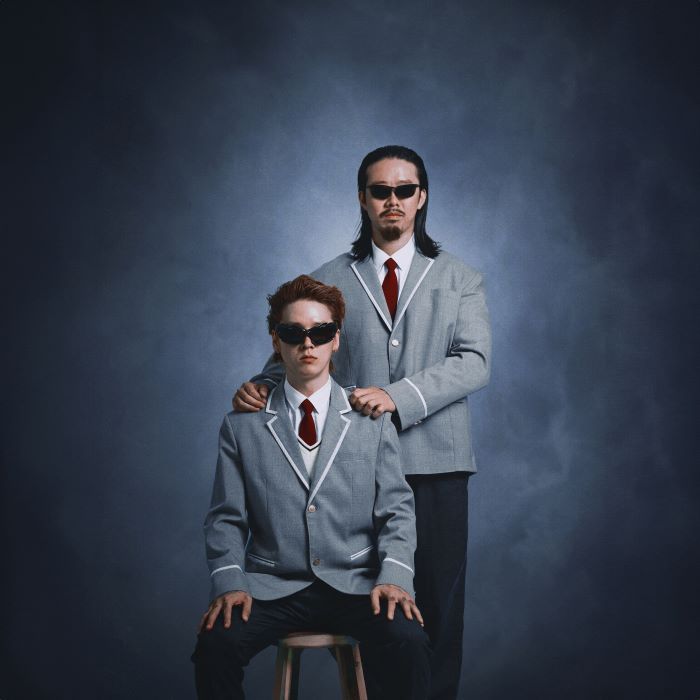
Published
Name: HYPNOSIS THERAPY
Nationality: South Korean
Members: Jjangyou (vocals), Jflow (production)
Current event: HYPNOSIS THERAPY will perform at 2024's Reeperbahn Festival. For more information about the Korea spotlight of the event and for buying tickets, go here.
Recommendations: Hypnosis Therapy's entire discography and Jean-Paul Sartre’s Nausea.
If you enjoyed this HYPNOSIS THERAPY interview and would like to know more about the band and their music, visit the duo on Instagram, twitter, and tiktok.
When I listen to music, I see shapes, objects and colours. What happens in your body when you're listening? Do you listen with your eyes open or closed?
We don't imagine specific shapes when listening to music. Instead, We focus on the forms that appear before us. We concentrate on the emotional aspect and the sound of the music.
We listen with our eyes open, taking in everything with our senses. We feel most connected when the sound of the music blends with the space around us.
Entering/creating new worlds through music has always exerted a strong pull on me. What do you think you are drawn to most when it comes to listening to and creating music?
The meditative experience we encounter through both listening and creating draws us the most. We enjoy meditation that leads to a transcendent state where time and space no longer exist.
In Korea, we call this state "muahjigyeong." Is there a similar expression in Germany? We find joy in how these transcendent experiences broaden and evolve our thoughts.
According to scientific studies, we make our deepest and most incisive musical experiences between the ages of 13-16. What did music mean to you at that age and what’s changed since then?
At that age, we were both captivated by hip-hop. Even though we didn’t know each other at that time, we were both chasing and engrossed in the same thing. Since then, we have pursued music as our profession.
Back then, music was simply something we found fascinating and wanted to try. We believe that at that age, we are all naturally drawn to certain things, and we should follow those instincts to explore everything fearlessly.
Tell me about one or two of your early pieces that you're still proud of (or satisfied with) – and why you're content with them.
We have released around 20 albums in total throughout our music career. We're satisfied with all of them because we poured everything we had into them at the time.
Even though we could create better work now, we can't judge a piece solely by its quality. We made what we needed at the time. Each work represents the best conversation and healing we could share with ourselves, and it's fascinating that all of it has been recorded.
What is your current studio or workspace like? What instruments, tools, equipment, and space do you need to make music?
Our studio is filled with various musical equipment, like synthesizers, outboards, and modulars. While we use these for making music, they also breathe life into the space aesthetically. A studio can be a dark and gloomy place where we're confined for hours.
New equipment naturally leads us to new projects. For musicians, new gear is like a new toy—we spend all day playing with it and creating something new.
From the earliest sketches to the finished piece, tell me about the creative process for your current release, please.
Jflow: First, me as a producer, sets the direction for the songs and the album. I create several tracks and shares them with JJANGYOU, our rapper, giving only small hints about the direction. The hint is a way to listen to JJANGYOU's fresh ideas.
Since it's a team effort, the album can't be dominated by my thoughts alone; balance is essential. We continuously share and refine ideas until we've finished almost all the work. I also handle the mix.
Afterward, we collaborate with our designer, Marvin kim, to create the album cover based on the images and ideas that came to mind during the production. Then we release it.
What role and importance do rituals have for you, both as an artist and a listener?
This is quite a mystical part. Through sound alone, we share an experience that allows us to find or feel a common point with our listners. This creates a very organic relationship.
We cherish and love our listeners because they empathize with our stories. However, when we create, we don’t really consider them; we focus purely on ourselves. This allows the work to present a new perspective.
Are you acting out parts of your personality in your music which you couldn't or wouldn't in your daily life? If so, which are these?
We indirectly express things through music that we cannot say to others. If we express our anger or frustration in everyday life, it negatively affects others. However, through music, we can release and resolve these negative emotions, allowing us to live more peacefully and generously.
Therefore, it doesn't feel like we are acting; instead, we try to encapsulate all forms of emotion within our music. In doing so, we aim for a calm and peaceful everyday life.
Late producer SOPHIE said: “You have the possibility [...] to generate any texture, and any sound. So why would any musician want to limit themselves?” What's your take on that?
Of course, we both completely agree with SOPHIE’s opinion. We strive never to lose sight of this and constantly seek new methods in our work. New combinations, new instruments, new plug ins—all of these represent possibilities. We attempt unconventional and random approaches to explore them.
Sometimes we search for safer paths, but we believe that "safe" means following someone else's path. We actively seek out the more difficult road, which makes our music more enjoyable for many listeners.
Do you feel that your music or your work as an artist needs to have a societal purpose or a responsibility to anyone but yourself?
We think that having such a responsibility might hinder us from delving deeper into a pure and essential creative realm.
However, we do put energy into having a positive influence. The word "responsibility" feels heavy, but we approach music with a firm attitude and want to create with the innocence of a child.
Once a piece is done and released, do you find it important that listeners understand it in a specific way? How do you deal with “misunderstandings?”
Music is ultimately a wave, intangible and ungraspable. We believe it’s more important to focus on the essence of that wave before thinking about many meanings. We think it’s essential to first feel the intangible form of music itself. The message within will be interpreted according to each person's background.
Misinterpretations are not a significant issue for us because music can be open to such interpretations. Just as everyone has different opinions and thoughts, that's how we express ourselves, and that's our life.
Sound, song, and rhythm are all around us, from animal noises to the waves of the ocean. What, if any, are some of the most moving experiences you've had with these non-human-made sounds? In how far would you describe them as “musical”?
We believe that all forms of sound are music. Even our spoken words are music, as are the sounds of birds chirping, the wind hitting the mountains, the waves in the sea, and the natural sounds of animals.
Why do we consider these sounds to be music? Because if we overlay our music on top of them, it doesn’t feel out of place. It’s beautiful. Try it, and you’ll immediately feel that it is music.
We can surround us with sound every second of the day. The great pianist Glenn Gould even considered this the ultimate delight. How do you see that yourself and what importance does silence hold?
Although we live surrounded by sound, when we work, it’s almost no different from silence. We listen to the inner sound and strive to bring out what’s inside.
There is sound in that process, but I consider it silence. The dialogue I have with myself is, in essence, silence.
Do you feel as though writing or performing a piece of music is inherently different from something like making a great cup of coffee? What do you express through music that you couldn't or wouldn't in more 'mundane' tasks?
To make a great cup of coffee, there’s the effort of the farmers where the beans originate, the people who transport them, the roasters, and finally, we grind and brew it. Without the efforts of many people, it would be hard to have a cup of coffee.
Music is the same. It requires the strength and help of many people, and we consider its result similar to a cup of coffee. Therefore, when we drink coffee or listen to music, we value and enjoy them equally.
There is nothing that cannot be expressed through music. There are no limits, so we can reach people in a broader sense.
What is a music related question that you would like to ask yourself – and what's your answer to it?
Question: Until when will you stay passionate, learn, and grow?
Answer: Until we die.