Published
Name: Julie Hill
Nationality: American
Occupation: Composer, producer, vocalist, sound artist
Current release: Julie Hill's glow serene is out via Umé.
Recommendations: For books - I highly recommend if on a winter’s night a traveller by Italo Calvino. It’s something between a work of fiction and poetry that intricately weaves around the reader's mind. Makes me feel like I'm on a small country road; sometimes you’re not sure where the book is going or where you are or if any of it makes sense, and then everything comes together in the most beautiful way.
I also really love the music and the visual art of Vinyl Williams - a musician / visual artist from Los Angeles. It’s very ethereal and full of beautiful messages for the listener.
If you enjoyed this Julie Hill interview and would like to know more about her music, visit her on Instagram, and bandcamp.
When I listen to music, I see shapes, objects and colours. What happens in your body when you're listening? Do you listen with your eyes open or closed?
Usually I end up closing my eyes to focus on the aspects of the music itself so I can listen deeply to the composition. Things I pay attention to are: instrumentation, timbres, mixing choices, melodic contour, the progression of harmonies, and any musical motifs / development of a theme.
Music is a language and the deeper you listen, the more you can understand its message.
Entering/creating new worlds through music has always exerted a strong pull on me. What do you thinkyouare drawn to most when it comes to listening to and creating music?
I am certainly drawn to music’s ability to take the listener somewhere new mentally and emotionally - without having to travel physically. Since I was a kid, I used music to uplift myself and put myself in different states of mind.
When I create music, I honestly get lost in having fun - making the music with the lovely people I get to make music with! My friends and I are all striving to express ourselves in new, innovative ways musically and there is always an exciting atmosphere of exploration. I love feeling like I am going to discover something new.
I constantly surprise myself. Hopefully, it continues on that way for the rest of my life.
According to scientific studies, we make our deepest and most incisive musical experiences between the ages of 13-16. What did music mean to you at that age and what’s changed since then?
Haha oh no! Really? To be honest, I mostly spent those teenage years going to local emo and punk shows … I used to love going into mosh pits and jumping around.
Besides local bands, I always listened to what was playing on the radio (mostly R&B and hip hop, and “oldies” from the 60s and 70s). Friends turned me onto Joni Mitchell, Nico, Emmitt Rhodes, Lou Reed, and Nick Drake.
A teacher had given me a CD of spirituals that I used to listen to a lot and another teacher gave me some film score soundtracks (which got me into French classical music like Ravel as well as rock music like the Clash, the Ramones, Elliott Smith, the Shins). Somehow, I also got a CD of Leonard Bernstein works I used to love listening to.
Tell me about one or two of your early pieces that you're still proud of (or satisfied with) – and why you're content with them.
Difficult to say. I don’t have a lot of my old songs anymore. An ex-boyfriend told me he still has my very first CD from 2008 though.
I still really like a string quartet I wrote in 2011. It is a solid composition and it flowed quite naturally from my brain to the paper as I played at the piano. Working it out on sheet music and with players was a good experience and the score is still good. I’d love to have it performed again.
What is your current your studio or workspace like? What instruments, tools, equipment, and space do you need to make music?
You do not need anything to make music. A lot of the time, I just sing. I love to sing in my house in those rare moments when no one else is home.
My home setup is just an SM58, my synth and a small MIDI controller. I have been a music teacher for most of my life, so I can usually play piano or electric keyboard wherever I teach.
Sometimes I make things entirely on the computer, sometimes I do it the old way (sit at the piano and write what’s in my brain on a sheet of paper). Then I go into some studio with a band and we create a new version of my ideas. What people hear as the final track is a team effort - my demos are always pretty different than what ends up being released.
From the earliest sketches to the finished piece, tell me about the creative process for your current release, please.
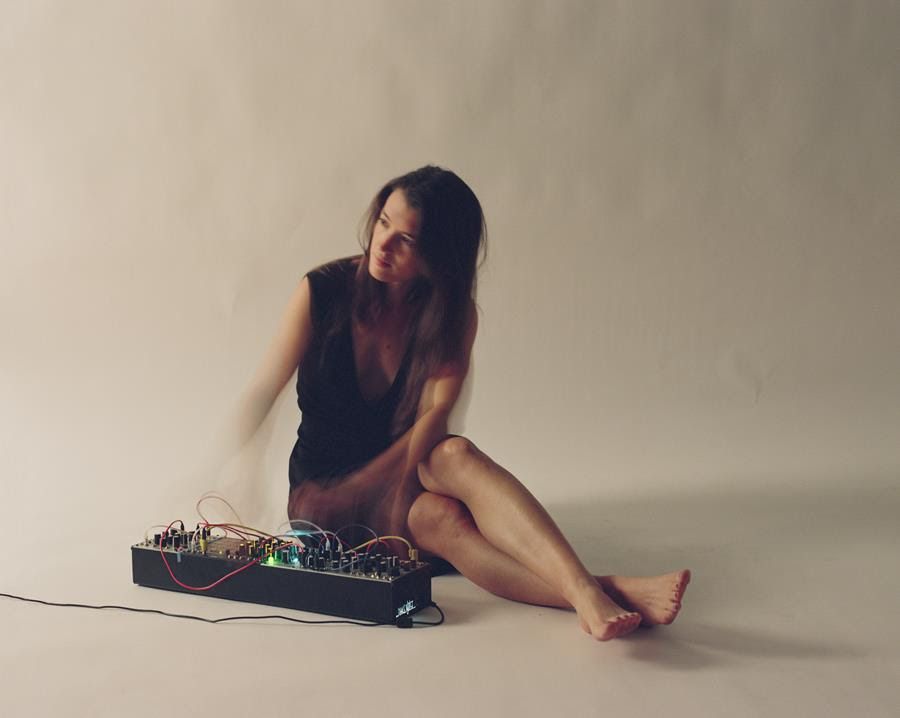
My friend got me into modular during the pandemic because we were bored and I was interested. I got my first module (Beads) and really didn’t know how to use it. Just stared at it and made some alien sounds. That year, I got more modules and created a very humble setup. This was a new way of making music for me and it was both delighting and frustrating (because I really never knew exactly what would come out of the machines).
I would get up early before work and layer sound from the modular. After work, I would add sounds from my juno and my singing. Then I would send tracks to various friends here (Jack, Zach, Sean) and there and ask them to improvise whatever they wanted on top.
At some point, it all needed to be organised. I met Zubin Hensler who helped me re-record the vocals on a good mic and get all my ideas in order. I described what I envisioned for every mix in such detail ... I felt bad because it must have been a bit frustrating ... I knew what I wanted but didn’t have the plug-ins or patience to do it myself.
What Zubin created with his mix and his french horn sounds was so far beyond the level of my original concept. I feel so lucky that we got to work together on this record.
What role and importance do rituals have for you, both as an artist and a listener?
This is an interesting question. The word ritual inherently has a religious connotation, and although I’m not religious music has always served a meaningful purpose in my life the way I suppose religion can have for some people.
There are certainly rituals around my compositional process; sitting at the piano is usually a big part of that. This album is so unique because I had no access to a piano until the end. I created it entirely with electronics and by recording friends remotely - which is so different from my usual method of writing songs at a piano and live recording with a band.
This album glow serene came out of a morning routine of waking up, doing yoga, and recording some music before heading to my day job as a music teacher. Perhaps there is some ritual in that.
Julie Hill Interview Image (c) the artist
Are you acting out parts of your personality in your music which you couldn't or wouldn't in your daily life? If so, which are these?
Certainly - I have to admit that part of my music is a form of escapism from my real life.
Often I write love songs about no one specific; my imagination cares out scenarios or people I’d like to be in or meet and I write about that. It always starts from the seed of reality and my lived experience but what it turns into is something entirely different.
For example, this very pretty album came out of a time when everything in my life was chaos and sadness and I often cried. Making this music was a form of therapy for me.
Late producer SOPHIE said: “You have the possibility [...] to generate any texture, and any sound. So why would any musician want to limit themselves?” What's your take on that?
Yes SOPHIE! Totally agree! I love to explore as many sounds as I can. Up until this album, I was making more psychedelic indie rock/ pop and before that I made some electronic dance music, some hip hop, wrote classical
music …
I think it's fun to allow one’s creativity to flow through many different mediums because it’s always going to be your voice and your message.
Do you feel that your music or your work as an artist needs to have a societal purpose or a responsibility to anyone but yourself?
Not always - I make a lot of music for myself that no one else hears.
On the whole, however, I believe my music needs to have a purpose. My current music does not have a political purpose or a statement of social change; someday I hope to write music like that.
Right now, I just hope my music connects with listeners and moves them toward feeling better than they did before (or thinking more deeply about something). That’s what listening to music does for me.
Once a piece is done and released, do you find it important that listeners understand it in a specific way? How do you deal with “misunderstandings?”
Sometimes it is important that the music is understood as I originally meant it, but many times I find alternate interpretations interesting. They make me reconsider the state I was in when I wrote the music and wonder whether there is truth in the alternate interpretation (usually there is).
Sound, song, and rhythm are all around us, from animal noises to the waves of the ocean. What, if any, are some of the most moving experiences you've had with these non-human-made sounds? In how far would you describe them as “musical”?
I really love walking in public parks in the summer - listening to the sounds of cicadas and birds, the wind, different communities enjoying parties playing all
sorts of music.
The flow of these sounds is very musical to me - so dynamic and expressive, so timbrally interesting and pitched if you listen closely. Sometimes I catch a harmony or polyrhythm floating in the air.
We can surround ourselves with sound every second of the day. The great pianist Glenn Gould even considered this the ultimate delight. How do you see that yourself and what importance does silence hold?
When I was younger, you couldn’t find me without a boombox nearby or headphones on. These days, however, silence is more important to me.
Silence breathes - it allows space for my mind to create new ideas, space for me to feel more grounded in my own thoughts and develop a deeper sense of my personal musical language.
Do you feel as though writing or performing a piece of music is inherently different from something like making a great cup of coffee? What do you express through music that you couldn't or wouldn't in more 'mundane' tasks?
This question is funny to me because I have a horrible habit of burning food because I am distracted composing and lose track of time.
I think mundane tasks are much more akin to great engineering; they require a lot of technical skill with a bit of creativity. For me, composing new music often comes from a deeper need for emotional expression or some deeper self-inquiry.
I feel that there is more connection between writing music and cooking; in fact, a lot of musicians I know talk about composing by saying they’re “cooking” up something new.