Published
Name: Keshavara
Members: Keshav Purushotham, Niklas Schneider, Benedikt Filleböck, Christopher Martin
Interviewee: Keshav Purushotham
Nationality: German-Indian
Current release: Keshavara's III is out via Papercup. Catch them live:
26.08. Radioeins Parkfest, Berlin (noch nicht offiziell angekündigt)
26.09. Milla, München
27.09. Neue Zukunft, Berlin (with GOBLYNS)
28.09. Arttheater, Köln
Recommendations: The fascinating book Ocean of Sound by David Toop, exploring ambient music, and moments like when Debussy first heard Javanese music.
Richard Siegels 'Ballet of Difference‘. It's an incredible dance company!
[Read our David Toop interview]
If you enjoyed this Keshavara interview and would like to know more about the band and their music, visit their official homepage. They are also on Instagram, bandcamp, and Facebook.
When I listen to music, I see shapes, objects and colours. What happens in your body when you're listening? Do you listen with your eyes open or closed?
When I listen to music, it’s a whole other dimension. With my eyes closed, the music paints pictures in my head—memories, emotions all come alive. It's like stepping into a dream where the music tells the story.
But when I keep my eyes open, the music weaves into the world around me. It changes the scene, gives new life to what I see, like a moving canvas.
Both ways are different trips, each with its own magic. Music’s got a way of transforming everything, inside and out.
Entering new worlds and escapism through music have always exerted a very strong pull on me. What do you think you are drawn to most when it comes to listening to and creating music?
For me, it's all about that child-like excitement of discovering something new. Whether I'm listening to music or creating it, I'm drawn to the thrill of exploring uncharted territory.
It's like tasting a lemon for the first time—surprising, refreshing, and always keeps me coming back for more.
What were your very first steps in music like and how would you rate the gains made through experience?
Music was just part of growing up for me. My dad is a musician, so sleeping on stages and hanging backstage was just how it was.
Over time, I've picked up a lot, seen a lot. But these days, I'm feeling this pull to get back to basics. It's like I want to forget everything I know and just approach music like a wide-eyed kid again. There's a kind of freedom in that, you know?
According to scientific studies, we make our deepest and most incisive musical experiences between the ages of 13-16. What did music mean to you at that age and what’s changed since then?
Back then, I was fully in the musical scenes—it was like my whole world revolved around it. The different subcultures shaped who I was and how I lived my life.
But now, things have shifted. I'm still fascinated by all the different scenes out there, but it's like I'm viewing them from a different perspective. It's more about curiosity and appreciation rather than direct influence.
It's like I've stepped back a bit, taking it all in from above, seeing the bigger picture.
How would you describe your own relationship with your instrument, tools or equipment?
We like to keep things interesting. We’ve got a bunch of (weird and not so weird) gear, and we’re always switching it up to keep it interesting. My voice and guitar are constants, but even with them, I try finding new sounds, new ways to play.
It's those unexpected moments I’m looking for. That feeling when you stumble onto something completely new and exciting—it's addictive.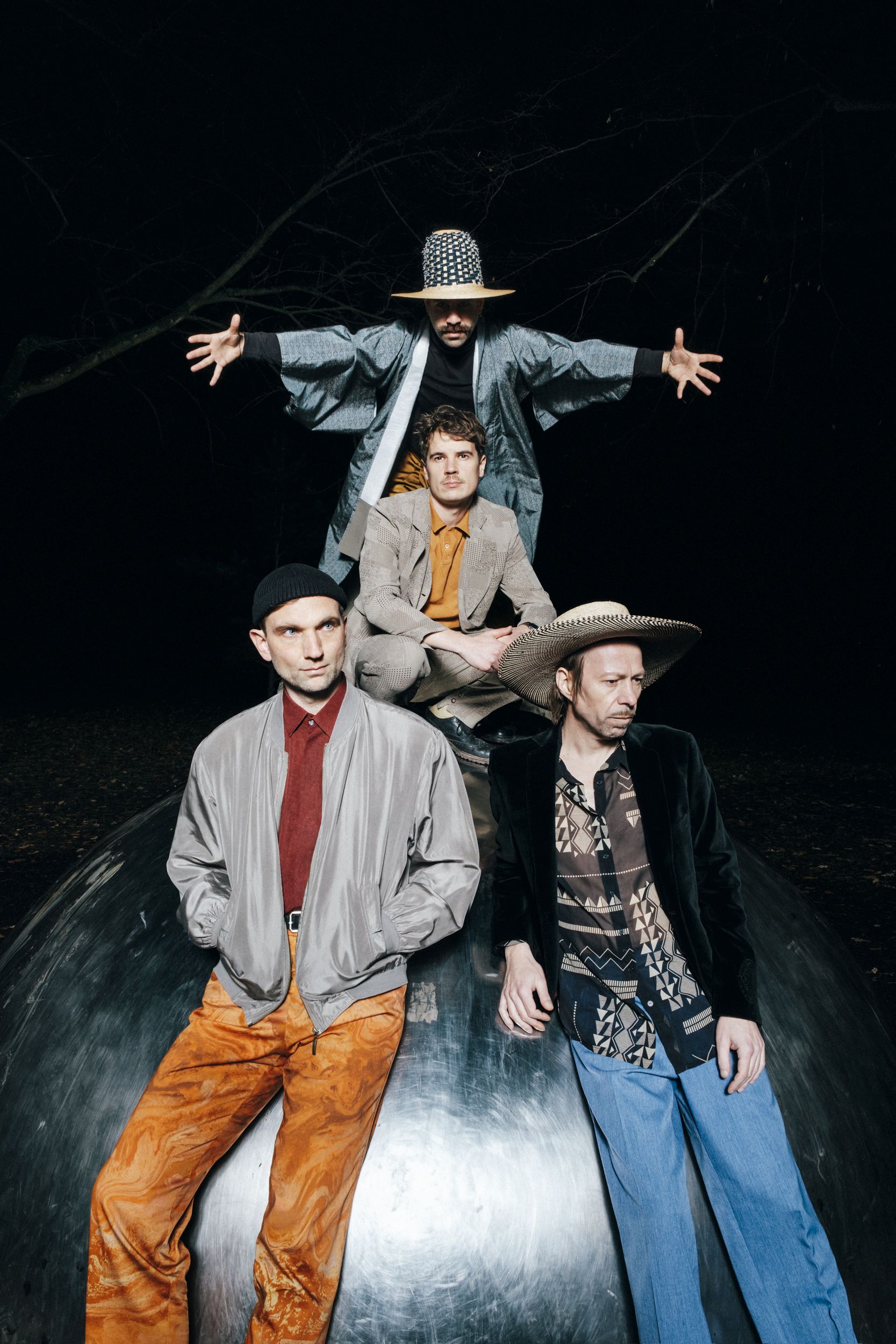
Keshavara Interview Image by Niclas Weber
Where does the impulse to create something come from for you? What role do often-quoted sources of inspiration like dreams, other forms of art, personal relationships, politics etc play?
The impulse to create, for me, it's like a force of nature. It's always been there, bubbling under the surface, waiting to burst forth.
And really, anything can set it off. Cooking a meal, reading a book, listening to a new band, even just going on a trip anything.
Are you acting out parts of your personality in your music which you couldn't or wouldn't in your daily life? If so, which are these? What, would you say, are the key ideas behind your approach to music?
I definitely tap into parts of myself through music that don't usually come out in daily life. I like to invent different personas, like my rap alias on stage—it's a side of me that wouldn't show up otherwise.
As for the key ideas behind my approach, honestly, I have no clue what they are, and I hope I never figure it out. It feels good to keep experimenting and creating without a clear plan.
Maybe that's the plan itself, just to keep exploring and trying new things without getting tied down to a specific idea.
If music is a language, what can we communicate with it? How do you deal with misunderstandings?
Music has this incredible ability to express the full range of human emotions in a way that words sometimes can't.
As for misunderstandings, I’ve found they’re pretty rare in music. The beauty of it is that people can interpret it in their own way, and that’s part of the magic.
If there ever is a misunderstanding, I just see it as another layer of interpretation.
Making music, in the beginning, is often playful and about discovery. How do you retain a sense of playfulness and how do you still draw surprises from tools, approaches and musical forms you may be very familiar with?
We really try to mix things up. Tune a guitar differently, hold an ocarina upside down, or come up with weird ideas for the studio. Like imagining how a commercial for a meditation center in the 80s would sound for Japanese TV and creating a song around that.
It's all about keeping things surprising. Even with familiar tools and musical forms, approaching them from a new angle or with a quirky twist keeps the creativity alive.
Sound, song, and rhythm are all around us, from animal noises to the waves of the ocean. What, if any, are some of the most moving experiences you've had with these non-human-made sounds? In how far would you describe them as “musical”?
For us, everything is music. It's all sound. We're big fans of a meditation text by Alan Watts where he says, "There are no proper or improper sounds, and it doesn't matter if someone coughs or sneezes—it's all just sound."
Some of the most moving experiences with non-human-made sounds come from nature—the rhythm of waves crashing, the rustle of leaves, the calls of birds. These sounds have their own rhythms and melodies that can evoke emotions and inspire creativity. The world's soundtrack.
There seems to be an increasing trend to capture music in algorithms, and data. But already at the time of Plato, arithmetic, geometry, and music were considered closely connected. How do you see that connection yourself? What aspects of music do you feel can be captured through numbers, and which can not?
Music and numbers have always had a close relationship. It's fascinating how rhythms can be broken down into mathematical patterns, like the intricate Indian rhythmic systems.
However, while numbers can capture the structure and patterns in music, they can't capture its soul. The algorithms that platforms like Spotify use to market music are based on data and trends, but they miss the human element—the emotion, spontaneity, and creativity that make music truly special.
There's an essence in music that goes beyond numbers, something that can't be fully quantified or predicted.
How does the way you make music reflect the way you live your life? Can we learn lessons about life by understanding music on a deeper level?
The oneness of music teaches us valuable life lessons. The way we make music—open, experimental, and embracing diverse sounds—reflects how we live our lives.
Understanding music deeply helps us appreciate harmony and dissonance, structure and improvisation. It teaches us balance, listening, and being present, showing that everything is interconnected and there's beauty in both the planned and the unexpected.
We can surround us with sound every second of the day. The great pianist Glenn Gould even considered this the ultimate delight. How do you see that yourself and what importance does silence hold?
I love a silent moment. It can be so powerful and loud, especially after hours of sound. But I'm not sure if there's really such a thing as 100% silence.
Do you feel as though writing or performing a piece of music is inherently different from something like making a great cup of coffee? What do you express through music that you couldn't or wouldn't in more 'mundane' tasks?
I don't think it's that different, actually. It's like how nature sounds can be just as beautiful as music. It's all one thing, and that's the beauty of it.
Whether we’re making music or doing something mundane, there's a connection, a rhythm that runs through it all.
If you could make a wish for the future – what are developments in music you would like to see and hear?
For the future of music, I wish for more nowness, more love, and more freedom in people's ears worldwide and beyond.