Published
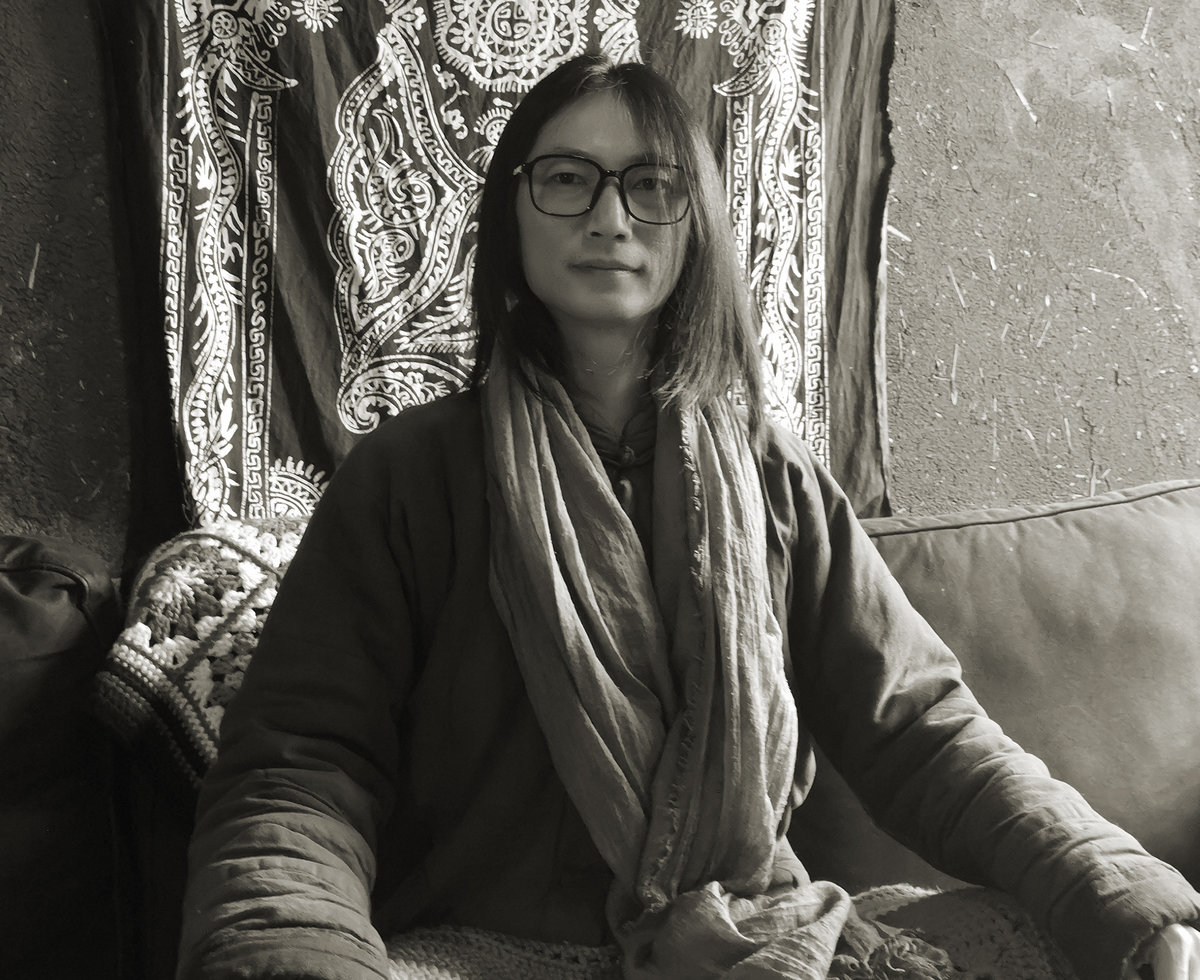
Name: Lang Yiyuan
Nationality: Chinese
Occupation: Composer, performer, improviser, Yangqin player
Current release: Liang YiYuan teams up with Li Daiguo for Sonic Talismans, out via Full Spectrum.
Recommendations: One is the poetry collection "Returning Home on Paper"(纸上还乡) by Chinese poet Guo Jinniu(郭金牛). I don't know if there is an English version, but he is the best poet in China today.
Also, I recommend Wang Xilin's(王西麟)Fourth Symphony.
[Read our Li Daiguo interview]
[Read our Li Daiguo interview about music's social responsibility]
If you enjoyed this Lang Yiyuan interview and would like to dive deeper into his work, visit his bandcamp store.
When I listen to music, I see shapes, objects and colours. What happens in your body when you're listening? Do you listen with your eyes open or closed?
That may largely depend on what music I am listening to. My body usually doesn't change much when I listen to music.
Most of the time, I keep my eyes open, like lying in bed at night.
Entering/creating new worlds through music has always exerted a strong pull on me. What do you think you are drawn to most when it comes to listening to and creating music?
I think it's an exploration of boundaries. If there is a road ahead, I always hope to walk to its end and take a look.
According to scientific studies, we make our deepest and most incisive musical experiences between the ages of 13-16. What did music mean to you at that time?
Yes, at that time, music was like something God gave me to save my life. At that time, I felt that the world around me was just too boring. If I couldn't find something interesting to do, I would probably die.
So I first found painting, and later I started to love music.
Tell me about one or two of your early pieces that you're still proud of (or satisfied with) – and why you're content with them.
For example, the first song on my first album, The Dream of Sunrise. At that time, I was in my twenties and didn't know much about music. I wasn't quite sure whether I should become a painter or a musician in the future.
By chance, a friend was sleeping at my house with a loud snoring sound. Out of a prank, I recorded his snoring sound. Later, while listening to the recording, I found that the rising and falling breath inside was very strange, as if it could enter his dream. It seemed like a somewhat terrifying dream. So I followed the ups and downs of this snoring breath and made this work.
This incident opened a door for me and allowed me to find a way to create music, at least at that time.
What is your current your studio or workspace like? What instruments, tools, equipment, and space do you need to make music?
My studio is located in a mountainous village in Yunnan Province, western China. I rented a farmer's yard, which is a relatively old traditional residential building. My wife has planted many plants in the yard, as well as our cat. Most of the time here is very quiet, and the natural environment around is good. I always like to take a walk on the mountains behind, which is an important part of my creative work.
I use various instruments and tools, including guitar, bass, double bass, traditional Chinese instruments such as guqin, yangqin, guzheng, sanxian, as well as percussion and wind instruments. I like to put different playing styles on different instruments, making them produce sounds that are not their own.
From the earliest sketches to the finished piece, tell me about the creative process for your current release, please.
Most of my recent works have a tendency towards improvisation.
I will first immerse myself in a scene based on a certain feeling, such as a designed situation or sometimes a scene where a story takes place, and then start recording. Sometimes with musical instruments, sometimes with vocals, and sometimes with various effects. It may be recorded many times.
Then I will spend a lot of time listening to these recorded materials, feeling the direction that a certain material is going, and then edit these materials or add other tracks. Until the piece is done.
What role and importance do rituals have for you, both as an artist and a listener?
I don't place much importance on rituals, especially as a creator.
I do need a long time of solitude, where I can meditate, think, drink tea, sleep ... it's just that there don't seem to be any ritual elements here.
Are you acting out parts of your personality in your music which you couldn't or wouldn't in your daily life? If so, which are these?
That is inevitable, because real life always limits the possibilities of existence and there are many shortcomings. Music can sometimes be a place of escape, where many wishes that cannot be fulfilled in the real world can be fulfilled.
For example, some dissatisfaction with society, some aggressive parts, I will put them in music. There are also some soft parts that often require emotional isolation in daily life. Because to survive in this society, if you don't want to go crazy, it's best not to be too sensitive.
These normally suppressed tendencies can be extended into music.
Late producer SOPHIE said: “You have the possibility [...] to generate any texture, and any sound. So why would any musician want to limit themselves?” What's your take on that?
I don't know who SOPHIE is, and I don't know the context in which he said that. For me, perhaps it's not a limitation, but a choice.
Just like there are millions of clothes and millions of foods in this world, even if we spend our whole lives trying them out one by one, we can only choose a limited few that are most suitable for ourselves. On the other hand, new sounds may not necessarily represent good music, and even using the oldest sounds does not hinder the birth of good music.
I believe that the ultimate destination of music is beyond sound.
Do you feel that your music or your work as an artist needs to have a societal purpose or a responsibility to anyone but yourself?
I will divide the work into two parts, one belonging to the abstract and spiritual world, which has nothing to do with responsibility. Just like a mountain, a river, or a leaf, it is just a subjective or objective landscape.
On the other hand, as a person living in this world, I certainly hope to express some attitudes through my music. I don't think anyone wants to swim alone and silently in a cesspool. At least I can't.
Once a piece is done and released, do you find it important that listeners understand it in a specific way? How do you deal with “misunderstandings?”
I don't care how the audience understands it, and even encourage the aesthetics generated by misreading.
Sound, song, and rhythm are all around us, from animal noises to the waves of the ocean. What, if any, are some of the most moving experiences you've had with these non-human-made sounds? In how far would you describe them as “musical”?
I think any sound, as long as you calm down and listen continuously, may encounter God. Just like examining a leaf or a stone, it is associated with our existence, and this thing itself is incredible.
Although I often prevent myself from delving deeper into that perception in order to avoid becoming mentally ill, I am always willing to treat all of this as music, preferably everything as poetry. However, there are some obstacles in both the real world and subjective will, and I can only appreciate that beauty and universal love based on this' impossible '.
We can surround us with sound every second of the day. The great pianist Glenn Gould even considered this the ultimate delight. How do you see that yourself?
I really need a quiet space to be with myself. I can't stay in an environment with a lot of sound all the time.
I need to know myself through silence, otherwise I'm afraid I'll be swallowed up by this world.
Do you feel as though writing or performing a piece of music is inherently different from something like making a great cup of coffee? What do you express through music that you couldn't or wouldn't in more 'mundane' tasks?
Of course, making music is definitely different from making coffee, because the feelings that a cup of coffee can bring to the drinker are mostly not created by the creator, Even if it includes the process of God creating plants... no matter what emotions the maker contains when making coffee, the drinker cannot perceive it.
But music is very different. Although I don't necessarily believe that music has to express anything, let alone we can't strictly articulate what a particular piece of music actually expresses through language. However, I do believe that even the mundane surroundings of daily life can have a subtle impact on my creativity, just like how dietary habits affect a person's health.
What is a music related question that you would like to ask yourself – and what's your answer to it?
I don't seem to have any questions related to music to ask myself, because specific questions may not be real questions, and non-specific questions are mostly philosophical questions in the end.
For example, the issue of eating, which appears to be a question of what to eat, is actually a series of questions about how to live and why to live, and it determines the previous question. And for this question, there may never be an answer. And I can also accept living in a problem without even opposing myself becoming the problem itself.