Published
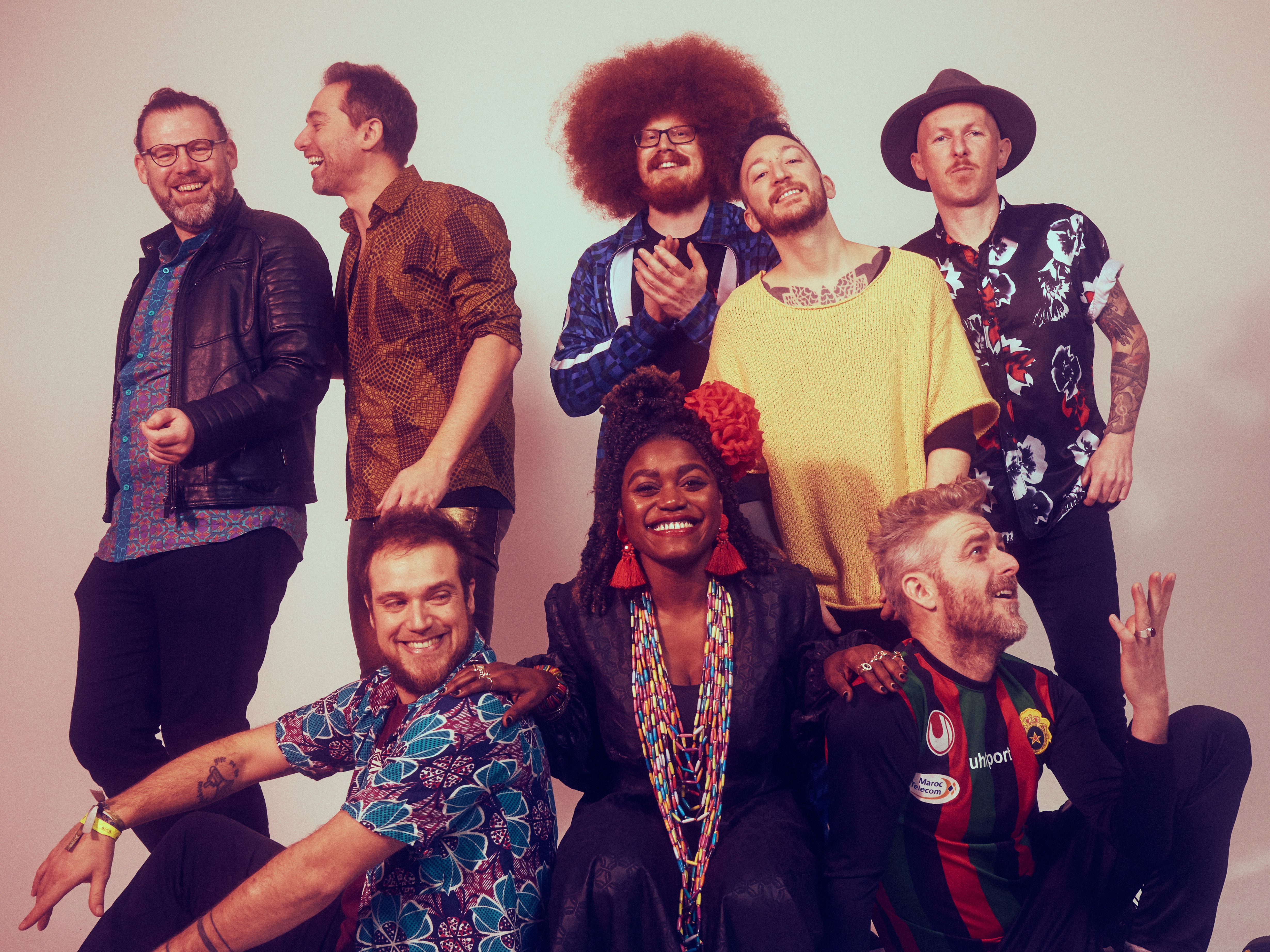
Name: London Afrobeat Collective
Members: Juanita Euka (vocals), Alex Farrell (guitar), Alexis Szyjanowicz (guitar), Luigi Casanova (bass), Giuliano Osella (drums), Richie Sweet (percussion), Andy Watts (trumpet), Klibens Michelet (baritone sax)
Interviewee: Andy Watts
Current release: London Afrobeat Collective's Esengo is out now. Buy it at Juno.
Recommendations: Terry Pratchett - The Colour Of Magic: an amazing novel, filled with fantastical creatures and wild stories, with a subtle and dry humour that ties everything together.
Fela Kuti - "Expensive Shit": essential listening for any fan of Afrobeat, and central to our development as a band. The B-Side “Water No Get Enemy” was one of the first songs we jammed when the band began.
If you enjoyed this London Afrobeat Collective interview and would like to know more about the band and their music, visit their official website. They are also on Facebook, Instagram, and Soundcloud.
When I listen to music, I see shapes, objects and colours. What happens in your body when you're listening? Do you listen with your eyes open or closed?
With my eyes closed.
I like to make space for the music to affect me physically and emotionally, so that I can feel the vibrations of the bass, and let the music flow without the distractions of vision.
Entering new worlds and escapism through music have always exerted a very strong pull on me. What do you think you are drawn to most when it comes to listening to and creating music?
When listening I’m attracted to unconventionality. So much of our life has a background of music that could be described as “normal” or “safe”.
I love it when a song takes me out of that and makes me think or feel differently.
What were your very first steps in music like and how would you rate the gains made through experience?
My parents were classical musicians, so I’ve always been surrounded by music. I trained at a jazz conservatoire, but then I think the most important part of my development was actively trying to get away from the “college sound” and discover my own path.
I believe now I have a clearer vision, and can execute my ideas more effectively than when I was first searching for my way.
According to scientific studies, we make our deepest and most incisive musical experiences between the ages of 13-16. What did music mean to you at that age and what’s changed since then?
As a teenager I was struggling to find my place in the world, and I found some safety and confidence in jazz and metal genres. While I’m still into that stuff a little, my mind is far more receptive to all things now, so I’m not sure I would entirely agree with those studies.
The most important periods in my musical life I’d say were between 21-24 (when I started touring with reggae/dub bands in New Zealand), and between 27-30 (when I got seriously into the history of afrobeat).
How would you describe your own relationship with your instrument, tools or equipment?
The trumpet is traditionally a complicated instrument to progress on. It requires a humble approach, and to be able to understand that some days, things just won’t quite work the way you want them to. This can be at odds with the traditional image of the brash, testosterone-fuelled brass player (which is an unhelpful cliche, and not a true reflection of the instrument at all).
In recent years I have tried to develop a balanced relationship with the instrument, where I accept my inability to do everything, but practice every day to attempt to close gaps in my technique.
The goal is to allow myself to express my musical ideas with as few barriers as possible.
Where does the impulse to create something come from for you? What role do often-quoted sources of inspiration like dreams, other forms of art, personal relationships, politics etc play?
As a band we’re heavily influenced by the world around us, by political events, by the universal struggle for human rights, and by our own personal struggles.
We each feel the creative spark in different ways at different times, but when the creative magic is flowing for all of us at the same time, that’s when our best work happens!
Are you acting out parts of your personality in your music which you couldn't or wouldn't in your daily life? If so, which are these? What, would you say, are the key ideas behind your approach to music?
No, music is a hugely important part of my life, but I try to live in a holistic way and not require an escape or release through music.
Music for me is an opportunity to communicate the fullest and best version of myself with a large audience, in the same way I would try to communicate when in conversation with friends.
If music is a language, what can we communicate with it? How do you deal with misunderstandings?
Music is absolutely a language, an international language with which we can communicate in a way that crosses the borders setup by countries, languages, and locations. It cuts straight to our feelings, and makes us move, dance, shout, weep, and ponder.
In my experience, misunderstandings are less common with music than other forms of communication, but can be dealt with in the same way - through good-natured and intentional discussion, and airing of views.
Making music, in the beginning, is often playful and about discovery. How do you retain a sense of playfulness and how do you still draw surprises from tools, approaches and musical forms you may be very familiar with?
If you’re working with a large group of musicians (as we do in London Afrobeat Collective) there is always the opportunity for playfulness and whimsy.
Often it may not be directly obvious when listening to a finished product, but absolutely we try to approach the writing process from a place of experimentation, rather than just writing the same song that worked last time.
Sound, song, and rhythm are all around us, from animal noises to the waves of the ocean. What, if any, are some of the most moving experiences you've had with these non-human-made sounds? In how far would you describe them as “musical”?
Everything has a music to it, from the bustle of a city like London or New York, Paris or Berlin, with their high background noise, punctuated with sirens, trains and planes, to the natural music of the forests and oceans with their equally busy, but different timbre.
One morning last year, while visiting the Redwood Forest in California, I awoke to a glorious autumnul chorus of native birds, insects, and the light breeze whispering through the trees. It was magical!
There seems to be an increasing trend to capture music in algorithms, and data. But already at the time of Plato, arithmetic, geometry, and music were considered closely connected. How do you see that connection yourself? What aspects of music do you feel can be captured through numbers, and which can not?
Numbers are just a way of measuring and explaining music from a scientific point of view, in order for us to understand it. In some ways, I guess you could say music is applied mathematics, in that the frequencies of the notes we play can be defined numerically, and within groups of frequencies, other resonant harmonics can be created that complement the music being performed.
I’m not sure that anything can be “captured” by numbers, but certainly they can help us to create a clearer picture of what it is that moves us, and why.
How does the way you make music reflect the way you live your life? Can we learn lessons about life by understanding music on a deeper level?
I think the way that London Afrobeat Collective write and perform our music is a good reflection of the way each of the 8 members lives, and the way we interact with each other. Trying to craft something greater than the sum of its parts, and unlocking the best of all of us.
Deep learning and enhanced understanding in any area can teach us a lot about ourselves and each other, so yes, absolutely music can give us life lessons!
We can surround us with sound every second of the day. The great pianist Glenn Gould even considered this the ultimate delight. How do you see that yourself and what importance does silence hold?
Claude Debussy said “Music is the silence between the notes”, and in that way I think that silence is vital. If we are constantly listening, hearing, consuming, then after a while the glory of the music can be diminished, as it becomes nothing more than a canvas that we paint our lives on.
I prefer to make music the centrepiece, and celebrate whan I have the opportunity to listen to it. For this to work, time spent without music is important, in order to maintain balance.
Do you feel as though writing or performing a piece of music is inherently different from something like making a great cup of coffee? What do you express through music that you couldn't or wouldn't in more 'mundane' tasks?
No, I think doing anything at an exceptional level is a skill that requires constant refinement and practice, whether that be playing the trumpet, making a coffee, or driving a car.
I’d also suggest that many parts of becoming an exceptional musician are incredibly mundane (the hours of long tone practice, the scales, the vocal warm ups etc). In the same way that we don’t see the years of training when we drink an exceptional coffee, you don’t see the years of training when you come to our show, but without it, our show (and the coffee) would be much less enjoyable!
However a person can express their quest for perfect technique and sensitive execution to make people happy, this should be celebrated.
If you could make a wish for the future – what are developments in music you would like to see and hear?
I think the developments in making music performance and production accessible to everyone have been one of the great levellers of the last 20 years. Anybody with a laptop now (and it doesn’t even have to be that good of a laptop) can create and record music, and share it with the world.
I would love to see even more democratisation of the music business process, where artists can be compensated for their work fairly and have access to greater performance opportunities without gatekeepers.
I’m hopeful that the industry is moving in that direction, but I’m still concerned about how in this world of the internet and the overloading of constant consumption, maybe we’ve missed the point about what music is, and how we should be respecting the people that create it at a high level.