

Name: Morgan Swihart
Nationality: American
Occupation: Singer, songwriter
Current release: Morgan Swihart's Broken Ceilings EP is out now.
Recommendations: I’m sure most readers know about this album, but I’m gonna recommend it anyway. Last Splash by the Breeders. I just think it’s great from start to finish. Even if you’ve already heard it a million times, listen again cause why not.
I’m also gonna recommend the book Girls to The Front by Sara Marcus. It’s a really well told history of the Riot Grrrl movement. I find it inspiring and also just a fun read. The music mentioned is great too.
If you enjoyed this Morgan Swihart interview and would like to know more about her music, visit her on Instagram.
When I listen to music, I see shapes, objects and colours. What happens in your body when you're listening? Do you listen with your eyes open or closed?
When I listen to music, I listen with my eyes open, but they may as well be closed. I’m rarely paying attention to what’s in front of me. It’s as though I’m daydreaming with my eyes open, while the music is guiding my dream – if that makes any sense.
What happens in my body is always different depending on what I’m thinking about, or what memory is surfaced by the music. Sometimes it’s physical like goosebumps or the need to move, and sometimes it’s an emotional reaction like sadness or nostalgia.
Entering new worlds and escapism through music have always exerted a very strong pull on me. What do you think you are drawn to most when it comes to listening to and creating music?
For listening, I’d say it’s escapism for me as well. I stop paying attention to the world around me and fall into whatever alternate world or memory the music takes me to.
Creating music, however, is sort of the opposite for me. Rather than escaping, I run straight into the thoughts, feelings, and memories I tend to avoid. I draw on it.
Everyone says this, but it really is my outlet. I’ve always had a hard time talking to anyone about personal struggles, but music somehow feels isolated and universal at the same time. It’s like I pour my heart out and release it to the world while still feeling protected from being looked at differently.
What were your very first steps in music like and how would you rate the gains made through experience?
My first steps were taking piano lessons where I discovered that I hate piano. Or at least I thought I did. I hated the constrictions of classical piano lessons, so I started taking guitar. My teacher, Alden, let me learn the music I was passionate about and in my own way.
I’d say the most important step I took was applying to colleges. When it dawned on me that I had to start thinking about what I wanted to do with my life, the only answer I could come up with was music. But I didn’t think I had a good enough voice to be successful as an artist. I decided to apply to the Clive Davis Institute which is when I started writing and recording so I could submit a creative portfolio.
It was the best thing that ever happened to me. I really loved writing, recording, and producing original music. I added to that portfolio and ended up releasing an album before graduating my senior year of high school.
According to scientific studies, we make our deepest and most incisive musical experiences between the ages of 13 -16. What did music mean to you at that age and what’s changed since then?
From 13 – 16 I hadn’t started writing original music yet. I didn’t know it at the time but all the music I was listening to would become fundamental in my own songwriting/production.
I found that I really loved music that made me slightly uncomfortable in its vulnerability. Not only lyrically, but also melodically. I listened and learned a lot of Elliot Smith, Nirvana, Radiohead, The Breeders, etc. I think something about the vague lyricism really resonated with me.
I found my own ways to relate to the music whether or not it was what the artist intended. For me, music was simultaneously an escape, and a safe space to confront uncomfortable thoughts/feelings.
What’s changed is mostly that I began writing and releasing my own music. Not only does listening to music mean a great deal to me, but the process of creating it does as well. The safe space and escape I found in listening has translated into the art I create.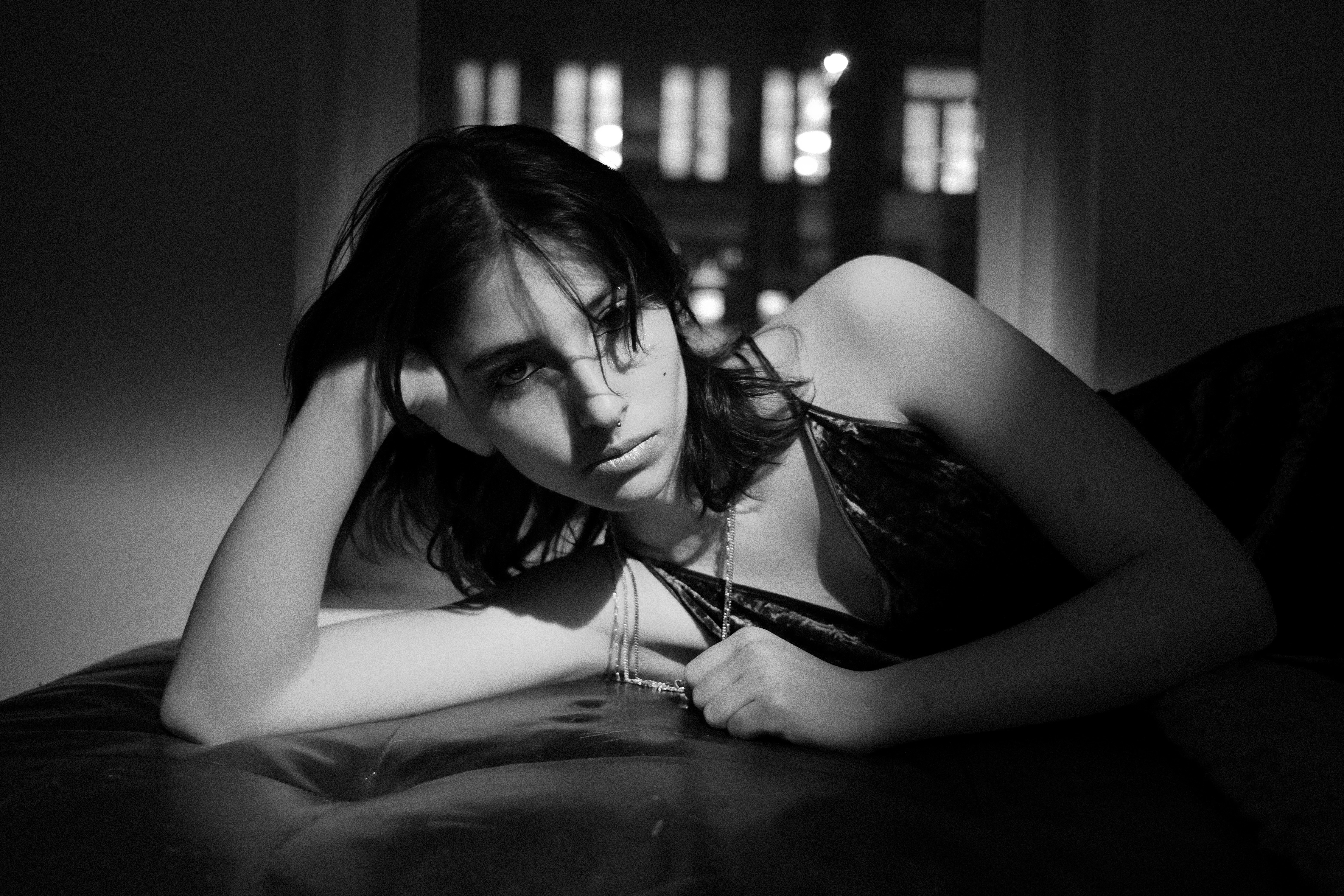
Morgan Swihart Interview Image (c) the artist
How would you describe your own relationship with your instrument, tools or equipment?
I’d say my relationship with my instrument is intimate. My guitar is what I write all of my music on and playing/practicing is like a form of meditation for me.
As someone who often struggles to sit still, the pandemic made it really difficult to feel at ease with too much time on my hands. I probably played more guitar than any other point in my life during lockdown. It not only gave me a break from everything going on in the world, but it also let me express myself in a way that’s comfortable for me.
I’m extremely grateful for my instrument and I feel that gratitude every time I pick it up.
Where does the impulse to create something come from for you? What role do often -quoted sources of inspiration like dreams, other forms of art, personal relationships, politics etc play?
I think the impulse to create comes from how moved other’s music can make me feel, and the drive to actually put in the work and commit myself to a piece of art comes from the need to express myself. Music is my ultimate form of self-expression, and my artistic impulses are inspired by personal relationships, memories, and my relationship with myself.
A lot of my songwriting revolves around mental health issues. I’d say my creations are inherently “selfish” because they’re basically a form of therapy for me. But I don’t think selfish creations are a bad thing. I might be writing something because it makes me feel better, but most experiences are resonated with on a universal scale.
I find that I most often relate to music where the singer is expressing something personal, and even though it’s meant for them, it still means something for me.
Are you acting out parts of your personality in your music which you couldn't or wouldn't in your daily life? If so, which are these? What, would you say, are the key ideas behind your approach to music?
I’d say I definitely express parts of myself that I don’t express in my daily life. For instance, I very rarely talk about romance or my love life when it really means something. I’ll talk about meaningless dates, or people I find attractive, but when it’s serious to me I often keep it private. In my songwriting however, I do express how much the person I love means to me.
I think almost all of my songs revolve around the things I don’t discuss in my daily life. That’s sort of the point. It’s my outlet to say, think, and feel whatever I want.
It’s ironic considering that putting those feelings out into the world is a much larger scale of expressing myself then a conversation with friends or family. Yet somehow it couldn’t feel more intimate.
If music is a language, what can we communicate with it? How do you deal with misunderstandings?
I’d say that misunderstandings are okay, and communication is subjective. In art, a misunderstanding is just another lens to see something through. The artist will see their art differently than the viewer/listener who will see that art differently than the next viewer/listener.
People often try to find a way to resonate with something and in order to do so, they have to sculpt it to fit their own perspective. I think that’s one of the best things about art. It belongs to all of us in different ways. We’re creating something tangible to everyone who comes across it.
An artist might not feel that they’ve properly communicated what they wanted through their art, but that doesn’t mean they’ve communicated nothing. We can’t control what gets through to people, and that’s what makes art so attractive in my opinion.
Making music, in the beginning, is often playful and about discovery. How do you retain a sense of playfulness and how do you still draw surprises from tools, approaches and musical forms you may be very familiar with?
I retain a sense of playfulness and allow for surprises by ignoring the notion that if I’m not doing something that’s never been done before, it’s not good enough. I think I really struggled with this in my first year at college. It felt like everyone around me was trying to do something completely “new” and music that wasn’t as innovative as possible wasn’t worth our time.
I completely disagree with this. I decided to have my mindset be that as long as the music is coming from my head, it is innovative and new. It’s mine. It might be a “basic” chord progression and it might just be guitar bass and drums, but it’s my perspective which makes it worthwhile. When I implemented this mindset into my writing I was surprised from what came out of it. I was just making something that sounded good to me. After I’ve made that, I can play around with it as much as I want. Or not.
Either way, giving myself the space to not think about being the “best” or the most “unique” in my writing and production gave me more space to take twists and turns I never would’ve taken if I went in with the mindset that my song was going to be this groundbreaking work of art.
Sound, song, and rhythm are all around us, from animal noises to the waves of the ocean. What, if any, are some of the most moving experiences you've had with these non-human-made sounds? In how far would you describe them as “musical”?
In high-school, I ran a lot. It helped with stress and I loved moving to whatever music I was playing in my air pods. When I wasn’t in the city, I started running to the beach. When I got to the beach I’d take my ear buds out and just listen.
I don’t know if I can find a word for it, but it was definitely moving for me. I’d be running and blasting music for like an hour, and then I’d just sit still with no sound other than the beach. It felt like it’s own music, and was my favourite part of the run.
I wouldn’t necessarily describe the sounds as musical in the way I listen to or make music. But I do think nature’s sound has a similar and powerful impact.
There seems to be an increasing trend to capture music in algorithms, and data. But already at the time of Plato, arithmetic, geometry, and music were considered closely connected. How do you see that connection yourself? What aspects of music do you feel can be captured through numbers, and which can not?
In my process, I’d say there’s nothing mathematical.
I’m sure people could listen to my music and capture it in algorithms and mathematical theory choices, but for me nothing is in numbers. I never learned music theory and I don’t make choices because I know one note works well with another. I just write and play what sounds good in my ears.
Of course there’s mathematical reasoning to why it sounds good to me. I just don’t care to know or think about it. That’s just how I personally go about and think about my creative process.
How does the way you make music reflect the way you live your life? Can we learn lessons about life by understanding music on a deeper level?
I live in this limbo between going with the flow and being extremely meticulous about my decisions, and my music certainly reflects that. When I begin creating, it’s all very fluid. I’m playing what I like, and I’m writing whatever is inspired from that melody. I don’t really have a songwriting regimen that I strictly follow. It just flows, and I write music pretty fast because of that.
Once I’ve recorded the base of my song however, that’s when I get meticulous about it. I start thinking about where the song feels boring, where I need to introduce something new, what’s working and what’s not working. Sometimes I’ll write a song in 10 minutes and have it recorded an hour later. But I don’t feel like it’s finished until weeks later after I’ve properly thought it out. I go about my life the same way.
Initially, I just do what feels right and I go with the flow. But once I’m in the flow I start thinking deeply about the decisions I should be making.
We can surround us with sound every second of the day. The great pianist Glenn Gould even considered this the ultimate delight. How do you see that yourself and what importance does silence hold?
Growing up in NYC, I’ve been constantly surrounded by sound. When I’m falling asleep, I can hear all the city’s sounds through my windows. I very rarely hear silence.
I think I feel silence the most when I’m listening to music and there’s a break. Music is stimulating, but when there’s a pause, a moment of anticipation, that’s when I feel it. It’s simultaneously a moment of relief from the stimulation, and also a moment of wanting to see what happens next.
Silence holds importance for me, but I think I can only handle it to a certain degree. If I want a moment of silence in my own music, I want it to be comfortable. Like when you get close enough with a person that you can sit in silence with them and not feel awkward. That’s the relationship I want between my music and silence.
Do you feel as though writing or performing a piece of music is inherently different from something like making a great cup of coffee? What do you express through music that you couldn't or wouldn't in more 'mundane' tasks?
For me, yes. When I make coffee, or tie my shoes, I go into autopilot. I don’t want to feel like I’m in autopilot when performing or writing.
It’s my space to really express myself, and I think I’d be missing out if I wasn’t present in doing so.
If you could make a wish for the future – what are developments in music you would like to see and hear?
There are so many ways to answer this question. I mean obviously there’s the big things like more inclusivity, more attention to the art and less to media presence, taking risks again rather than only signing artists who have TikTok followings, etc.
But I think on a smaller scale I don’t have an answer. I want to be surprised. I want to hear whatever the future has to give for me to hear. I’m interested in what’s going to happen that I can’t anticipate.

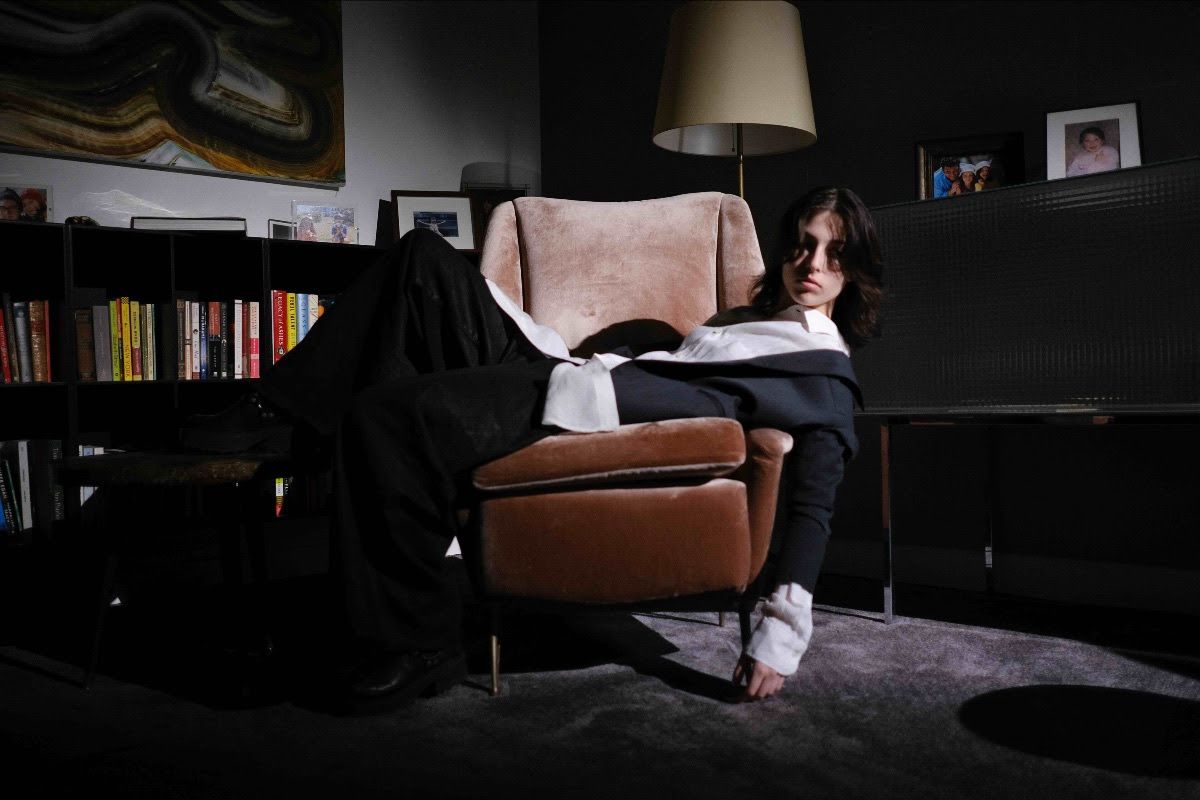 Morgan Swihart Interview Image (c) the artist
"In art, a misunderstanding is just another lens to see something through."
Video
