Published
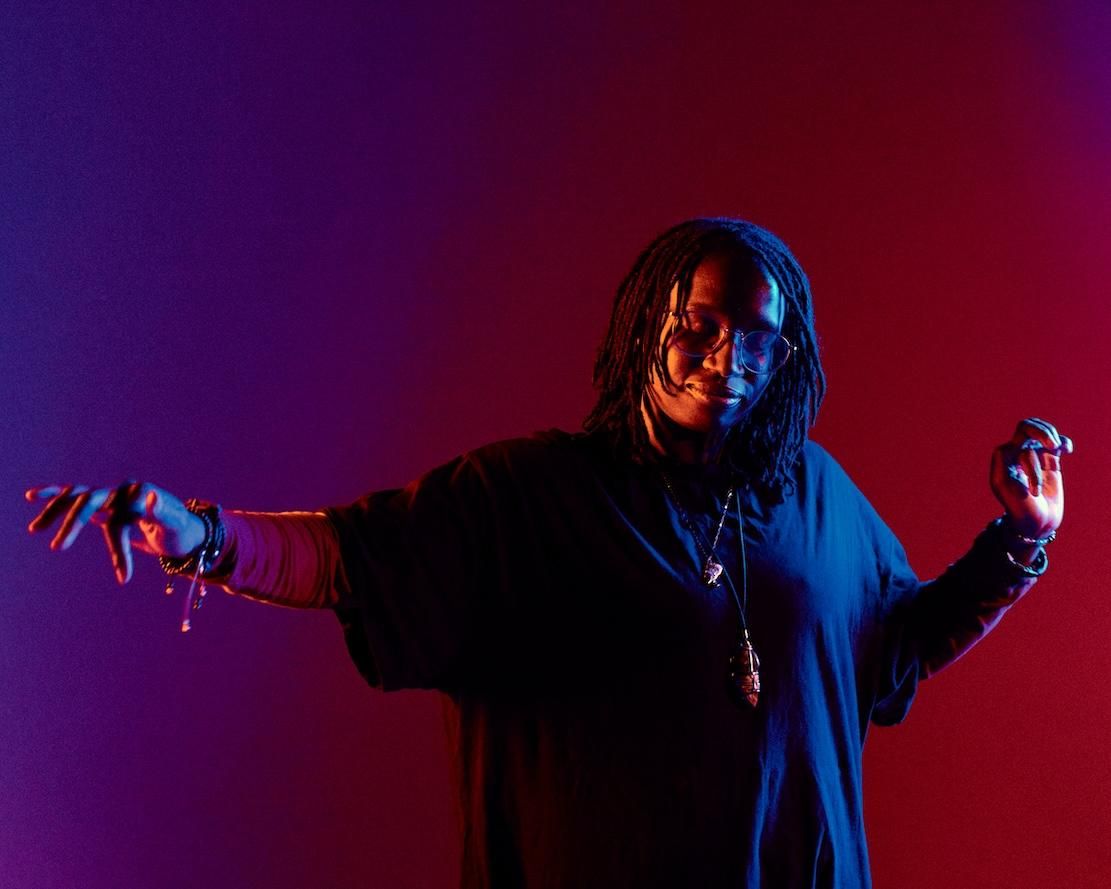
Name: Nicole Raymond aka NikNak
Nationality: British
Occupation: Producer, composer, DJ, turntablist
Current release: NikNak's Ireti is out via Matthew Herbert’s Accidental Records.
Recommendations: Octavia Butler’s Dawn - there’s an audiobook version too!
Camille Saint-Saëns - “Danse Macabre” - one of my favourite classical pieces.
[Read our Matthew Herbert interview]
If you enjoyed this NikNak interview and would like to know more about her work, visit her official website. She is also on Facebook, Instagram, and Soundcloud.
When I listen to music, I see shapes, objects and colours. What happens in your body when you're listening? Do you listen with your eyes open or closed?
It really depends … I know that if I really like a track, I’ll get goosebumps and/or make a bass face …
Both can happen with my eyes open or closed but it just depends on what I’m listening to.
Entering new worlds and escapism through music have always exerted a very strong pull on me. What do you think you are drawn to most when it comes to listening to and creating music?
I’m drawn to the worlds that can be created and the perspectives we’re able to experience in a musical environment.
Often times it’s nice to give focus to sounds that we take for granted or associate with negative emotions or reactions so it’s nice to juxtapose that for audiences and myself in the creation process.
What were your very first steps in music like and how would you rate the gains made through experience?
My first steps were via video games like Ejay and Music 2000.
From there, and whilst having a sound system in the house, came being surrounded by music loving friends. Tech like Fruity Loops and Reason helped me become more inspired and interested in the “behind-the-scenes” part of music creation … and how colourful it can be.
According to scientific studies, we make our deepest and most incisive musical experiences between the ages of 13-16. What did music mean to you at that age and what’s changed since then?
Music meant unapologetic joy. Even the mainstream charts had such a healthy variety of tracks from different genres.
Nowadays, a lot of the mainstream/pop charts feature very heavily manufactured music which mostly sounds the same.
How would you describe your own relationship with your instrument, tools or equipment?
The turntables are the best place for me to be as expressive as I want to be. I think that’s why I don't really get nervous much anymore when using them live. I can take my self-expression to a new level on them, and every time it’s different too. It’s probably kinda cliche to say that they’re an extension of me but I guess that they are … and their versatility is awesome too.
The other tech I have is mainly digital and might change in the future to better serve the sounds and worlds I want to create on the turntables first and foremost.
Where does the impulse to create something come from for you? What role do often-quoted sources of inspiration like dreams, other forms of art, personal relationships, politics etc play?
Sometimes it's a question, sometimes it’s exhibitions, nature, art … life in general as well as fiction … at times it's also been very spontaneous … I’ll just spend time figuring it out what the idea is and go from there.
A lot of times, when I’m improvising live and creating something, it’ll be me listening intently and responding to what I’ve just done and creating happy accidents to play with further later.
Are you acting out parts of your personality in your music which you couldn't or wouldn't in your daily life? If so, which are these? What, would you say, are the key ideas behind your approach to music?
Don’t think so … if anything I’d say the only time I’ve done this is on “You’ve Never Seen A Miracle” where I did backing vocals.
I’ve never sung on my own productions before to that was a new experience, very affirming.
If music is a language, what can we communicate with it? How do you deal with misunderstandings?
Emotions and thoughts both with and without lyrics. With misunderstandings, it’s important to remain teachable so you can learn from those moments and grow.
Making music, in the beginning, is often playful and about discovery. How do you retain a sense of playfulness and how do you still draw surprises from tools, approaches and musical forms you may be very familiar with?
Happy accidents everytime - In DJ sets, in live improvised sets … the more happy accidents occur, the harder and more I can go further.
Sound, song, and rhythm are all around us, from animal noises to the waves of the ocean. What, if any, are some of the most moving experiences you've had with these non-human-made sounds? In how far would you describe them as “musical”?
With Bashi, I found myself recording sounds in Turkey when I went there for a retreat for my mental health. Those sounds represented a moment in time for me, and so to repurpose them into a piece and make music with them is another form of storytelling at that specific moment in time.
Listening to those sounds whilst performing them provided a sense of nostalgia that lent itself to the creation of the album overall. So yes - I think I have a strong connection to sounds, especially sounds of water like rain or the beach. These in particular give me peace.
There seems to be an increasing trend to capture music in algorithms, and data. But already at the time of Plato, arithmetic, geometry, and music were considered closely connected. How do you see that connection yourself? What aspects of music do you feel can be captured through numbers, and which can not?
Maths and music are very much connected. Maths isn’t my strong suit as I’m neurodivergent. But I can understand the relationship it has with music and its importance too.
As someone who isn’t classically trained or super mathematical or scientific with music, there’s only so much I can say to be honest. But I think the emotional relationship between the listener and the material they’re listening to can’t really be replicated as it’s so unique per person.
There are studies that look into frequencies for example and how they make us feel, and that all makes sense on a larger scale to collect that data and decipher what it means later on. But zooming into a person-to-person scenario, there are fluctuations that maths and science sometimes can’t account for - and that’s ok.
How does the way you make music reflect the way you live your life? Can we learn lessons about life by understanding music on a deeper level?
It’s definitely freer now than it was a few years ago, and I’m more confident in myself now too.
For a long while I had imposter syndrome and would hesitate to call myself a turntablist because of internet trolls (often men) being very rude and negative about my practice. As I’ve gotten older and have been surrounded by like minded individuals, that crappy feeling has left me now thankfully, which has meant I can really just go for it and make what I want.
I’m also still learning about myself too and discovering things which adds to the sense of play. I think this is reflected in just how strict I am with my downtime and will rest, have a break, play video games - whatever, to have that sense of play in a different way outside of music creation.
I guess one lesson is that music can actually be really simple and minimal - it’s up to us if we want to add to it or not - just like in life. We can choose to make additions, complicate it further, or just go for what gives us peace and enriches us. I think those can be intertwined, or are linked for sure.
We can surround us with sound every second of the day. The great pianist Glenn Gould even considered this the ultimate delight. How do you see that yourself and what importance does silence hold?
We’re always taking in sounds and noises, and so to be able to really relish silence where possible is a wonderful privilege I think.
Easier said than done, especially in today's society where everyone and everything makes some kind of noise. But if you’re able to shut most of it out without the interference of something else, it can be a form of resetting yourself.
It can also give you perspective on just how noisy life can be.
Do you feel as though writing or performing a piece of music is inherently different from something like making a great cup of coffee? What do you express through music that you couldn't or wouldn't in more 'mundane' tasks?
Well I was a pretty shit barista once upon a time so that's saying something!
Performance can be pretty cathartic for me so there’s been moments where I’m feeling a certain way spiritually or emotionally and subconsciously, I’ve been able to release that into the performance and feel much lighter and calmer afterwards.
If you could make a wish for the future – what are developments in music you would like to see and hear?
More support and recognition of black and brown artists creating and thriving in the experimental music scene, and lineups to support this too.
With greater awareness of these artists on a bigger scale, it means that when we play, we’ll see people that look like us in the audience, and that has a powerfully positive effect.