Published
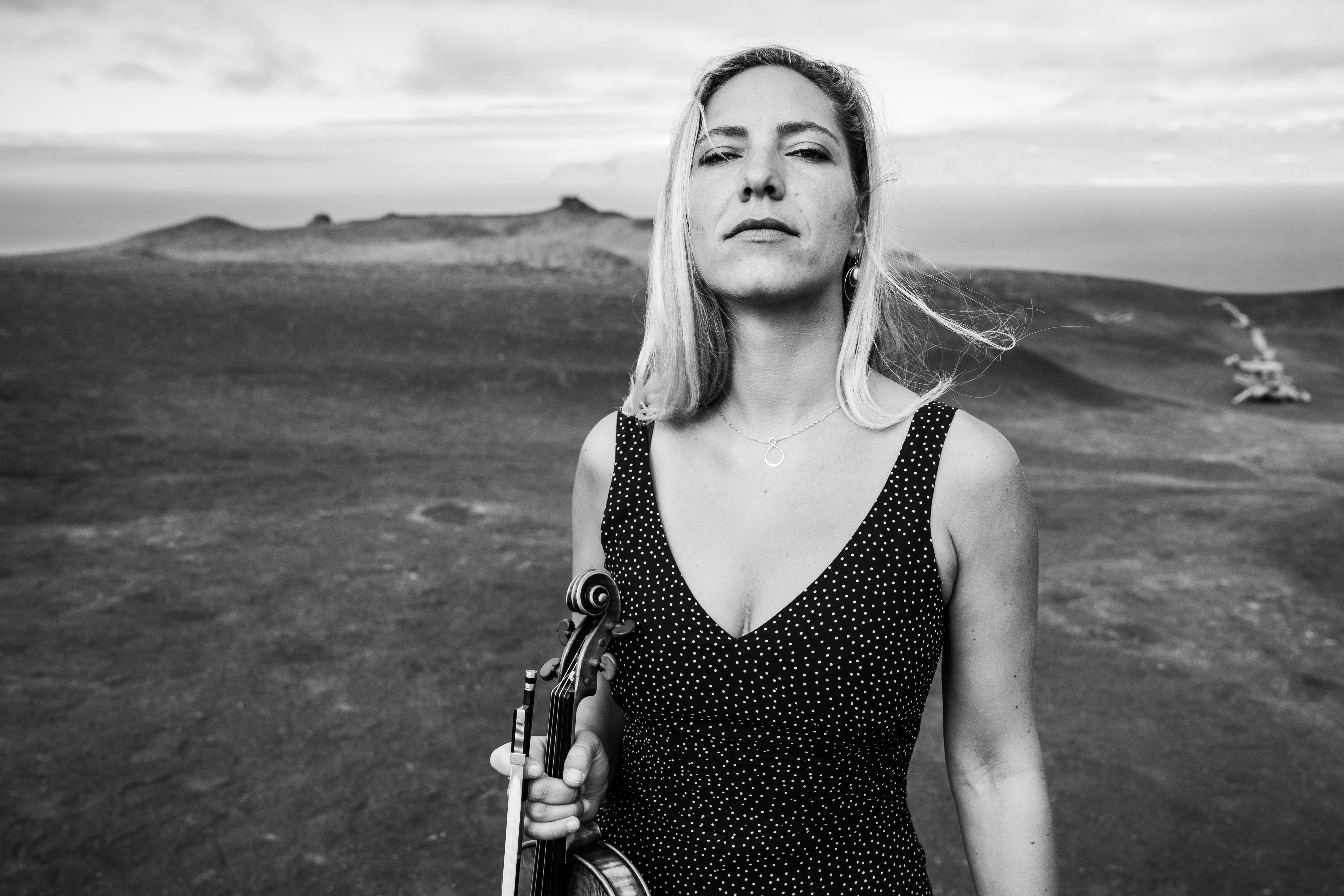
Name: Petra Onderuf
Nationality: Slovak
Occupation: Violinist, composer, improviser
Current release: Petra Onderuf's debut album An Odd Time of Day, featuring herself and Rok Zalokar (piano), Luka Dobnikar (double bass) as well as Aleš Zorec (drums), is out via Kaipati.
Recommendation for her hometown of Ljubljana: Just walk up to the castle in Ljubljana, and you will see a city with a picturesque view of the Alps in the background.
Topic I rarely get to talk about: Oh, I am a passionate skier and could spend days on the slopes.
If you enjoyed this Petra Onderuf interview and would like to stay up to date with her music, visit her official homepage. She is also on Instagram, Facebook, and bandcamp.
When I listen to music, I see shapes, objects and colours. What happens in your body when you're listening? Do you listen with your eyes open or closed?
I like to listen to music with my eyes open—perhaps because I mostly listen while driving, and driving with my eyes closed wouldn’t be very practical ;)
I also enjoy live concerts, where I love taking in the full experience—watching the musicians' expressions, their body language, and their communication with other band members. It’s a completely different experience.
Interestingly, though, when I play—especially when I improvise—I need to close my eyes. It helps me enter another space where I can fully follow the flow of the notes, sound and the story of the music.
If we forget about streaming numbers, target audiences, social media followers, and sales - why are you drawn to sound and music as a creator and listener? What is it that you give and receive through it?
I guess every music creator is initially drawn to making music without the aim of targeting audiences or gaining a large following. That part often comes later—sometimes as a bit of a burden—as you navigate your way, trying to survive, make money, and pay your bills so you can create again.
I see many creators, myself included, starting from a place of curiosity, fun, childlike excitement, and an insatiable hunger to play and create. Often, you don’t even know why or for whom—you just know you have to do it; otherwise, you’ll never feel truly satisfied. I don’t know what it is … human nature? Our purpose in life?
And why am I drawn to listening? Since my childhood, I’ve been fascinated by live music and people playing instruments. There was always something captivating about it—when someone started to play, I could sit, listen, and become completely hypnotized by the sound.
According to scientific studies, we make our deepest and most incisive musical experiences between the ages of 13-16. What did music mean to you at that age and what’s changed since then?
At that age, I actually played a lot of classical music while also going to jazz and singer-songwriter concerts. I joined a band with friends my age and started improvising—without any prior knowledge of improvisation.
I was fascinated by my bandmates when they would just start playing music without sheet music, without anything written down, and even without deciding on a key beforehand. They barely knew any music theory, and as a classically trained musician at the time, this was completely new to me. Thrown into this situation, I had to figure out how to play something that had never been written before.
They had a great groove and played a lot of funk, blues, and jazz fusion, and soon we started composing some really cool songs together. Looking back, I think meeting them was one of the key turning points in my understanding of music creation.
Tell me about one or two of your early pieces that you're still proud of (or satisfied with) – and why you're content with them.
The earliest pieces I co-wrote were from my teenage years, and I still enjoy listening to them from time to time—I think they weren’t bad at all ;)
Later, I composed pieces for the world music trio I play with, Wild Strings Trio. These pieces are a lot of fun to perform because of their rhythmic patterns and challenging grooves.
One of them, “5am,” was born during a late-night (or early-morning?) jam session and later completed. It’s written for violin, cello, and guitar.
Only later did I start to compose for jazz ensembles, even for big bands, which was definitely a next level and a lot of fun to do and play with.
What is your current studio or workspace like? What instruments, tools, equipment, and space do you need to make music?
I mostly like to sing melodies or bass lines first, then write them down on a computer or record them on a loop station, allowing me to play with them and develop them further.
The first song on my album, “Cremm,” was written exactly this way—I sang the melody while driving, recorded it, and worked on it later.
I’ve also written many pieces on the piano, especially while exploring harmonies that are of course easier to play on the piano than on the violin.
Two of my songs, “Eleven” and “Julia’s Sunset,” were composed this way.
From the earliest sketches to the finished piece, tell me about the creative process for your current release, An Odd Time of Day, please.
My current album, An Odd Time of Day, is my debut jazz album. I wrote these compositions over the past nine years as reflections of my life experiences and emotions—shaped by life’s unpredictable turns—or simply as expressions of playful curiosity with sound, odd rhythms, and musical ideas.
I wrote most of them during my composition studies, and they were waiting for the right people and the right moment to come to life. I believe it was the perfect choice because I found amazing musicians who truly understood this music and brought it to life in the best possible way.
Do you feel that your music or your work as an artist needs to have a societal purpose or a responsibility to anyone but yourself?
I guess it can have some significance, especially for classical violinists who grow up in environments where they aren’t exposed to the possibility of using their instrument for creation and improvisation. Maybe some of them—just like I was as a child—were very creative when they were young but lost that creativity while learning to play the violin.
I hope to remind them and, hopefully, inspire some to rediscover their freedom of expression and creativity, even on such a challenging instrument as the violin—an instrument that is still not so commonly used in improvisation and jazz.
For me personally, music has in many instances influenced my decisions and views and literally changed my life. What has this been like for you and how do you think does music make its power felt?
That definitely happened to me as well, especially when it came to deciding where to live. I moved to places that felt the most musically interesting to me at a given moment and then figured out my way from there. So, many of my important life decisions were largely influenced by music.
I now live in Ljubljana, Slovenia, which has a vibrant, diverse, and high-quality music scene. I recorded my album here with these amazing Slovenian jazz musicians: Rok Zalokar on piano, Luka Dobnikar on bass, and Aleš Zorec on drums.
I was also fortunate to have two incredible, internationally renowned guests—Jure Pukl on soprano saxophone and Gašper Selko on trumpet.
I would love to know a little about the feedback you've received from listeners or critics about what they thought some of your songs are about or the impact it had on them – have there been “misunderstandings” or did you perhaps even gain new “insights?”
I have to say, I’m very pleasantly surprised by the incredibly positive and insightful reviews from music critics about my album.
I was curious to see how they would describe the styles I’m blending, and most of them noted contemporary jazz with influences from Eastern European and Balkan world music. That’s quite accurate, as I’m deeply inspired by Balkan rhythms, and some Slovak melodies are probably “engraved in my blood.”
However, one reviewer surprised me by hearing a strong free jazz influence in my music—which I don’t think is really present, if at all, on the album. But I guess it depends on how one defines free jazz.
I also received wonderful comments from friends about individual songs, especially when they completely understood the feeling behind them. For example, with “Dete,” a friend told me she felt a sense of “happy sadness” or “sad happiness” in the song. And she was absolutely right—that’s exactly how I felt when I wrote it.
Sound, song, and rhythm are all around us, from animal noises to the waves of the ocean. What, if any, are some of the most moving experiences you've had with these non-human-made sounds? In how far would you describe them as “musical”?
Surely, birds are some of the best singers in the world.
We can surround us with sound every second of the day. The great pianist Glenn Gould even considered this the ultimate delight. How do you see that yourself and what importance does silence hold?
I need silence to have a space for the music in my head. Only in silence I can be creative.
Do you feel as though writing or performing a piece of music is inherently different from something like making a great cup of coffee? What do you express through music that you couldn't or wouldn't in more 'mundane' tasks?
I would say you can make both—music and a cup of coffee—without any feeling, simply by going through the motions, and it can still turn out well if you've mastered the skill. But if you make them with intention, great effort, and a lot of love, I’m certain people will feel the difference.
I hope that every cup of coffee and every piece of music will bring people a positive and meaningful experience.