Published
Name: Finian Paul Greenall aka FINK
Nationality: British
Occupation: Singer songwriter, guitarist
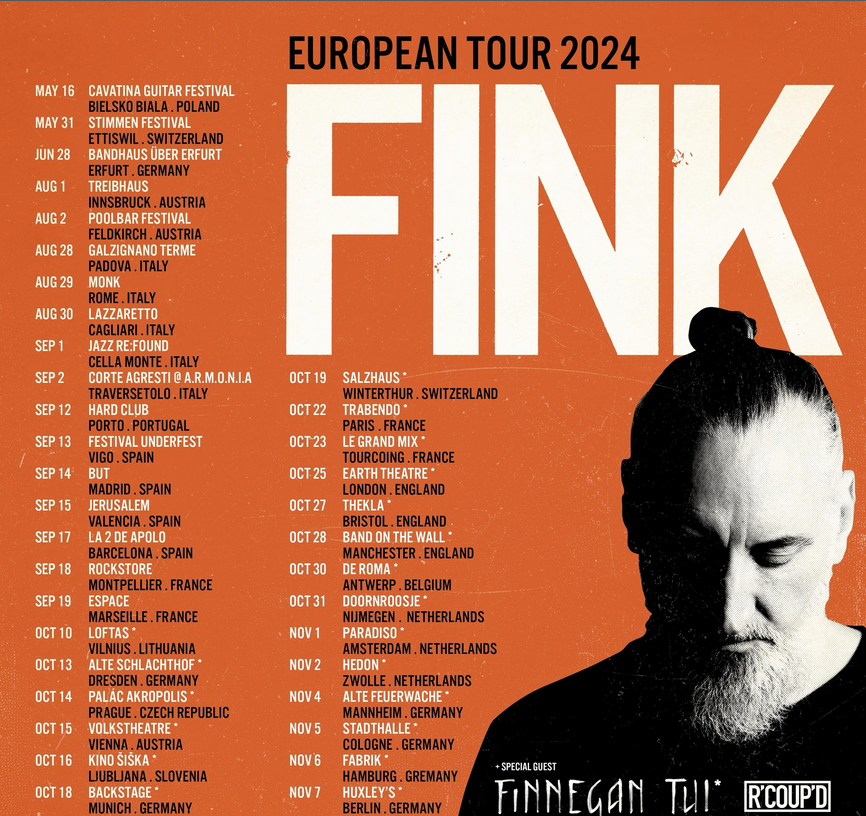
Current Release: FINK's new single “One Last Gift” is out via R'coup'd. Pre-order his upcoming full-length album Beauty in Your Wake. Catch him live on tour: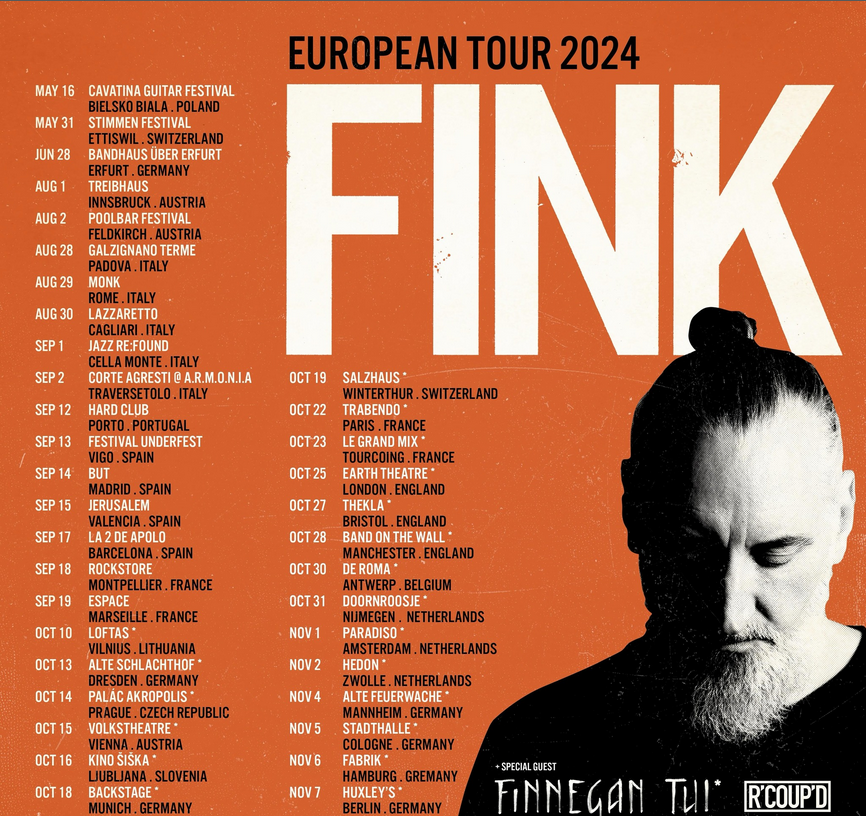
Recommendations: NonNonBa – Shigeru Mizuki; The Mysticism of Sound And Music – Hazrat Inayat Khan
If you enjoyed this FINK interview and would like to stay up to date with his music and tour dates, visit his official homepage. He is also on Instagram, bandcamp, and Facebook.
Where does the impulse to create something come from for you? What role do often-quoted sources of inspiration like dreams, other forms of art, personal relationships, politics etc play?
The impulse is something I’m thinking about a lot more these days. It’s just there! Maybe it’s the impulse to improve oneself or the promise of a problem solved. It’s a mediation with results in a way.
I am always enthralled by the new music of others and so I’m sure that feeds into my own. Personal relationships, yes, for sure, but mainly I suppose the relationship with myself and what it means to be an emotionally active in the modern age.
Books, plays, politics and art exhibitions really don’t influence me at all. If anything, they are a welcome distraction. I read a lot.
For you to get started, do there need to be concrete ideas – or what some have called a 'visualisation' of the finished work? What does the balance between planning and chance look like for you?
There is no planning. There is a general vibe, like: “This record I want to be more folky” or something like that. I am aware of my own tastes and how they are around me and the records that I am thinking about making. I can’t plan anything for me, I just plan some space and wait for the possibility of something happening in that space.
On the latest album we did have a visualisation. We kinda totally missed the mark, however! We had a copy of Graham Nash’s Wild Tales in the studio on the piano to look at and I wanted to make a record that LOOKED like that cover, so it was on the piano for everyone to look at should they be getting a little off message.
At the end of the day the whole record was off message! In a good way.
Is there a preparation phase for your process? Do you require your tools to be laid out in a particular way, for example, do you need to do 'research' or create 'early versions'?
I always do demos. My phone is full of them. Lyrics or melodies or guitar riffs. When the time is right, I crack open the vaults and see what speaks to me.
I listen to a lot of music in the genre that I want to inhabit and try and stay exclusively to it, so I soak in it.
Do you have certain rituals to get you into the right mindset for creating?
This changes with every record. The thing we all need is time and space, not for the initial ideas, they come whenever they like. You kneel beside the stream and they float by.
When it comes to songwriting, you need to be in a place of openness and release. Often a healthy mind and body helps with this.
What role do certain foods or stimulants like coffee, lighting, scents, exercise or reading poetry play?
I have holistic routines in my everyday life and specifically when on tour just to keep me engaged and plugged in to what is out there.
I have been doing this a long time my life and lifestyle is tailored anyway to the creative process.
What do you start with? And, to quote a question by the great Bruce Duffie: When you come up with a musical idea, have you created the idea or have you discovered the idea?
I prefer Rick Rubin’s description of it in his book. The ideas are always there, always out there, we are just receptors for inspiration. You really cannot force it.
It helps to have a muse. I always find that if I am uncertain I often listen to Radiohead as all of their albums are so approachable and inspiring in so many ways.
I think, in my career, I can count the truly original ideas on one hand. To be honest, that’s pretty good going. I have lyrics floating around and I have riffs floating around and I am like the matchmaker.
When do the lyrics enter the picture? Where do they come from? Do lyrics need to grow together with the music or can they emerge from a place of their own?
Lyrics are everything. The music is the easy bit but lyrics dictate melody, vibe, ambition, destination.
Every good song surely starts with poetry and storytelling, the music is simply the outfit the song is wearing
What makes lyrics good in your opinion? What are your own ambitions and challenges in this regard?
The challenge is to be yourself – always. Simple is great, complicated is great, just striving to be yourself is what it’s all about in my opinion.
Personally, the greatest lyricist I know of right now is Rachel Sermanni. I think she is the closest to purity in expression of soul.
Many writers have claimed that as soon as they enter into the process, certain aspects of the narrative are out of their hands. Do you like to keep strict control or is there a sense of following things where they lead you?
Creation is always a journey into the unknown. You start off thinking that you have a rough idea of where you are going but the truth is, if you are being really creative and truly artistic, you will always end up somewhere very different.
Sometimes, of course, you end up in a familiar place and that is sometimes a great thing and sometimes the worst thing. You just have to judge it at the time, just continue to strive for greatness.
I used a mantra from Bowie on this latest record: “if you’re in your comfort zone you’re in the wrong place.”
Often, while writing, new ideas and alternative roads will open themselves up, pulling and pushing the creator in a different direction. Does this happen to you, too, and how do you deal with it? What do you do with these ideas?
This is something that comes with a bit of experience. Should we be chasing the demo? Should we be striving for a certain thing? Is this a good idea? A bad idea? Or, even worse, an average idea? The longer you do something the more often you have had certain conditions and certain outcomes, y’know? So you can use those experiences to save you time.
My advice would be to allow the push and pull, explore it and don’t be lazy. Explore every dark corner and angle that the songs present to you. Chances are you’ll end up back where you started anyway but occasionally you find new inspiration hidden in unusual creative places.
For me, if I am bored, I will try another instrument, perhaps bass or piano or something, just to get me out of the cage my skillset on guitar keeps me in. Be bold, be inquisitive and, above all, don’t be lazy.
There are many descriptions of the creative state. How would you describe it for you personally? Is there an element of spirituality to what you do?
I would absolutely subscribe to this. It is euphoric and vulnerable. It is uncertain and solid. The creative state is one giant contradiction and with that you get a kind of universal tension that you can almost touch when you have done something great.
True creatives are never really carving out the songs, they are streaming the ideas that exist all around us all the time and somehow capturing them.
To achieve creative greatness, I think you have to truly ignore everybody, even yourself. To channel it, like Bowie.
When you're in the studio to record a piece, how important is the actual performance and the moment of performing the song still in an age where so much can be “done and fixed in post? “
Our studio experience is essentially live. I rarely do more than three takes for a comp. All the work is done in the writing phase. If my producers fix me when I’m not looking, they don’t tell me and I don’t ask.
As far as I’m concerned, performance is built into the song during the writing process. If it isn’t, it should be. You can’t write about emotion without emotion.
Once a piece is finished, how important is it for you to let it lie and evaluate it later on? How much improvement and refinement do you personally allow until you're satisfied with a piece? What does this process look like in practise?
This question is impossible to answer. I have learned to walk away but this is my eighth studio album and my 15th Fink record. I am going for immediate awesomeness in my own opinion, no-one else’s, and that opinion changes every single day. I wake up anew into a new universe every morning, so I am very careful about my opinion.
I won’t listen to records once they are mastered and won’t listen to live recordings of gigs. I was there, I know how it felt and that is how I want to remember it and have a relationship with it.
This is a healthy learned behaviour for me
Even recording a solo song is usually a collaborative process. Tell me about the importance of trust between the participants, personal relationships between musicians and engineers and the freedom to perform and try things – rather than gear, technique or “chops” - for creating a great song.
Gear doesn’t matter, technique only enables you to express yourself better, but often it is the technique of others that you have learnt, and so therefore you have simply learned the code to another man’s prison.
Recording a solo song is about performance, which takes practice, heart and a lack of fear of judgement. You must go as far as you can emotionally or else it doesn’t matter. For me, I have to forget there is anyone else out there or listening. If this freaks you out just ask everyone to leave for your takes.
Producers and engineers, at least the ones I have been lucky to work with, are audio nuts and music fanatics and all they want is to feel something. So that, to me, is the key: to really dig deep and feel it.
What's your take on the role and importance of production, including mixing and mastering for you personally? In terms of what they contribute to a song, what is the balance between the composition and the arrangement (performance)?
These elements are important, like a good piece in your wardrobe. Those Uma Wang trousers will look better and last longer than those Uniqlo Chinos, simple as that. One is expensive the other is cheap.
I don’t think it matters too much for the Tik Tok Pop generation, you can just use a plug-in to maximise your mix into oblivion for that. This side of things is often worth every penny. If you are making records, you want them to sound amazing. It really is that simple. Having said that, however, a beautiful person with right genetics can wear head to toe H&M sweatshop merch and look stunning, so in a way the better the music, maybe the less important these steps are.
I suppose it all depends on the ambition you have for your music. I have so much music on vinyl that is in MONO and it sounds incredible. I have reggae records cut onto recycled acetate that still sound so full of flavour. Modern pressings are generally a bit dull, especially those from the past 10 years as everything is getting a little worn out.
But a recent release of mine, called LOWSWING was full analogue and the label went all out on the expense of how it SOUNDS. From recording direct to tape, to mastering at Abbey Road and to cutting at Air. These steps on a session cost more than the budget for my entire album but it sounds amazing.
I would say if you can afford it then do it. It’s worth it.
After finishing a piece or album and releasing something into the world, there can be a sense of emptiness. Can you relate to this – and how do you return to the state of creativity after experiencing it?
Our world is a trinity – writing, recording, touring. We love each bit equally but touring generally seems to take up most of your time to be honest. The trick is to try and balance it out.
FLOOD the producer taught me that a record is finished when it’s awesome, simple as that. So, take as much time as you need. An awesome record will do more for you than a record that is on time. The emptiness of writing is replaced by recording, the emptiness of recording is replaced by touring, and round we go.
We are always simultaneously missing what we just did whilst enjoying what we are doing whilst preparing for what is come.
Music is a language, but like any language, it can lead to misunderstandings. In which way has your own work – or perhaps the work of artists you like or admire - been misunderstood? How do you deal with this?
The songs themselves, they’re just songs. The artists are humans though, right? They come in all shapes and sizes and not every artist is a nice person. We learn a lot about our idols from their music that we admire, so it can be very shocking to learn they are assholes. It happens.
Then you start getting into the whole “am I still allowed to openly like The Smiths?” debate and the answer is to me: “fuck yeah! The Smiths are fucking awesome!” It’s just that Morrissey, these days, has a whole host of opinions that I vehemently don’t agree with but it doesn’t ruin The Smiths for me.
Creativity can reach many different corners of our lives. Do you personally feel as though writing a piece of music is inherently different from something like making a great cup of coffee? What do you express through music that you couldn't or wouldn't in more 'mundane' tasks?
Music has a magic quality that, through the ages, has never ceased to amaze, transport, enthrall and entrance. It’s magic. The Sufis know it, Buddha knows it, Stone Age man knew it, 90s Ravers know it, Idles fans know it.
Why that is the case we will never know. I think we are made of music and that’s why, when we hear something truly moving, it is our soul moving and not our mind.