Published
Name: Florian Arbenz
Nationality: Swiss
Occupation: Drummer, percussionist, composer, improviser
Current release: Florian Arbenz's new album with his convergence ensemble, Moon, is out via Hammer. Alongside Arbenz on drums, it features Michael Arbenz (piano), João Barradas (accordion), Rafael Jerjen (bass), Maikel Vistel (tenor sax), and Jorge Vistel (trumpet).
Solo Drumming Record Recommendations: For me, the universe of Milford Graves is still extremely fascinating. Then there are a few contemporary classical percussion-tunes I really find fascinating: drum-control by Thomas Kessler, Interieur by Helmut Lachenmann, or Straight Inside by Siegfried Kutterer.
Recommendations for Bern, Switzerland: I was born here and I still love to live in this city! We have a very famous carnival, called Fasnacht. It’s really worth a visit and has a lot to do with drums ... :-)
If you enjoyed this Florian Arbenz interview and would like to stay up to date with his music, visit his official homepage. He is also on Instagram, Facebook, and bandcamp.
It seems as though most aspiring artists are drawn to the drums and percussion for one of two reasons: Creating sound/noise and creating rhythm. What captivated you?
As a kid I already felt very much attracted to drums and rhythm. I think, back then I was attracted mostly by groove and “dance“, I just loved it!!
Of course, meanwhile I also create a lot of “sound“ on drums, but there is one thing I definitively would add: Creating sound and groove also means creating a "space“ or a "vibe“ in which listeners and other musicians hopefully feel good and inspired.
In addition, creating tension and release and a certain "flow“ for music are something I consider crucial to my musical world
When I listen to music, I see shapes, objects and colours. Others experience emotions. Everything around drums, on the other hand, is based on touch, vibration, and movement. Does this mean that your own perception as a listener is also more connected to touch, vibration, and movement? What happens in your body when you're listening?
As described in the last question, I like flow, tension / release and a certain "storyline“, so I would say my body reacts, on the one hand, "physically“ to music.
On the other hand, I like music which creates spaces and stories which put my mind into places which extend our "normal physical world“.
What was your first drum set like and what are you using today? What, to you personally, are factors in terms of build and design that you appreciate in drums and percussion instruments?
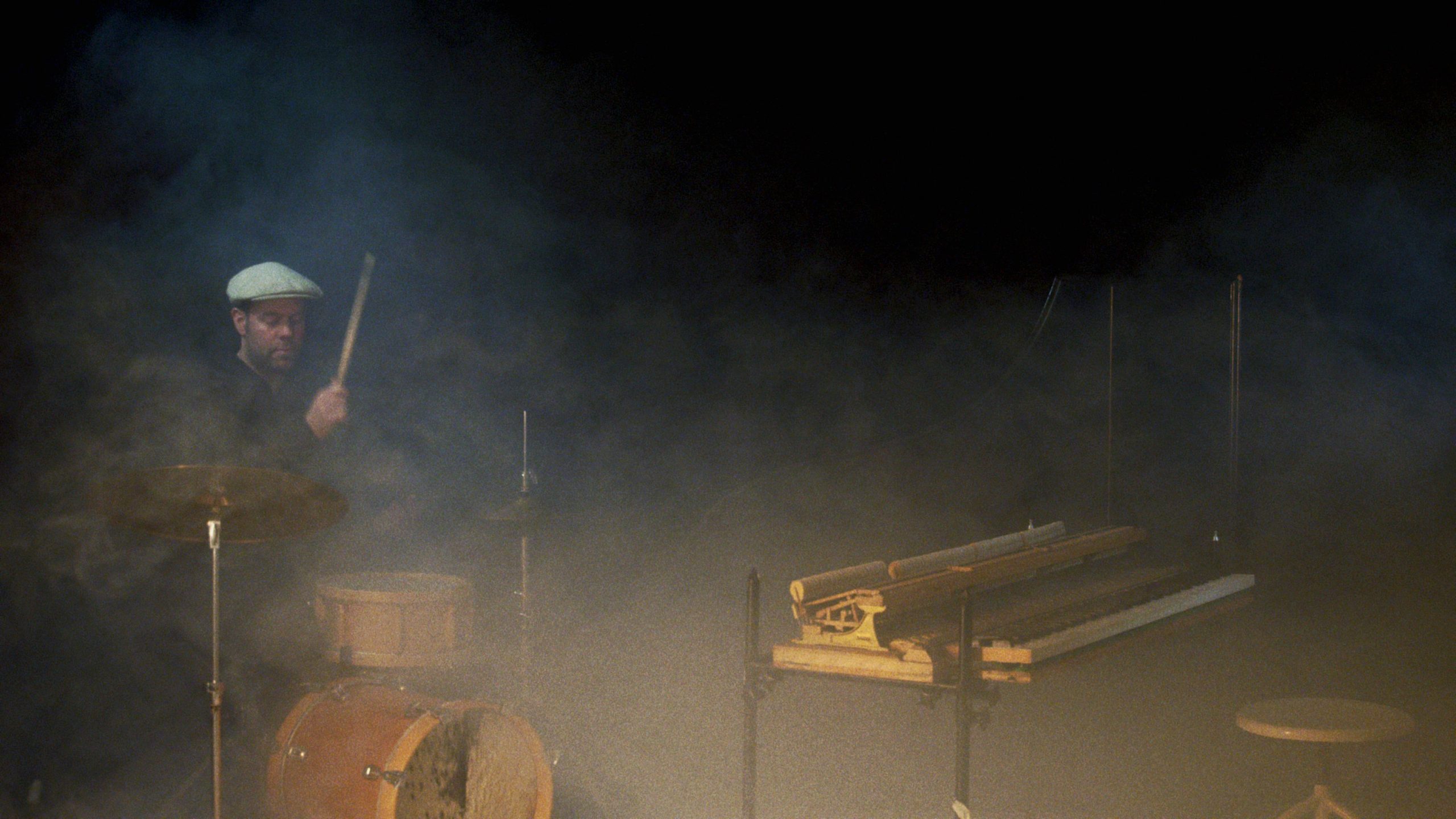
My first drums was a regular Pearl fusion-kit. Nowadays I use a custom made kit with a very small bass-drum (16“), natural heads, wooden rims and a goat-head on the bass-drum. I really like the warm and melodic sound of this kit!
My cymbals are made or customized by Michael Paiste. Michael belongs to the famous Paiste family and runs his own small and independent business in Lucerne.
I would say, compared to most other instruments, most drums are just built in a factory without a lot of handcraft ... That’s a pity as it takes out a lot of the soul of those drums. I’m happy to see that there are many small businesses nowadays building their own drums, that’s a great development!
Late Rush-drummer Neil Peart said: “The equipment is not an influence. It doesn't affect the way I play. It's an expression of the way I play.” What's your take on that?
I certainly agree with that! Once you start to hear a certain sound in your head, you will look for it and then eventually also find it ...
Of course this also applies to the way you tune your drums, the sticks you use etc …
The drums and percussive instruments are an integral part of many cultures, and traditions. Which of these do you draw from in your playing – and why?
I really love the Cuban Bata and the Persian Tombak. They come from completely different cultures, but both have a very warm, but strong sound and both can create very precise melodies while still producing strong grooves.
I always try to integrate this concept into my drum-sound.
What were some of the main challenges in your development as a drummer / percussionist? Which practices, exercises, or experiences were most helpful in reaching your goals?
There were a lot of difficulties and they still are a lot of challenges. Being a creative musician is for me a daily struggle.
But if I look at my personal history, I think it was a big challenge for me that I studied classical percussion and learned to play jazz-music in an "old-school-way“ by playing with older musicians … (Back in the days with Kirk Lightsey.)
It took me many years to create my own world from this history. Now I’m thankful for the way I went …
How would you describe the physical sensation of playing the drums? [Where do you feel the resonances/pulse/groove, what are emotional sensations, is there a sense of release or tension etc …]
I would say, playing the drums is a full body experience. It’s my daily therapy. :-)
But then, playing with sticks and having shoes on our feet, we drummers (in contrary to almost all other instrumentalists) don’t actually touch our instruments with our skin while playing. So for myself, there are moments where drumming feels like a dance to me, but there are also other moments where I try to create soundscapes which could be much less physical.
We drummers can play incredibly soft and incredibly loud, so I would say there is much more than just "physical sensation.“ It’s a whole world of characters we can create on drums.
What is the relationship between harmony, rhythm and melody? How do non-percussion instruments contribute to the overall rhythmic texture of a piece?
I would consider myself a melodic drummer in the lineage of Sid Catlett, Max Roach, Peter Erskine, Al Foster or Joey Baron. From my point of view most of the instruments can play melodic, harmonic or rhythmic parts and so can the drums! (Even if it’s not "tonal“)
I also love to extend my drums with different percussion-instruments to find the rooms between groove and tonality.
Do you feel that honing your compositional / songwriting skills has an effect on your drumming skills?
Yes definitively!! I’m trying to be a musician who plays the drums and not a drummer who shows of his skills ... :-)
Besides finding the right sound or groove for a certain tune I consider it as a great challenge to lead the big forms of a song from my drumstool.
I've long been intrigued by bands or ensembles where the drummer is the leader and/or main composer. In as far as it is possible to generalise, what do you think changes in terms of the music or performance in these situations?
I’m leading a lot of projects and also write most of the music for those. And I’m having quite a bit of discussions with my fellow musicians about the advantage of being a leader sitting on the drums.
The easy part is creating tension and release and to "navigate the ship“ from the drum-stool. The difficult part is that I’m not playing any melody nor any chord, so I strongly depend on fellow musicians who understand my music ...
But I also think it’s very exciting as being a bandleader as a drummer because it also creates a lot of space for exploring the unknown.
How are you making use of the timbral and textural potentials/possibilities of your drums and percussion instruments when making music?
I would say this is one of my biggest advantages of having an education in classical music.
I’m quite trained in using textures and I also try to be as precise as possible soundwise when playing music.
How has technology, such as drum machines and sequencers, impacted the way rhythm is created and perceived? Has it been a concrete influence on your own approach?
I think drum machines and sequencers open up a completely new world. It needs a lot of dedication and practice to include this seriously in your own playing. So far I never really found the time to put this effort into technology, so I never used it so far.
But I do like drummers like e.g. Jojo Mayer, who achieve this fusion of acoustic drums and technology in an exciting way!
Physical strain is a particularly serious issue for many drummers. How does it manifest itself, how do you deal with it and in how far does it affect your creativity?
I mostly need strength to carry my drums … :-)
When playing, I don’t really get physical strain, I try to use as much rebound as possible for my drumming. As I mostly play with acoustic instruments this works very fine.
But if I watch Rock- or Metal-drummers I’m always very impressed by their strength. I never could play as hard for such a long time! :-)
Many recording engineers have remarked that the drums can be particularly hard to capture. What makes drums sound great on record and in a live setting?
It’s a very personal thing how you like your drumsound.
Personally, I like when the drums sound clear but not isolated from the other instruments. In my studio, we always record all the musicians in 1 room. I like my drumsound much better when it’s part of an overall sound instead of being too isolated and produced.
I have the luck that I've been working with the same sound-engineer for many years. We try to improve the drum-sound in every session.
Drums and percussion are remarkably often used for physical therapy / healing. What, from your point of view, makes them particularly suitable tools for this?
Drums are among the oldest instruments on earth, so for me it’s quite obvious that the drums also can connect with very archaic feelings.
But I would say that the therapy-setting is completely different from being a creative drummer and musician. The focus is set on certain effects and sounds which can trigger certain points in your brain and body.