Published
Name: Font
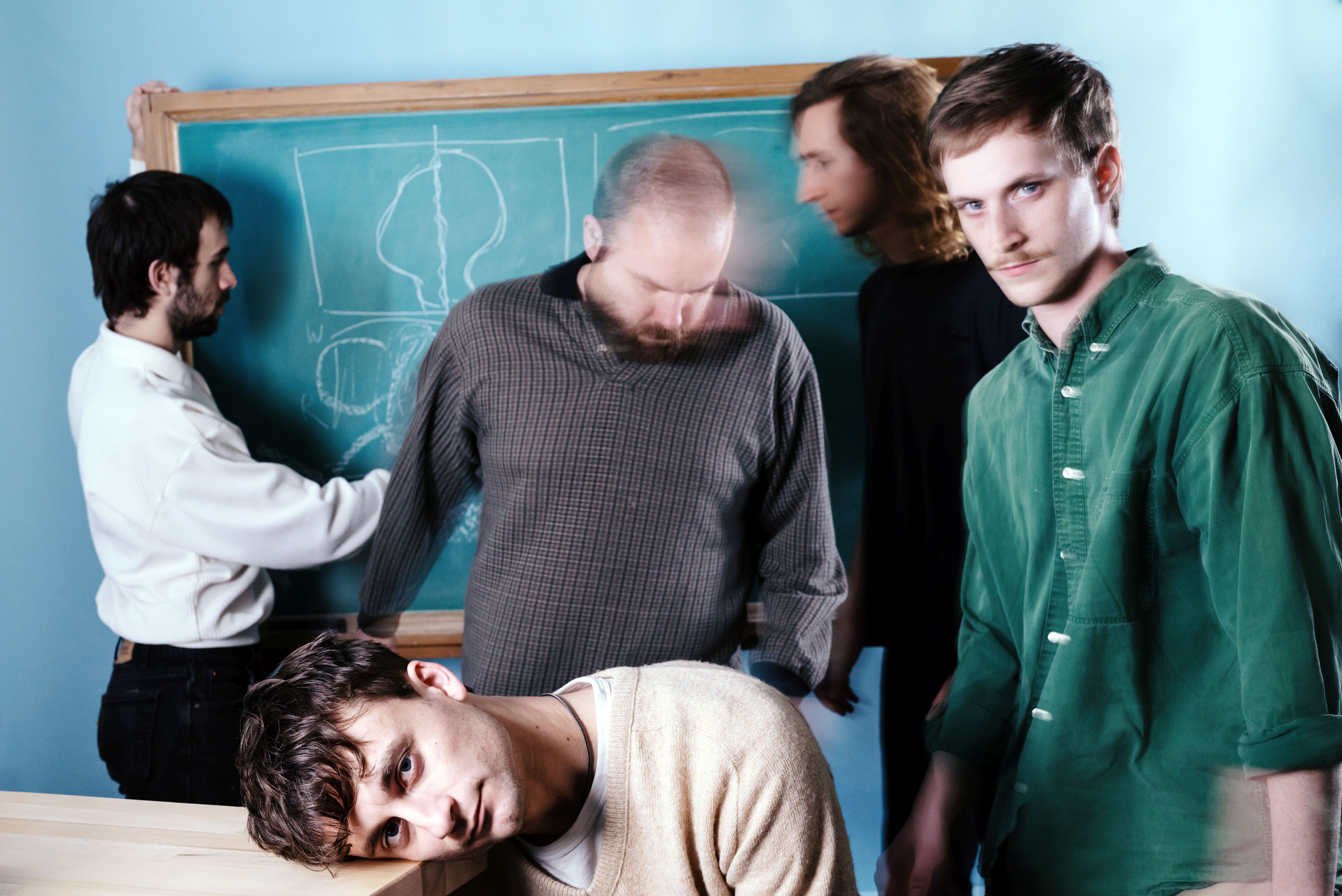
Members: Thom Waddill, Jack Owens, Anthony Lawrence, Roman Parnell, Logan Wagner
Interviewee: Thom Waddill
Nationality: American
Current release: Font's Strange Burden is out via Acrophase. Stream the album here, and buy an LP directly from the label.
Recommendations: I recently read this Lyn Hejinian collection, Tribunal, that really spoke to me. She died earlier this year.
When we were in San Francisco on our last tour, I saw a Helen Frankenthaler painting called Interior Landscape (1964) that has stayed on my mind.
If you enjoyed this Font interview and would like to stay up to date with the band and their music, visit them on Instagram, and bandcamp.
Where does the impulse to create something come from for you? What role do often-quoted sources of inspiration like dreams, other forms of art, personal relationships, politics etc play?
I tend to think of art as a form of wish-fulfillment, the way Freud thought about dreams. All of my most powerful experiences of art — of any medium — have had something to do with the feeling that I am in contact with the material of some unconscious wish.
“Looking at Engines” was one of the first Font songs, and it was one of the first for me where I felt like I could follow the dream-feeling into a set of lyrics.
My personal life and relationships are not things that I’m trying to write about, but I feel like if I am writing in the way that I want to, their residue will remain on the lyrics in the way the events of the day are residually present in the dream.
For you to get started, do there need to be concrete ideas – or what some have called a 'visualisation' of the finished work? What does the balance between planning and chance look like for you?
For my part of the songwriting (vocals, lyrics, and some of the composition and production) I start with the title, which is like a lid.
Writing the song can be like trying to uncover the shape of the container under the lid, and then to fill it up.
Is there a preparation phase for your process? Do you require your tools to be laid out in a particular way, for example, do you need to do 'research' or create 'early versions'?
I guess my “research” takes the form of automatic writing. I’ll fill up a couple of pages trying to associate as quickly as I can. I’ll pull phrases from that. A set of lyrics to me is a collection of phrases that I like. Hopefully they’re emotionally magnetized together in some way.
But I also like collage and want there to be surprising juxtapositions, like when the dreamt sun is actually a medallion or a padlock.
Do you have certain rituals to get you into the right mindset for creating? What role do certain foods or stimulants like coffee, lighting, scents, exercise or reading poetry play?
My apartment has to be totally clean and in order before I can write anything.
What do you start with? And, to quote a question by the great Bruce Duffie: When you come up with a musical idea, have you created the idea or have you discovered the idea?
It feels most like discovery to me. It feels to me like an initial musical “idea” is a problem, like an equation, where the known terms are the boundaries implied by the song idea and the sensibilities of each band member. The finished song, which lurks in the equation, is the variable we’re solving for.
I’m not sure if other members of the band feel this way, but that’s how I’ve always tended to think about it. Art has always felt like problem-solving to me.
“Cattle Prod” was a song that took us months to write — we had the drum beat for a long time and wrote multiple ideas over it, none of which stuck. Then a set of chords seemed to completely unlock the song and we finished a draft of the song in a night.
I remember the way that the chords reframed the beat felt like the discovery of a new room in a house that had begun to feel claustrophobic.
When do the lyrics enter the picture? Where do they come from? Do lyrics need to grow together with the music or can they emerge from a place of their own?
I’m always trying to find the vocal part (melody, cadence, tone, et cetera) before thinking about the lyrics. I fill the lyrics in as I discover the vocal part. To get the words where I want, I can’t be thinking about their content or trying to shoehorn sentiments or sentences into the music. They have to respond to the music. If I’m on the computer, I’m also usually making compositional choices with the music as I write the vocal part.
I want the lyric-writing decisions and the musical decisions to be as intimately involved as possible. I’m trying to get to the place where I can write lyrics spontaneously in practice when we’re working on something and I’m singing over it, but I’m not there yet.
What makes lyrics good in your opinion? What are your own ambitions and challenges in this regard?
I think of the words as an aperture through which something else passes. Lyrics are good if they’re out of the way. But they’re also good if they evoke passing images and can provide moments of surprise that intensify the overall emotional effect of the music.
Caroline Polachek’s “Bunny is a Rider” comes to mind as I’m writing this; somehow the lyrics are evocative and visual but they retain a really wonderful fluidity and transparency.
“It” was a song in which I thought it’d be interesting for the subject of the lyrics to be completely absent, or only present as a kind of tease, which made for a really fun writing process. That song all came out in an afternoon.
I’m not sure if those lyrics are “good,” but I know I stand by the idea.
Many writers have claimed that as soon as they enter into the process, certain aspects of the narrative are out of their hands. Do you like to keep strict control or is there a sense of following things where they lead you?
Being in a band means that one of the assets you’re trying to take advantage of is an abundance of hands. No matter what, relinquishing control of the music to the band is a part of the process.
As for the lyrics, the sensation is one of following and pursuing. I know that part of what I’m following and pursuing is myself, in a way. But a crucial part of that is responding to music that I didn’t necessarily write. We’re all responding to and pursuing each other through the music.
Often, while writing, new ideas and alternative roads will open themselves up, pulling and pushing the creator in a different direction. Does this happen to you, too, and how do you deal with it? What do you do with these ideas?
I think if you aren’t following the paths that reveal themselves in the process of making something then you aren’t really doing it right.
A state of flow is a state of response — back-and-forth response with a material.
There are many descriptions of the creative state. How would you describe it for you personally? Is there an element of spirituality to what you do?
Yeah, there’s certainly an element of flow in it for me. I’m not very regular in my songwriting, but when I get on an idea I tend to stay locked in for seven or eight hours at a time.
I’m still figuring out the difference between the spiritual and the somatic. I do feel like I’m in touch with something when I’m in a flow state, but it may just be my brainstem or my hippocampus.
I’d like to say it’s spiritual, but I’m still not sure what that is. I know that time passes differently.
When you're in the studio to record a piece, how important is the actual performance and the moment of performing the song still in an age where so much can be “done and fixed in post?“
We were locked in that “post” mindset for a long time, and it was paralyzing. It prevented us from being happy with anything.
When we were recording Strange Burden after our first tour, we realized how important it was for the bones of the songs to be performed together in the studio and for us to make the bulk of the sonic decisions in the engineering phase rather than the production phase.
Strangely, that was freeing for us.
Once a piece is finished, how important is it for you to let it lie and evaluate it later on? How much improvement and refinement do you personally allow until you're satisfied with a piece? What does this process look like in practise?
I don’t think any of our songs are finished. There is a threshold an idea can reach where we feel like it’s ready for the stage, but that repeated performance is, in turn, just another stage in the songwriting. Inevitably, we’ll tweak our parts and I’ll tweak my lyrics as the song settles into itself.
Sometimes we’ll play a song for a couple of months and then take it out of the set because we decide we need to reimagine it, or even just scrap it. Refinement and revision make up most of the songwriting process. Perhaps to a fault.
What's your take on the role and importance of production, including mixing and mastering for you personally? In terms of what they contribute to a song, what is the balance between the composition and the arrangement (performance)?
It’s still difficult for me to understand the difference between songwriting and production. It all feels like the same thing.
The aim of making anything — including songs — to create an effect, a sensual impression, and the selection of effects and samples and sounds seems to be to be just as important as the words or chords.
After finishing a piece or album and releasing something into the world, there can be a sense of emptiness. Can you relate to this – and how do you return to the state of creativity after experiencing it?
I’m writing this a week before the album comes out, so I’m not sure what the sensation will be then. I will say I find that I’m not really thinking about the release.
Although we’re proud of the work, we’ve lived with these songs for a long time, and I think we’re ready to move on to new ideas. I have begun to feel a competitiveness with the record already; I want to write better stuff, go in different directions, solve new problems.
Music is a language, but like any language, it can lead to misunderstandings. In which way has your own work – or perhaps the work of artists you like or admire - been misunderstood? How do you deal with this?
Music isn’t language. I think that’s crucial to its fundamental cultural function. Any misunderstanding of a piece of music comes from the idea that music meant to be “understood” at all. Understanding is only one form of apprehension, and music engages other forms.
If I ever feel like our music is misunderstood or misapprehended in some way, it’s usually because there’s an assumption that we’re trying to “say” something with it, or that there’s some kind of message. There isn’t – we’re trying to make stuff that makes us feel good.