

Name: Francesca Remigi
Nationality: Italian
Occupation: Drummer, percussionist, composer
Current release: Francesca Remigi's new album WITCHESS is out November 7th 2025 via Hora. Next to Francesca on drums, percussion instruments, electronics, composition and vocals, it also features Andrea Giordano (voice, flute, electronics) and Silvia Cignoli (electric guitar, electronics and vocals)
If you enjoyed this Francesca Remigi interview and would like to stay up to date with her music, visit her official homepage. She is also on Instagram, Soundcloud, Facebook, and bandcamp.
Where does the impulse to create something come from for you? What role do often-quoted sources of inspiration like dreams, other forms of art, personal relationships, politics etc play?
I’ve always conceived music as a language to express and share culture, traditions, and emotions, and a powerful tool which connects people to one another. I have always been struck by the product of artistic voices that really had something to say more than a mere formal representation, so that’s what I aim for in my own practice.
For me, music has always been a way to process, shed light and rise awareness about different topics which have been somehow impactful on my journey. Especially in moments of crisis, such as the one we are currently experiencing, I think the artist’s responsibility is to offer an alternative interpretation of highly debated current issues, and to provide audiences with a new perspective and an emotional and compassionate experience of those.
As an artist I often think of how to go beyond music itself in order to look at the bigger picture of why I make music and how I can contribute to society with what I do.
For you to get started, do there need to be concrete ideas – or what some have called a 'visualisation' of the finished work? What does the balance between planning and chance look like for you?
I’m a very visual person so normally in order to put myself at work I need to have a strong concept / image in mind to give direction and purpose to my creative process. That said, I also really value leaving space for chance and spontaneity. Some of the most exciting elements often emerge unexpectedly while composing.
For example, for my tune "Roots for Gender Violence” I had a clear picture of what I wanted to represent: a slow, solemn march of chained witches being led to the stake and burnt alive. So in the music, that’s what I’ve tried to recreate through metallic chains’ sounds, women shouting, clanging noise and a heavy crackling fire’s samples.
So in general I like to have a solid foundation or vision to begin with, but I allow myself to have enough flexibility to explore, adapt, and let the work grow organically.
Is there a preparation phase for your process? Do you require your tools to be laid out in a particular way, for example, do you need to do 'research' or create 'early versions'?
I think for me it’s the other way around:
I read about a topic I’m fond of, go to exhibitions or meet certain people and those experiences become the source of inspiration for a new artistic idea. Then I start digging into the topic to learn more about it and normally after that I have an intuition or a visualization about something more specific I want to write about.
The preparation phase to composing a new piece can include me reading books and watching interviews to select or write snippets of text to improvise or compose with later on, doing field recordings, looking for samples which can be embodied in the compositions … That’s what happened with WITCHESS:
I spent months reading Angela Davis and Silvia Federici’s books to gain a deeper understanding of their thinking and found many points of connection with my own personal experience of being a woman playing probably the most masculine instrument ever. That made me decide to use some of that material in the music as a form of social criticism.
For instance, the composition “Caccia alle Streghe” came out from a rhythmic-melodic transcription of myself reading a snippet of “Caccia alle Streghe, Guerra alle Donne” by Silvia Federici.
Do you have certain rituals to get you into the right mindset for creating? What role do certain foods or stimulants like coffee, lighting, scents, exercise or reading poetry play?
I don’t really follow precise rituals but I definitely like to do some yoga or go for a run before putting myself to compose or practice.
I also try to keep a healthy diet avoiding gluten, meat, coffee and alcohol, that really helps to energize my body and to keep my mind sharp.
For WITCHESS, what did you start with? If there were conceptual considerations, what were they?
For WITCHESS, everything began with a strong conceptual foundation rooted in personal experience and in a deep commitment to the feminist cause.
This is something incredibly important to me, and not just in theory, but through lived experience. I’ve personally faced the systemic inequalities and discrimination that women and marginalized groups often encounter in the music field. Being a womxn playing the most masculine instrument ever has definitely been tricky for me.
When I was five, I remember joining my town brass band and never being able to play during rehearsals, as the other male drummers were always bullying me and shutting me out. It’s been a life of fighting ever since, especially in a deeply patriarchal and misogynistic country like Italy. At the time, I genuinely didn’t believe I could ever make it as a female drummer: there were simply no examples around me, and very few even internationally.
Things began to shift when I moved to the US a few years ago and started reading the works of Angela Davis, Silvia Federici, Chimamanda Ngozi Adichie and many more, which had a profound impact on me. I also started to participate in feminist protests and to collaborate with more and more womxn musicians and mentors.
This led to the creation of my band WITCHESS —Womxn Implement The Creation of Harmonious Ecosystems of Selfless Species—an interdisciplinary project that merges creative music and contemporary dance in a performance that seeks to re-imagine a reality without patriarchy or predefined gender roles. The acronym alludes to an inclusive feminist vision where womxn actively build collaborative, non-hierarchical spaces that challenge patriarchal systems through creativity, care and empathy.
WITCHESS stems directly from my experience that groups predominantly made up of minorities are often more supportive, inclusive, and collaborative, and I think that bright energy defines the project at every level. Our music confronts the intersections of gender, race, and capitalism, tracing the roots of gender-based violence from the historical witch-hunts to today’s systemic economic inequalities.
Tell me a bit about the way the new material developed and gradually took its final form, please.
After composing a few initial sketches and ideas by myself, we were given the chance to develop the material collectively during a few artistic residencies supported by nusica.org, OperaEstate, and WeStart CPM. These residencies gave us the space to refine the music and dive into the performative aspects of the project, where us musicians not only play but also move and interact on stage alongside Clotilde Cappelletti, our dancer.
As we began touring with the project, the repertoire naturally solidified, and I think the band really found a unique aesthetic by blending different artistic languages—literature, movement, electroacoustic and electronic elements—into a unified expressive output. The goal has always been to invite the listener into a free creative space with no rigid aesthetic boundaries.
After being awarded the Pathways to Jazz grant, we went to the studio in December 2024 to record the music. I invited bassist and sound engineer Alessandro Mazzieri to handle parts of the production process, and he also laid down bass on some tracks.
We also featured pianist and Blueberry Picking co-composer Naomi Nakanishi on three pieces; her presence added another beautiful layer to our trio sound.
Many writers have claimed that as soon as they enter into the process, certain aspects of the narrative are out of their hands. Do you like to keep strict control or is there a sense of following things where they lead you?
A bit of both I think. I like to stay connected to the original vision since having a sense of direction helps ground the process, but I also think it’s important to remain open to where things naturally want to go.
Sometimes unexpected shifts happen, and instead of resisting them, I try to follow and see where they lead. Often, those surprises bring something more honest or interesting than what I initially imagined.
There are many descriptions of the creative state. How would you describe it for you personally? Is there an element of spirituality to what you do?
I wouldn’t say it’s spiritual exactly, but when I’m in the creative state, I definitely enter a very focused zone. It’s like everything else fades away, I sometimes forget to eat or even notice time passing.
In that moment, it’s just me and the work, fully immersed and connected with my inner self. That feels very good.
Once a piece is finished, how important is it for you to let it lie and evaluate it later on? How much improvement and refinement do you personally allow until you're satisfied with a piece? What does this process look like in practice?
Once I finish a piece, for me it’s normally really finished, I don’t usually go back to tweak or refine it on my own. What I do instead is bring it to the band, and that’s when we might make some arrangement, textural, or sonic decisions together.
I find that fresh ears and collaboration help shape the final touches in a way I might not have thought of alone. I trust my musicians and the collective process or co-creation :)
How do you think the meaning, or effect of an individual piece is enhanced, clarified or possibly contrasted by the EPs, or albums it is part of? Does each piece, for example, need to be consistent with the larger whole?
Not necessarily, each piece doesn’t always have to be consistent with the larger whole. But for me it usually does, probably also due to the musical aesthetic I’ve chosen to identify with.
I often create concept albums where every track I write serves a purpose within that bigger picture. So, while individual songs can stand on their own, they also contribute to a larger story or atmosphere, enhancing the meaning and effect of the album as a whole.
What's your take on the role and importance of production, including mixing and mastering for you personally? In terms of what they contribute to a song, what is the balance between the composition and the arrangement (performance)?
For me, production—including mixing and mastering—is absolutely crucial. It’s the stage where a song really comes to life and finds its full expression.
I really like having a trusted hand in this process, someone who can bring fresh ears and perspective to refine and elevate my work.
That’s how I’ve approached the production process for my new record. I asked my trusted friend and brilliant producer / engineer / musician Alessandro Mazzieri to help me improve my music not only on a sonic level but sometimes also when it came to orchestration and arrangement. Often, he has heard or sensed things that I might have missed or haven’t fully realized yet.
So, for me, the relationship between composition, arrangement and production is very much like a partnership where each element depends on the others to create a good final musical product.
Music and the accompanying artwork are often closely related. Can you talk about this a little bit for your current project and the relationship that images and sounds have for you in general?
Absolutely, I feel the same way about artwork as I do about production: a trusted hand makes all the difference!
For my album WITCHESS, I collaborated with Serbian visual artist Dalia Koler, a dear friend of mine whose creative vision I really admire. I’ve precisely asked her to bring her personal perspective and sensitivity to the album’s artwork based on the music I wrote, and that helped create a strong, meaningful connection between images and sounds.
For me, sounds and images are two sides of the same coin—they both tell a story, evoke emotions, and shape the way the audience experiences the work. When they come together thoughtfully, they amplify each other, making the whole project more impactful.
Having someone I respect guide the visual side has let me focus on the music, knowing that the artwork will complement and elevate the overall concept perfectly.
After finishing a piece or album and releasing something into the world, there can be a sense of emptiness. Can you relate to this – and how do you return to the state of creativity after experiencing it?
Absolutely, I can relate to that feeling. After investing so much time, emotion, and energy into an album, releasing it can feel a bit like letting go of something deeply personal. That can also be experienced as highly liberating sometimes, but there's often a strange silence that follows a release.
I’ve always had the luck of being involved in many different projects as a co-leader or as a side-person too, so that post-release creative “horror-vacui” was never too disturbing for me since I could dedicate myself to something else right away.
I would love to know a little about the feedback you've received from listeners or critics about what they thought some of your songs are about or the impact it had on them – have there been “misunderstandings” or did you perhaps even gain new “insights?
Many of them liked it a lot, some others probably hated it and found it too extreme.
The important thing is not to care too much about what others have to say and always create and work with honesty. The rest will come naturally (hopefully).
Creativity can reach many different corners of our lives. Do you personally feel as though writing a piece of music is inherently different from something like making a great cup of coffee? What do you express through music that you couldn't or wouldn't in more 'mundane' tasks?
Music is energy and emotions, and I use this language because it is what I was mostly exposed to since I was a kid and it is what I’ve mostly dedicated my life to.
I think if you study your whole life to make a great cup of coffee some people are gonna notice someday. The pursuit of excellence is applicable to every single field and mundane tasks like cooking or cleaning can become artistic and creative.
But I think as Nietzsche used to say that music gives form and expression to human emotion in a way that other arts cannot. That’s what makes music unique and that’s what I mostly like about it.

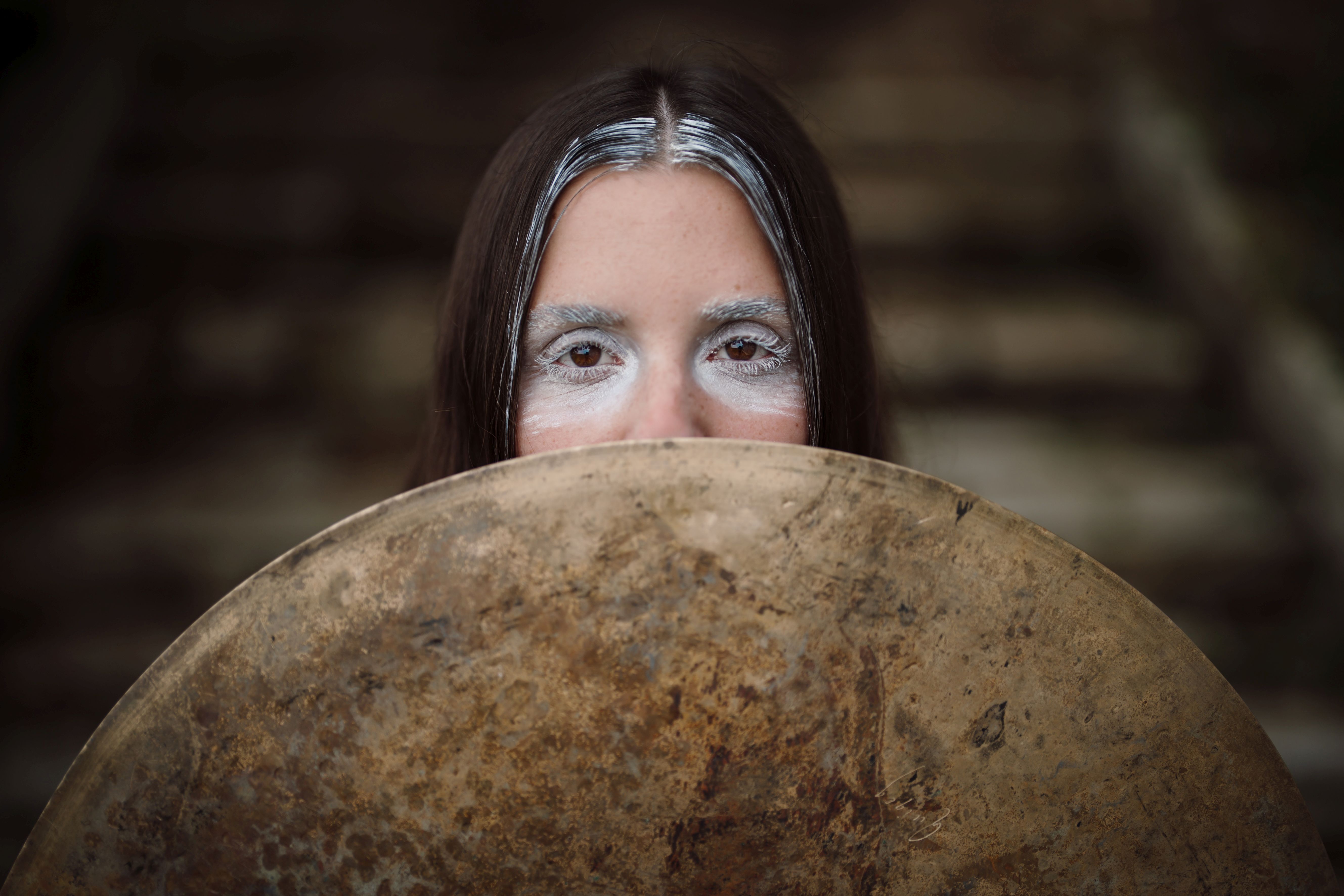 Francesca Remigi Interview Image by Elisa Caldana
“WITCHESS stems from my experience that groups predominantly made up of minorities are often more supportive, inclusive, and collaborative.“
Video
