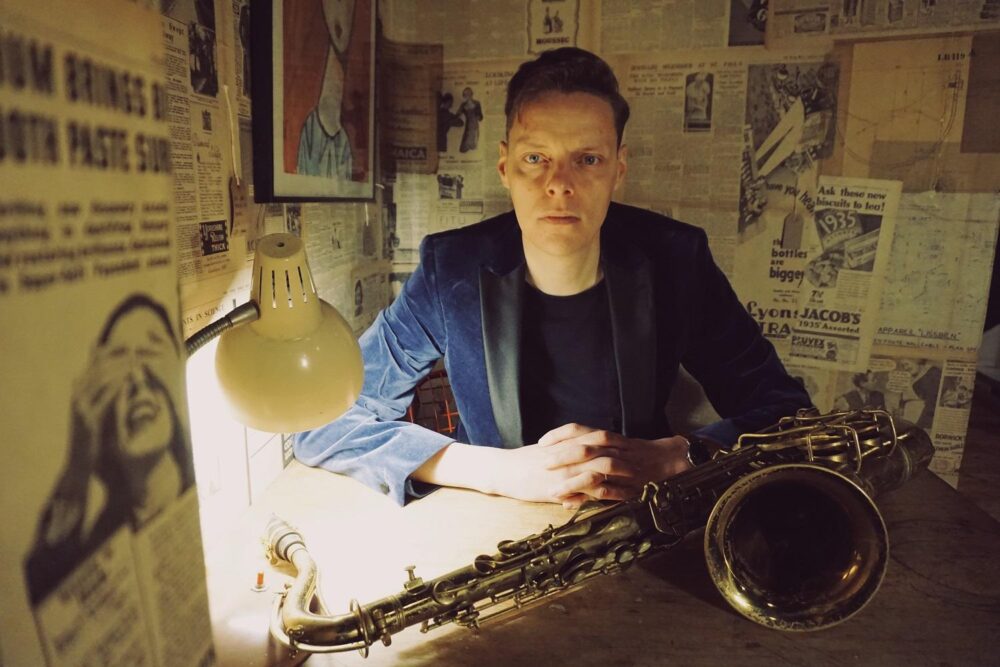
Published
Name: Fraser Smith
Nationality: British
Occupation: Saxophonist, composer, improviser
Current event: Fraser Smith performs with his Quartet at Ladbroke Hall on Friday 18th April as part of their Friday Jazz Series. For tickets and more information on the event, visit the location's website.
Current release: Fraser Smith's most recent release is TipTop! with his Fraser Smith Quartet.
Recommendation for London: I’m really into the history of London, so I’d have to recommend going for a pint in The Angel, Tottenham Court Road. They have a real fire in the winter and a pub cat. It is supposedly where the saying ’one for the road’ comes from, as en-route to execution they would let the prisoners off for one last drink. Pretty grim! But great history.
Topic I am passionate about but rarely get to talk about: I love reading, but I’m always banging onto my friends about anecdotes I’ve recently read. So I’d say I get to talk about it quite often, maybe against everyone else’s will.
Shoutouts: ‘Good Evening Arts’ in South London is doing great things for all parts of the scene. Tom has run events for years and given so many well-known musicians some of their first gigs. The nights are always full of people of all ages and the atmosphere is great, really supportive and fun. That’s how it should be!
If you enjoyed this Fraser Smith interview and would like to know more about his music and upcoming live dates, visit his official homepage. He is also on Instagram, and bandcamp.
What were some of the musical experiences which planted a seed for your interest in jazz?
When I was a kid my uncle played a bit of blues piano. That was my first exposure to live music in that sense. I was desperate to know what it was he played and how it worked so he gave me some very basic lessons in theory, song structure and piano technique..
I then bought some jazz CDs and played them over and over again every night in my bedroom. I was so obsessed with the mainstream jazz music of Louis Armstrong, Ike Quebec and Charlie Parker, that the same uncle bought me a sax around age 14. Back then in Wales they had a great music programme where kids got free lessons if they wanted and the youth groups at the time were really well funded.
When I was 16 I caught Soweto Kinch playing on the free stage at the Birmingham jazz festival. This completely changed my life and I knew then that I wanted to play this music and take it seriously.
What does the term jazz mean today, would you say?
The million dollar question!
It means lots of things to different people but to me it describes music played by acoustic instruments that swings, with a good beat. Must include improvisation!
As of today, what kind of materials, ideas, and technologies are particularly stimulating for you?
For me, living in this digital world that we all find ourselves in, hearing acoustic instruments playing together in a live setting seems to be becoming more and more rare and therefore really grabs me when I hear it.
That said, with YouTube we now have a world of amazing resources at our disposal. I use it to help paint a clear picture of the time and context of the era that birthed the music we call jazz.
Just recently some footage emerged of the iconic Dizzy/ Rollins/ Stitt session, which we would maybe never have had access to without the internet.
Where do most of your inspirations to create come from – rather from internal impulses or external ones? Which current social / political / ecological or other developments make you feel like you need to respond as an artist?
My inspiration mostly comes from the rich catalogue of American jazz of the 20th century.
I keep discovering lesser known albums of my favourite musicians, and also albums from relatively unknown jazz musicians that never got the attention they deserved for whatever reason. It seems there is an endless well of amazing music if you look in the right places.
My goal is to try and internalise as much of the jazz language of the greats and somehow make it my own when I improvise and play.
Music has become a lot more global, and incorporating elements from other parts of the world or the musical spectrum is commonplace. Do you still think there are city scenes with a distinct, unique sound? How does your local scene influence your work?
In many ways Jazz was one of the first truly global musics, with its roots in the city of New Orleans. A huge influx of immigration from all over the world at the end of the 19th Century brought many of the world’s cultures together like never before. I feel that now there is a danger of a 'standardisation' of cultures. But that said, we're exposed to different musics like never before and it has never been easier to travel, so this can opnly be a good thing for artists being able to share.
I remember my first trip to hear music in London. We drove from Cardiff to the Ronnie Scott’s jam, which in those days was absolutely jumping until 4am. We drove back to Wales as the sun came up. There are so many amazing musicians in London on my local scene that really capture the spirit of the music in their playing, that you can’t help but be humbled and inspired living here.
What role do electronic tools and instruments play for your creative process?
I use my iPhone to ask voice notes of song ideas or licks and phrases that are stuck in my head. I’d be lost without it!
I also use YouTube to slow down fast passages that I’ve been listening to in order to analyse them. In the old days they would put a penny on the record player to slow it down. I’ve tried this and it’s almost impossible as it changes the key of the tune and you have to keep winding it back.
Again, my respect just grows for the master jazz musicians that were developing the music, when you realise what little was available to them.
Thanks to technological advances, collaboration has become a lot easier. What have been some of the most fruitful collaborations for you recently and what approaches to and modes of collaboration currently seem best to you?
With what I do it’s all in-person and face to face for the actual music making. But that said, I have a cross-channel project with musicians from all over Europe and we can communicate on WhatsApp in real time and send each other charts and music to listen to. That’s pretty crazy when you stop to think about it.
Also through instagram and YouTube etc, people are gaining access to all new music at once. This can be slightly overwhelming but at the same time inspiring, to see someone the other side of the world working in a similar way to yourself, driven by the same things.
Jazz has always had an interesting relationship between honouring its roots and exploring the unknown. What does the balance between these two poles look like in your music?
It’s a question I ask myself daily! My influences and obsessions are with bebop through to the later blue note, soul-jazz music, so I’m definitely more aligned with the history and roots of the music.
These eras have long been and gone, but I find that audiences still resonate with the music when we play it live. When we play it we’re still exploring within the established framework , so it will feel fresh and exciting.
Also there will always be modern factors that make their way into my music though. I spent many years dancing in underground clubs across the country for example when I was younger.
How much potential for something “new” is there still in jazz? What could this “new” look like?
It’s totally possible yeah! We always think we’re at the end of history as people, but then something new comes along and blows us away.
My obsession is with understanding the jazz that happened as a result of all of the forces that were taking effect in early to mid century America. In the same way that people like dancing to their favourite rock/ hip hop song, or listening to their favourite classical tune etc, I think that certain styles of jazz that have already happened can be eternally relevant. At least that’s what I tell myself!
We’ll continue to swing and it’s ok if people don’t dig it because it’s not new.
For many artists, life-changing musical experiences take place live. How do you see that yourself?
Absolutely can relate to that yeah. As an artist it’s important to learn your craft and personally I’ve way exceeded the 10,000 hours personal dedication, but the music doesn’t happen in a vacuum.
The most valuable and transformative experiences happen when everyone on the stage has their ears open and is ready to receive and react. We’re trying to chase the high on a daily basis as improvisers, to create moments where everything aligns and the music reaches another plain.
How, would you say are your live performances and your recording projects connected at the moment? How do they mutually influence and feed off each other?
For me my recordings are merely stepping stones, snap shots of the musical ideas and groups that I’ve been working on or with at any one time. They can serve as great indicators of what I need to work on and areas for improvement, but generally I don’t listen back more than I have to and am already trying to push things forward the next day after a session.
It’s quite rare that I’ll capture any real magic in the often sterile studio environment compared to onstage, but I’ll keep trying!
Ímprovisation is obviously an essential element of jazz, but I would assume that just like composition, it is transforming. How do you feel has the role of improvisation changed in jazz?
Ultimately I feel people are doing the same thing that they always have, but over evolving soundscapes.
The rhythmic, harmonic and instrumental templates have changed, but people are still trying to reach whatever it is that is inside of them in the moment.
What, would you say, are the key ideas behind your approach to improvisation?
For me I treat it as a vocabulary, like learning a language. There are thousands of micro-phrases that can be combined to make the sentences. This was a major breakthrough for me when I changed to this approach.
If you listen carefully many of these phrases can be traced right through the development of jazz, with the ideas being skill-fully obscured as the music moved on.
The Montreux Festival intends to preserve its archive of recordings for future generations. Do you personally feels it's important that everything should remain available forever - or is there something to be said for letting beautiful moments pass and linger in the memories of those that experienced them?
Great question. I can’t imagine my life without recorded jazz, and the invention of the record played a vital part in the music’s initial development. Master musicians often talk about their experiences of buying and listening to records to supplement their live listening experiences. I think without it the art form of jazz would be lost to history.
The beautiful moments that happened to be recorded can be relived again and again the world over by people for centuries to come. Definitely a good thing!