Published
Name: FRQNCY LDN
Members: Alex Lavery, James Ford
Interviewee: Alex Lavery
Nationality: British
Occupation: Music Supervisor, Artist, Sound Therapist
Recent release: FRQNCY LDN's The White Edition is out now on PRAH Recordings.
Recommendation for London, UK: St Matthias Church, becoming quite the gem in Hackney’s live crown. Say Hi to Father David & Polly.
Topic I am passionate about but rarely get to talk about: It’s wild how these sounds and layered frequencies are a meditation hack, how they lead your brainwaves into a relaxed or sometimes daydream states. And how such a state of mind facilitates epiphanies, creative solutions or a reset, all from the power of sound.
If you enjoyed this FRQNCY LDN interview and would like to stay up to date with their releases and live dates, visit them on Instagram.
What were some of your earliest collaborations? How do you look back on them with hindsight?
I was a lucky 13 year old who discovered raves and DIY sound system in Somerset in the 90s and my ears have never turned back.
My earliest collaboration was playing Glastonbury at 17 with my A level music teacher (shout out Mr Chousmer … remember this name) We also closed the Whirligig stage at WOMAD that summer of '98.
Then a career working for various record labels (Wall of Sound, Ministry, Moving Shadow) alongside DJ’ing 2+ nights a week. (Mother & 333) This led to putting on club nights where I naturally began playing my own re-edits for live musicians to play over. We had Sax, Wurlitzer or Rhodes and percussion as staples. Sitar, trombone and a particularly edgy spoken word artist were memorable guests. Brilliant nights … from what I remember.
Looking back, the approach isn’t a far cry from that taken by FRQNCY LDN. Using re-edits as a frame work for musicians to work out parts that fit existing tracks has been superseded by tones and drones for FRQNCY musicians to create arrangements and improvisations that fit.
Also for those who like a family connection, harp and cello are from Chousmer girls.
There are many potential models for collaboration, from live performances and jamming/producing in the same room together up to file sharing. Which of these do you prefer – and why?
Loose parameters for live arrangements are where it’s at.
So long as everyone know’s where they’re going within the arrangement, generally, a loose approach tees up the chance for a tasty surprises through improvisation.
How did this particular collaboration come about?
After training in Naad Yoga (sound therapy), James came to one of my early sound sessions and turns out we’re both fascinated by the cross over between sound and neuroscience.
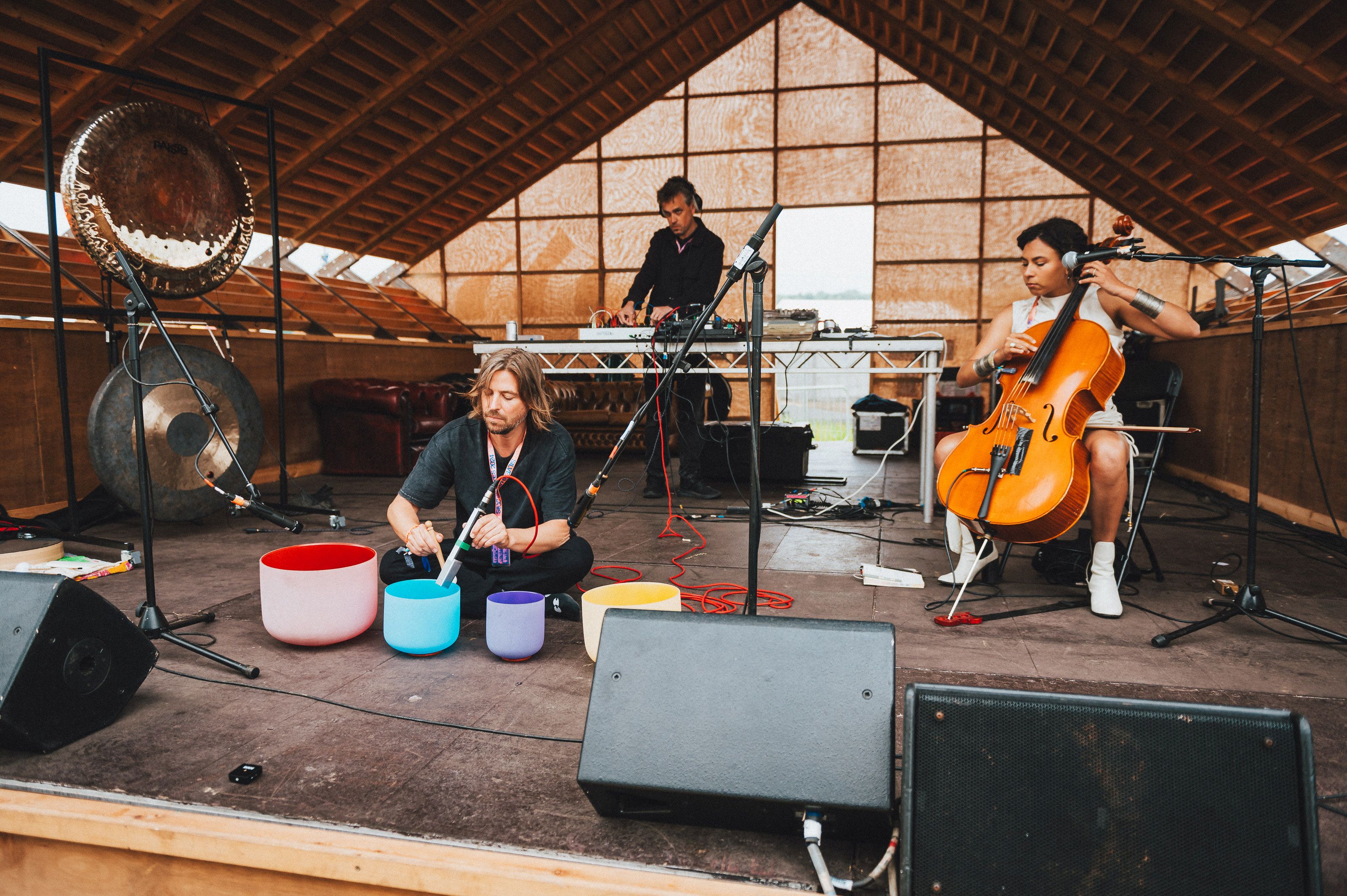
An opportunity to play Glastonbury arose, James was up for it, so we rehearsed with Satin Beige on cello. I pre recorded some harp and clarinet, much as I’d have loved Chloe and Arun to play live, passes are never in abundance. This did however give James delicious harp and clarinet parts to trigger, loop and effect live.
Then from the fields of Pilton, FRQNCY LDN was born. This led onto a full scale, live recording and collaboration with exceptional musicians Arun Ghosh, Raven Bush, Chloe Chousmer-Kerr, Nikita Gil, Satin Beige in St Matthias church, Hackney, where the first album was recorded.
What did you know about each other before working together? Describe your creative partner in a few words, please.
I knew of Simian Mobile Disco and James’ prolific producer run. It amused me how often I’d hear a new track that would prick my ears and somehow James would have had something to do with it.
I had the pleasure of commissioning SMD, James and Jas for a collaborative project with Japanese taiko drumming legends, KODO during lockdown. Jas, James and KODO turned in a couple amazing tracks for this project, you can hear “A Notch In The Saw” here:
FRQNCY LDN is a project of many collaborators we were lucky came together.
Arun Ghosh I saw play with Anoushka Shankar who stole the show with his passionate clarinet solos. Raven Bush from Speakers Corner on violin and string armonica is an incredible composer and session musician who was recommended from James. Chloe is the daughter of teacher Mr Chousmer and is a mean harpist. Nikita Gil, a literary tiger and magical poet I’d met at a few events and loved her words.
Satin Beige, the other Chousmer girl, has played cello regularly during sound immersions and been instrumental in evolving working with more instrumentation. Animesh Ravel was also pivotal engineering both live and getting everything down for the recording - it was a beastly set up in surround with a medusa of over 50 leads and channels recorded and going to front of house.
Tell me a bit about your current instruments and tools, please. In which way do they support creative exchange and collaborations with others?
It’s all about gongs, mostly played with flumie friction mallets to create consistent tones and overtones. This provides root notes for other players to tune to which sometimes throws up working in some alternative scales, keys and places. Bowls (crystal and singing) do something similar but the gongs have a richness of overtone goodness.
Then there are a few other percussion instruments, all cornerstones of the sound immersion journey that provide different sonic spaces. AND THEN … then things get wonky … James processes live sounds through 2 analogue tape machines and numerous FX boxes and pedals creating loops with beautiful sonic colouration and character.
On top of this, players lock into each other and sometimes loops and James adds synth parts. The amalgamation of sound housed in the reverb of St Matthias church, is quite a sound to behold.
Decisions between creatives often work without words. How did this process work in this case?
During the rehearsal run and first full ensemble show, from which the album recording was taken, no words were spoken between collaborators. Other than a few head nods cueing Nikita and Satin performing spoken words.
There were moments in the performance where pockets of sounds, overtones connected with frequencies of different instruments, possibly effected by phasing from FX but these pockets of sound had us in awe. I’ll never forget the communication through smiles from facial expressions and eyes when everyone was locked into this moment.
Was/Is this collaboration fun – does it need to be?
Fuck yeah, first time playing together at Glastonbury, even at 1:00AM on the Friday morning, that’s a way to start the weekend. You can hear an interview from Jamz Supernova on 6music here from that year.
And then later that weekend, Sunday afternoon on the Crow’s Nest stage, when half way through our set our sound was drowned out by Baxter Dury playing nearby on the Park Stage.
And that was the birth of FRQNCY LDN, from the fields of Pilton, which has to be said, is possibly the most fun to be found all year.
Following these shows, putting the ensemble together for the Church show was pure joy, no longer limited by pre recorded parts for James to trigger but feeling the freedom for everyone to play together … ooofffff!