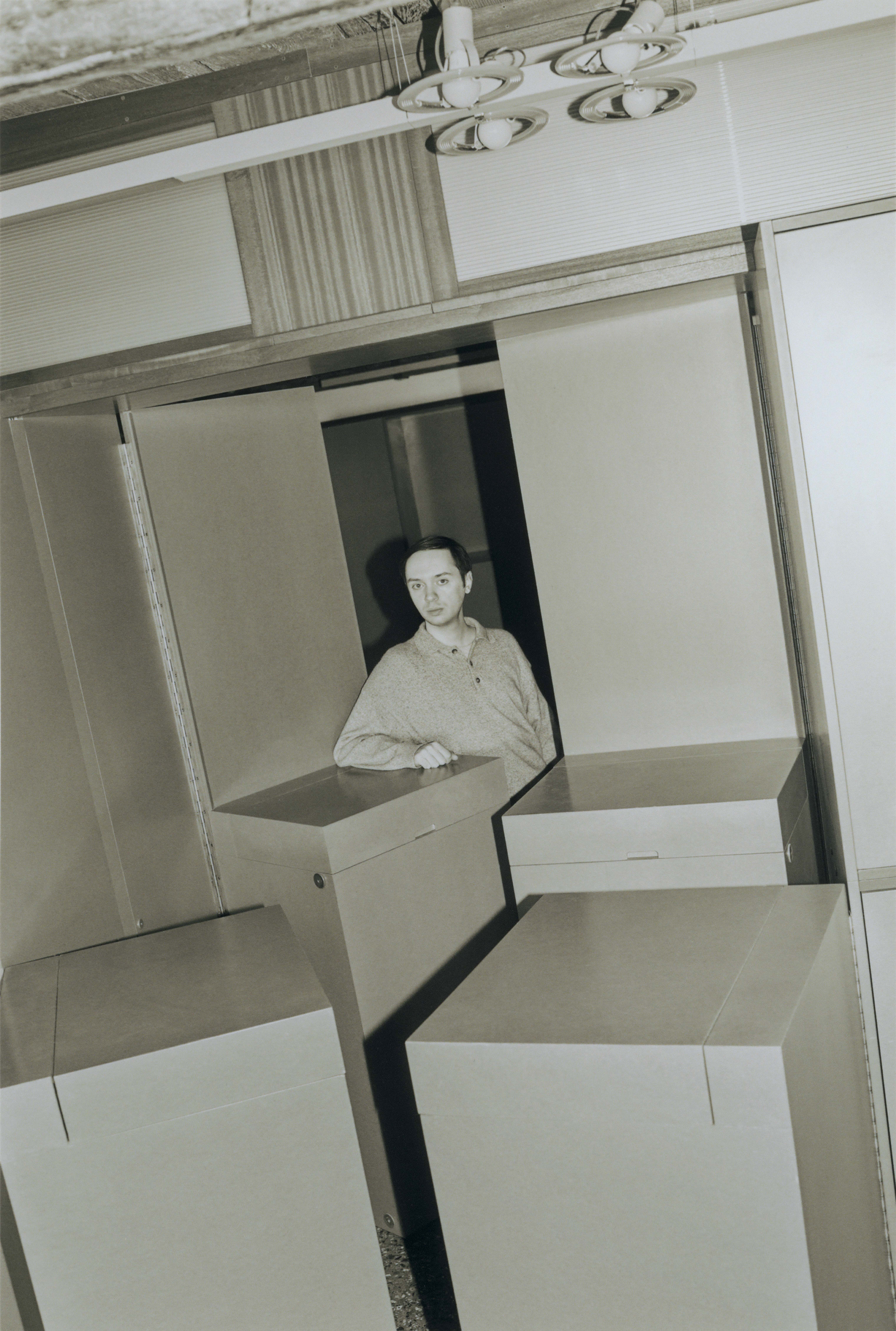
Published
Name: Tommaso Pandolfi aka Furtherset
Nationality: Italian
Occupation: Composer, producer, sound artist, visual artist
Current Release: Furtherset's new album Wounds of Melody is out via Kohlhaas.
If you enjoyed this Furtherset interview and would like to know more about his music, visit him on Instagram, Facebook, bandcamp, and Soundcloud.
Where does the impulse to create something come from for you? What role do often-quoted sources of inspiration like dreams, other forms of art, personal relationships, politics etc play?
The creative spark can come from many sources—films, novels, poems, essays, or images that strike me in a particular way.
While these influences may be present behind the scenes, I usually try to mask them in the final piece. What the listener hears, ideally, is something that has detached itself from its origin.
I’m not especially fond of rigid conceptual frameworks in my work. I prefer to leave as much space for interpretation as possible, placing the listener in a sort of fog where each person can find their own direction.
For you to get started, do there need to be concrete ideas – or what some have called a 'visualisation' of the finished work? What does the balance between planning and chance look like for you?
It's rare for me to start with a clear idea of how a piece will begin, evolve, and end.
I change direction quickly, and whenever I fixate too much on a defined structure, the outcome tends to fall short. I prefer to stay within an improvisational, combinatory process where new structural possibilities emerge along the way.
That said, there are recurring aesthetic choices—related to timbre or dynamics—that guide this process. These are tendencies I’ve developed over the years and which I continue to explore. Even in this open-ended process, they are a constant presence.
Is there a preparation phase for your process? Do you require your tools to be laid out in a particular way, for example, do you need to do 'research' or create 'early versions'?
My "research" tends to happen in between projects—when I’m preparing new live sets, performing, working on visual art, or simply listening to a lot of music. There isn’t a specific research routine for each individual track; it’s more about nurturing a daily curiosity.
When I do begin composing, I generate dozens of sketches and take a lot of notes. From there, I develop the material that resonates and discard the rest.
Do you have certain rituals to get you into the right mindset for creating? What role do certain foods or stimulants like coffee, lighting, scents, exercise or reading poetry play?
When I make music, I need complete order in my environment—everything must be in its place.
I can tolerate some chaos when I draw, but even then, by the end of the day, I need to tidy up my studio entirely so I can begin the next creative "mess" with a clean slate the following day.
For Wounds of Melody, what did you start with? If there were conceptual considerations, what were they?
At the beginning of 2024, due to health issues, I was confined to bed for two months. I used that time to write as much music as possible. My aim was to explore new sonic territory and expand my palette.
I started by creating hundreds of presets using synths I rely on—mostly native Ableton plugins like Wavetable, Operator, and Simpler—and experimented with how they interacted. Through this playful experimentation, the music began to emerge on its own.
There weren’t strong conceptual anchors at the beginning; I simply wanted to make music that felt more cinematic than my previous album, The Infinite Hour (OUS, 2023), and closer in tone to Auras (OUS, 2022).
Tell me a bit about the way the new material developed and gradually took its final form, please.
Following up on the previous answer: after generating a large body of material—more than I usually produce for a release—I started selecting potential tracks together with Marco from Kohlhaas, the label that released Wounds of Melody, my most recent album, released in May 2025. From there, I refined the selected tracks into final arrangements and moved into the mixing phase with Alberto Bertelli (Holy Similaun).
Once this process was complete, I began to reflect on what this music might actually be communicating—a question I still don’t have a clear answer to, and I’m happy about that ambiguity. As always, I started reading poetry and searching for possible titles in books.
Initially, I had envisioned using a drawing for the artwork, but with the input of Kohlhaas’ graphic designer, Nicola Chemotti Beutel, we shifted direction. That collaboration helped unlock several intuitive ideas I had been carrying with me for nearly two years—ideas that had previously felt unrelated, but which came together unexpectedly and perfectly in the final visual concept.
Many writers have claimed that as soon as they enter into the process, certain aspects of the narrative are out of their hands. Do you like to keep strict control or is there a sense of following things where they lead you?
When it comes to composing music, I definitely follow where the process leads me.
But with visuals—whether artwork, music videos, or accompanying texts—I tend to take much more control over every detail. That’s not to say there’s no intuition involved, but it requires a different kind of attention. I often find working with visuals far more intimidating than writing music.
Music operates on a deeply intuitive and perceptual level, while my visual work demands clear conceptual direction, editing, and explanatory text. Music, quoting Vladimir Jankélévitch, is much closer to the ineffable.
There are many descriptions of the creative state. How would you describe it for you personally? Is there an element of spirituality to what you do?
For me, the creative state is about decisively following intuition while resisting all distractions. It’s a mental state that must detach entirely from the everyday.
This detachment allows me not only to create but to return with greater clarity and perspective on the world around me. It’s a constant rhythm of stepping into and out of this sort of productive hypnosis.
Once a piece is finished, how important is it for you to let it lie and evaluate it later on? How much improvement and refinement do you personally allow until you're satisfied with a piece? What does this process look like in practice?
I try to move quickly through both the creative and refinement stages, though that second phase can happen even months or years later. At that point, I focus on how a piece fits into the structure of the release—whether it complements or contrasts with other tracks.
I'm also attentive to small technical details and dynamics, shaping a sort of pre-mix phase that gives the album its coherence.
How do you think the meaning, or effect of an individual piece is enhanced, clarified or possibly contrasted by the EPs, or albums it is part of? Does each piece, for example, need to be consistent with the larger whole?
For me, there has to be absolute coherence among the compositions within a release—whether short or long. Structural and formal balance is crucial.
I try to maintain a tension between stronger and more delicate pieces. It’s not easy, and I’m still figuring out how to manage that balance.
What’s certain is that with every new release, any solution I previously found becomes irrelevant, and I have to reinvent everything from scratch.
What's your take on the role and importance of production, including mixing and mastering for you personally? In terms of what they contribute to a song, what is the balance between the composition and the arrangement (performance)?
I always consider pre-mixing decisions during the writing phase, but I never mix or master my own work. I value having someone else involved—someone with greater technical expertise and, most importantly, emotional distance from the material.
Being too attached to your own music can lead to poor decisions during mixing, at least in my experience.
Music and the accompanying artwork are often closely related. Can you talk about this a little bit for your current project and the relationship that images and sounds have for you in general?
As someone who works both with visual art and electronic music, I’ve always been careful about how the two intersect. I usually keep them separate and only bring them together when absolutely necessary—for instance, in artwork, music videos, or live visuals.
Over the past year, however, I’ve started thinking more about how to bring these two practices closer together while still preserving their independence. My concern is that one might simply become decoration for the other, rather than forming a structurally cohesive whole.
I’m more interested in how these two dimensions can become mutual extensions and vital elements of each other. For this album, two images came together in the cover artwork, in both collision and harmony: Renaissance-style weeping figures generated via machine learning, and a still from a 2023 video of a white phosphorus bombing in Ukraine. What struck me was this figure that seemed to weep death—where the tear itself became a threat.
In one of the two videos created for the album—so far, only the one for Thy Tumultuous Rooms has been released—I worked with frame-by-frame hand-drawn animation at 24 frames per second. Until now, I had never combined drawing with my music practice, except superficially about a decade ago.
After finishing a piece or album and releasing something into the world, there can be a sense of emptiness. Can you relate to this – and how do you return to the state of creativity after experiencing it?
When an album is released, I’m usually relieved because it gives me permission to step away from music for a while and shift my focus to visual projects. Once those are finished, I return to music.
There’s never a true void in between—it’s more like a pendulum between two creative poles.
I would love to know a little about the feedback you've received from listeners or critics about what they thought some of your songs are about or the impact it had on them – have there been “misunderstandings” or did you perhaps even gain new “insights?”
I really enjoy hearing feedback from friends—it’s the space where the most useful advice and insights emerge. I often react defensively at first, but I usually come around and try to understand how to improve through criticism.
The biggest misunderstandings tend to happen within myself, more than from others—others actually help me understand what I’m truly doing.